The Wall the Sun Walks Through
The marble would not make it over the last hill.
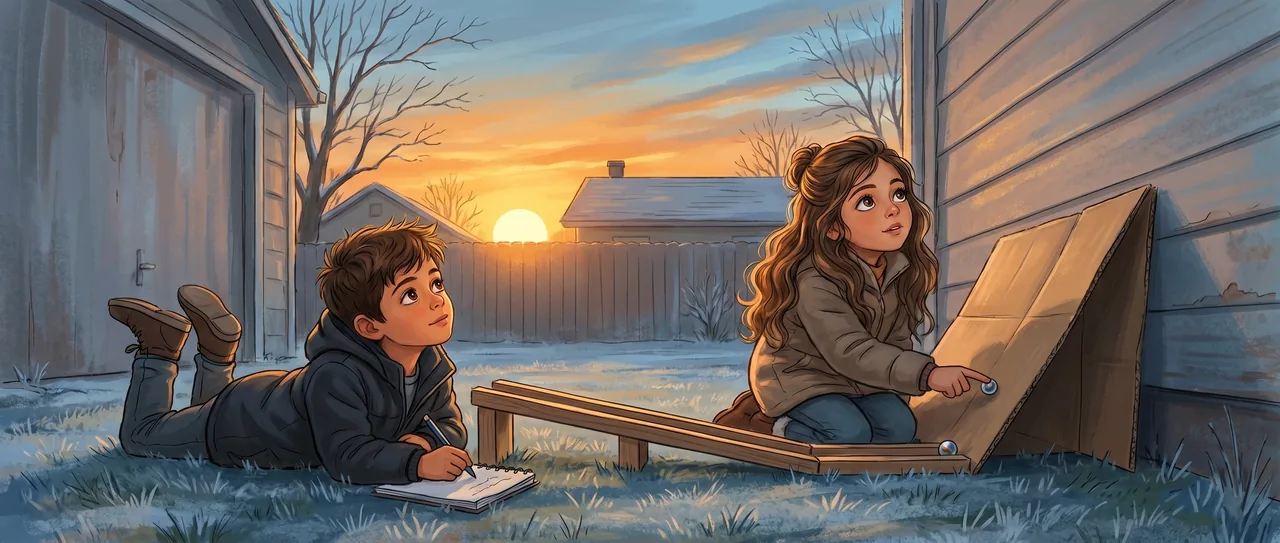
Maya had built the hill out of a folded cereal box, and every time she let the marble go, it rolled up, slowed, stopped halfway, and rolled back down into her hand.
"Not enough speed," said Soren. He was lying on his stomach in the cold grass with his eye level to the track. "It runs out of go right at the top."
"Lower the hill."
"That's cheating."
"It's not cheating, it's engineering." Maya let the marble go again. Up, slow, stop, back. "Watch. It always stops in the exact same place. Like there's a line it can't cross."
Soren watched it three more times. The marble stopped in the same place every time, a little short of the top, as if the top of the hill were a wall it didn't have permission to climb.
"There is a line," he said. "It's wherever the marble runs out of energy. To get over, it needs more than it has. That's just a rule."
"A rule." Maya did not like rules that stopped marbles. She rolled it once more, slower this time on purpose, and it stopped even sooner. "So if it doesn't have enough, it never gets over. Ever. No matter how long we wait."
"Never," said Soren. "That's the whole point of a wall."
The back door opened. Maya's mom leaned out, holding her coffee in both hands against the cold. "You two are going to freeze. The sun's already going down."
They both looked up. The sun sat low and orange over the neighbor's roof, the kind of sun you can almost look at.
"How does that even work," Maya said, not really to her mom. "It's been burning for billions of years. What's it burning?"
"Hydrogen," said her mom. "It squeezes hydrogen together until it turns into helium. Don't ask me more than that, that's the end of what I know." She went back inside, and the door clicked, and it was just the two of them and the orange light and the stuck marble.
Soren had pulled his notebook out of his coat. He wrote sun: squeezes hydrogen. Then he stopped with the pen on the page.
"Squeezes them together," he said slowly. "But hydrogen is protons. Protons are all positive."
"So?"
"So positives push each other away." He set down the pen and held up two fists and pushed them toward each other, slow, like there was a spring between them. "The closer they get, the harder they push back. It's like our hill. There's a wall."
Maya sat up. "A wall they have to get over."
"To touch. To fuse. They have to get close enough to touch, but the pushing gets stronger the closer they get." He moved his fists nearer and nearer and made them shake. "It's a hill that gets steeper the higher you go."
"How fast would they need to go to get over it?"
Soren thought. "Really fast. Really, really hot and fast."
"Is the sun hot enough?"
He wrote a number, crossed it out, wrote another. "That's the thing I half remember. I think the answer is no."
Maya went still. The marble was warm from her hand. "No."
"No. I think the middle of the sun isn't hot enough. The protons aren't moving fast enough to get over the wall. Almost. But not enough." He looked at his own fists, still shaking, still apart. "Which means they should stop. Like the marble. They should roll back every time and never touch."
They both looked at the sun.
It was shining.
"But it's right there," Maya said. "It's doing it. It's been doing it for four and a half billion years. The wall's too high and it's getting over anyway."
"It can't be getting over."
"Then it's not getting over." Maya said it fast, the way she said things when she'd seen the shape of an answer before she had words for it. "Soren. What if it doesn't go over."
"There's no around. The wall's everywhere. It's the pushing, it's the whole way in."
"Not around." She picked up the marble and pressed it flat against the cardboard hill, right at the bottom, on the side where it always rolled back. "Through."
Soren stared at the marble against the cardboard.
"You can't go through. It doesn't have the energy. We just said. It's a wall."
"For the marble it's a wall." Maya's voice had gone quiet and quick. "Because the marble's big. But the protons are little. They're the littlest things there are. And the littlest things, the really tiny ones, you can't say exactly where they are. Right? You said that. About the electron thing. You can't pin them down."
Soren's pen had stopped moving. "You can't pin them down."
"So if you can't say exactly where it is," Maya said, "then maybe it isn't only on this side of the wall. Maybe it's a little bit on the other side already. A little bit. Sometimes. And sometimes the little bit is enough."
Soren looked at his two fists, still not touching. Then he opened them.
"It doesn't climb the wall," he said. "It's just sometimes already past it."
"Without ever being on top of it."
"Without having enough to get on top of it. It just," and he couldn't find the word, so he made his hand do it, slid it flat through the air where the wall would be, "appears on the other side."
"Most of the time it doesn't," Maya said. "Most of the time it rolls back. Like ours." She let the marble go again, and it climbed, and slowed, and stopped, and came back to her open hand. "But there's so many of them in there. So so many. And it's been so long. So even if it almost never works."
The sun touched the neighbor's roof and spread out flat and orange along it.
Soren wrote one line and then put the pen down to watch it go.
"That's why it's warm on my face," he said. "Particles getting through a wall they can't get over."
They sat in the cold grass and let the light from the impossible thing land on them until it slipped behind the roof.
Read the interactive version, listen to the narration, and earn a gold star →
A science-verified short story for curious kids · Curiosity Land