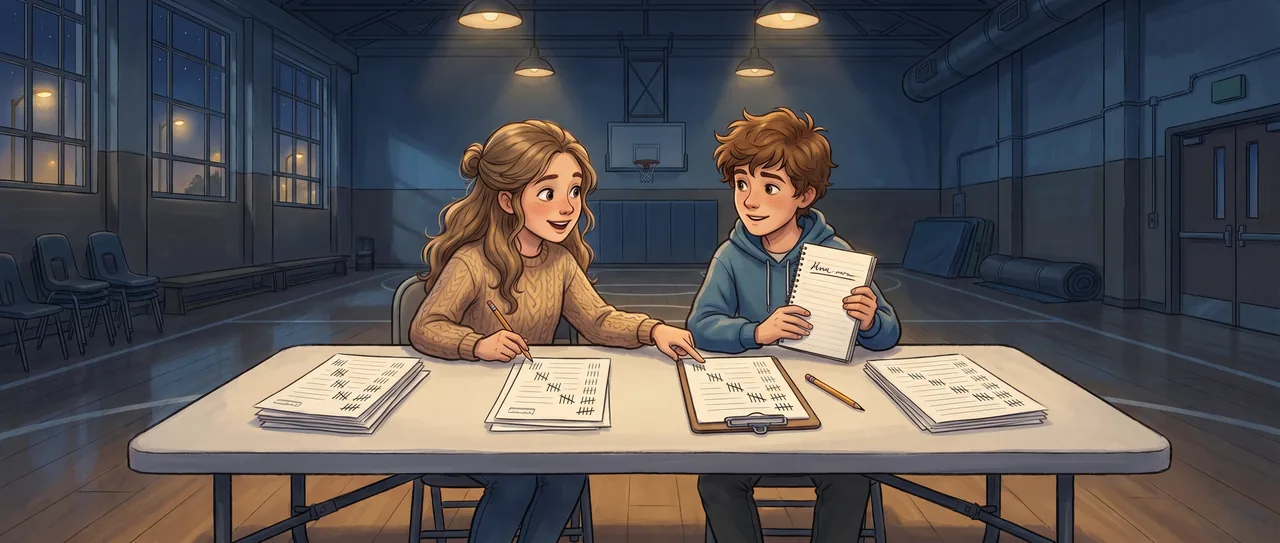
The Wrong Numbers
The gym smelled like floor wax and cold pizza, and there were two hundred and six donation slips left to count.
"You read, I'll tally," said Soren. He had a pencil and a paper notebook and a column drawn down the page.
"This is the worst possible Friday," Maya said, but she sat down anyway and started reading numbers off the slips. "Fourteen dollars. One hundred and twelve. Eleven. Nineteen-fifty."
Soren made his marks. Maya kept reading. After a while she stopped.
"Soren. Too many ones."
"Too many ones what?"
"First digit. Everything starts with one." She fanned the slips out. "Eleven. One-twelve. Fourteen. Nineteen. It feels rigged."
Soren looked at his column. He had been tallying the actual amounts, not the first digits. So he started a new list, one tiny number at the top of the page for each leading digit, and they read the whole pile again.
When they finished, the page looked like this. Slips starting with one: sixty-one. Starting with two: thirty-six. The numbers got smaller as the digits got bigger. By the time they reached nine, there were only nine slips.
"That's not random," Maya said. "If it were random, every digit would show up the same amount. About one in nine each. Twenty-something slips each."
"But it's not even close." Soren tapped the one. "Sixty-one. That's almost a third of everything."
Maya pulled her knees up onto the chair. "Somebody messed with it. Fake donations. People making up amounts always pick round friendly numbers. I've read about this. Made-up data looks wrong."
"Okay," Soren said slowly, "but here's the thing. Made-up data looks too even. Somebody inventing numbers spreads them out so it looks natural. They'd give you about the same amount of each digit. This is the opposite of even."
Maya stopped. She turned that over. "So if a faker makes it too even, and this is the least even thing I've ever seen, then this isn't faked."
"That's what I'm saying. The lumpiness might be the honest part."
"That doesn't make sense. Why would honest numbers crowd onto one?"
They sat with it. The big clock on the gym wall said nine-forty.
Soren picked up a slip. "Walk it with me. Say somebody starts with a dollar. To get the first digit to be a two, they have to go from one dollar all the way up to two dollars. They have to double."
"Okay."
"But once you're at, say, eight hundred, to get the first digit to be a nine you only have to climb from eight hundred to nine hundred. You barely have to move."
Maya's eyes went to the slips. "So getting off of one takes the longest."
"Every amount has to pass through the ones to get anywhere. Eleven, twelve, all the way to nineteen. Then a hundred and ten through a hundred and ninety. There are just more numbers that begin with one. The world spends more time there."
"Wait." Maya grabbed a clean slip and a pen. "Powers of two. One. Two. Four. Eight. Sixteen. Thirty-two. Sixty-four. One twenty-eight." She circled the leading digits. "One, two, four, eight, one, three, six, one. The ones keep coming back around."
"Because doubling eight gets you to sixteen, and you land on one again."
"It has to land on one again. To get past one you have to double, and once you're up high, doubling drops you right back onto one." She was reading faster now. "It's not the donations. It's not the gym. It's numbers. It's how counting itself is shaped."
Soren wrote a single line in his notebook and underlined it twice.
"Try the other piles," he said.
There was a box of old library cards in the corner with page counts on them. There was a clipboard from the science wing with measured plant heights in centimeters. There was the sign-in sheet with everyone's house numbers.
They counted all of it. Different things, measured by different people, on different days, for reasons that had nothing to do with each other.
Every single pile leaned on the one. About a third, every time. Two came in second. The rest trailed off small.
Maya stared at the four little stacks of tally marks, all making the same crooked staircase.
"Plant heights don't know about donations," she said. "House numbers don't know about library books. They've never met. How are they all doing the same thing?"
"They're not copying each other," Soren said. "They can't be. There's no way for them to be."
"Then the pattern isn't in any of them." Maya's voice dropped. "It's underneath all of them."
Soren turned his notebook around so she could read the underlined line. It said: the law is older than the numbers.
"People use this," Maya said suddenly. "To catch liars. Real liars." She was sure of it before she could say why, and then the why caught up. "If real money piles up on the one, and somebody's faked money is spread out nice and even, you can see the lie. You don't even have to know whose it is. The shape gives it away."
"Accountants do exactly that," Soren said. "It's been used in actual trials. Somebody invents thousands of numbers to hide stolen money, and the numbers come out too tidy, and the tidiness convicts them."
Maya laughed, a short surprised sound that bounced off the empty bleachers. "So a person can fool every auditor in the room. But they can't fool the leading digits."
"They'd have to know the world is lopsided." Soren looked at the four matching staircases. "And almost nobody knows."
"We didn't. An hour ago I thought ours was the fake one."
Maya pulled the donation slips back toward her and the science clipboard and the library cards and the sign-in sheet, sliding them into one heap in the middle of the table, four strangers that had turned out to be the same.
She read the top number out loud. "Eleven."
Then the next. "Sixteen."
Soren made the mark. Outside, the parking lot lights buzzed on, and the two of them kept counting into the lopsided dark, the ones arriving again and again, right on time.
Read the interactive version, listen to the narration, and earn a gold star →
A science-verified short story for curious kids · Curiosity Land