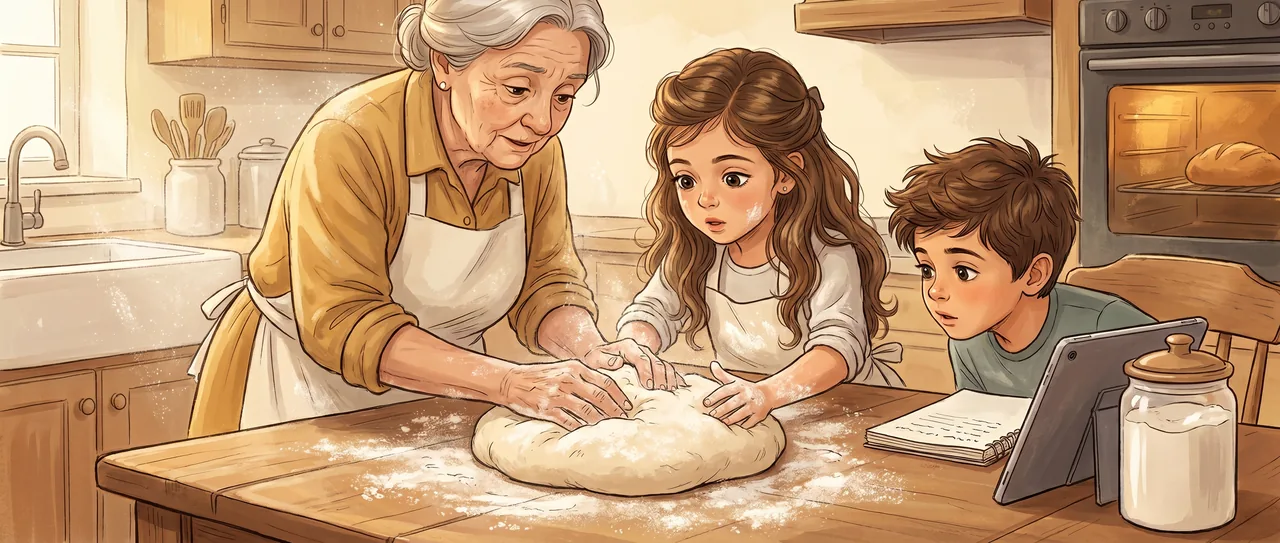
The Winter in the Bread
Maya's grandmother measured flour the way some people pray, slow and exact, like the cup might run out if she rushed.
"More than that," she said. "Always a little more than you think."
"You always say that," Maya said.
"Because I always mean it."
Soren sat at the end of the table with a tablet propped against the sugar jar, not baking. He had read the same paragraph four times.
"Maya," he said. "Listen to this. There was a winter, a real one, where a whole country almost starved. The grandmothers were pregnant during it. And the grandchildren, the ones who weren't even born yet, weren't even thought of yet, ended up with different metabolisms. Their bodies hold onto food differently. Now. Today."
Maya stopped flouring her hands. "From a winter that happened to somebody else."
"To their grandmother. Before their mother was born."
"That doesn't fit," Maya said.
"That's what I said. So I kept reading."
Grandmother set the cup down very gently, which was not how she usually set things down.
"What winter," she said.
"Nineteen forty-four," Soren read. "Into forty-five. People measured flour in spoons. Some days there wasn't any."
Grandmother wiped her hands on her apron, though they were already clean. "My mother counted potatoes," she said. "She told me. One winter she counted them out loud every night so she'd know if any were missing. She did it for years after, even when the cellar was full. Even when I was a girl and there was plenty. Counting potatoes in a full cellar."
Maya looked at the cup. The little more than you think.
"Grandma," she said slowly. "Do you do that. The counting. Without counting."
Grandmother didn't answer right away.
"I always make too much," she said. "Your mother says it. I cook for an army and we're three people. I can't stop. It feels wrong to see the bottom of a bowl."
"But you were never hungry," Maya said. "You said. You grew up with plenty."
"I was never hungry a day in my life," Grandmother said. "And I have never once felt safe about food."
The kitchen got quiet. The oven ticked as it warmed.
Soren had pulled his notebook out. He was writing, and his pen pressed hard.
"Okay," Maya said, the way she did when she was chasing something. "But that's a habit. She watched her mother count potatoes, so she makes too much bread. That's learning. That's not in you. That's not in your body."
"That's what I thought too," Soren said. "But the science part isn't about habits. The grandchildren in the study had measurable bodies. Slower at burning sugar. The article keeps saying one thing over and over. The DNA didn't change."
"Then what did," Maya said.
"That's the part I don't have yet."
Maya picked up the flour cup. She turned it in her hand.
"Think about the recipe," she said. "The DNA is the recipe. Right?"
"Right."
"But Grandma doesn't follow the recipe the way it's written. She adds the little more. She crosses out the two cups and writes more. The recipe still says two cups. The page didn't change."
Soren stopped writing.
"The notes," he said. "On top of the recipe."
"The notes," Maya said. "You can hand somebody the same recipe with your notes in the margin. Always a little more than you think. And they make it your way without knowing why. The page is the same. The bread is different."
Grandmother had gone still by the counter, holding the wooden spoon against her chest.
"Say that again," she said.
"The DNA is the recipe," Maya said. "The famine didn't rewrite the recipe. The famine wrote a note in the margin. Make less. Save more. Don't trust the cellar. And the note got copied down. To your mother. To you. Maybe a little to my mom. A note that says be careful, be careful, even when there's nothing to be careful about."
"That can't pass down," Grandmother said. "That's just a feeling."
"It's not just a feeling," Soren said quietly. He looked up from the article. "That's the thing. They can find it in the blood. There's a mark, a real chemical tag that sits on top of the gene like a sticky note and tells it to stay quiet or speak up. The gene is still there. Same letters. The note on top is what changed. And the note can be copied into the next person."
Maya looked at her grandmother's hands. They were her mother's hands. They might, someday, be hers.
"So a winter," Maya said. "A winter nobody in this room lived through. A winter that happened to your grandmother. Wrote a note. And the note is still being read. In your blood. Maybe in mine."
"You weren't even an idea yet," Soren said. "When the note got written, your grandmother's grandmother was the only person it happened to. And it's in the room now. It's in the bread."
Grandmother set the wooden spoon down. She walked to the bowl where the flour was waiting, two cups, level and exact, the way Maya had measured it.
She added more. A small handful. The little more than you think.
"My mother's hands," she said. "Doing this. Her mother's hands, in a winter I never saw."
"How long does the note last," Maya asked. "Does it fade? Does it get crossed out eventually? Does mine still say be careful?"
"They don't know yet," Soren said. "The article says they're still finding out. Some marks fade. Some don't. Some get added new." He looked at her. "Yours might say something we can't read yet."
Maya pressed her thumb into the dough. It pressed back, soft and stubborn, full of more flour than the recipe asked for.
"There's a winter in here," she said. "In the bread."
"There's a winter in you," Soren said. "And a winter in me. Different ones. Every grandmother who was ever hungry. Or scared. Or cold. All of them left notes."
Grandmother began to knead, folding the dough over the buried handful, and her hands moved in a rhythm older than the kitchen, older than the house, a rhythm she had never been taught and had always known.
Maya watched the dough rise under those hands and tried to count, the way someone in a cellar once counted, all the people she had never met who were folded into the loaf.
Read the interactive version, listen to the narration, and earn a gold star →
A science-verified short story for curious kids · Curiosity Land