The Smallest Stretch
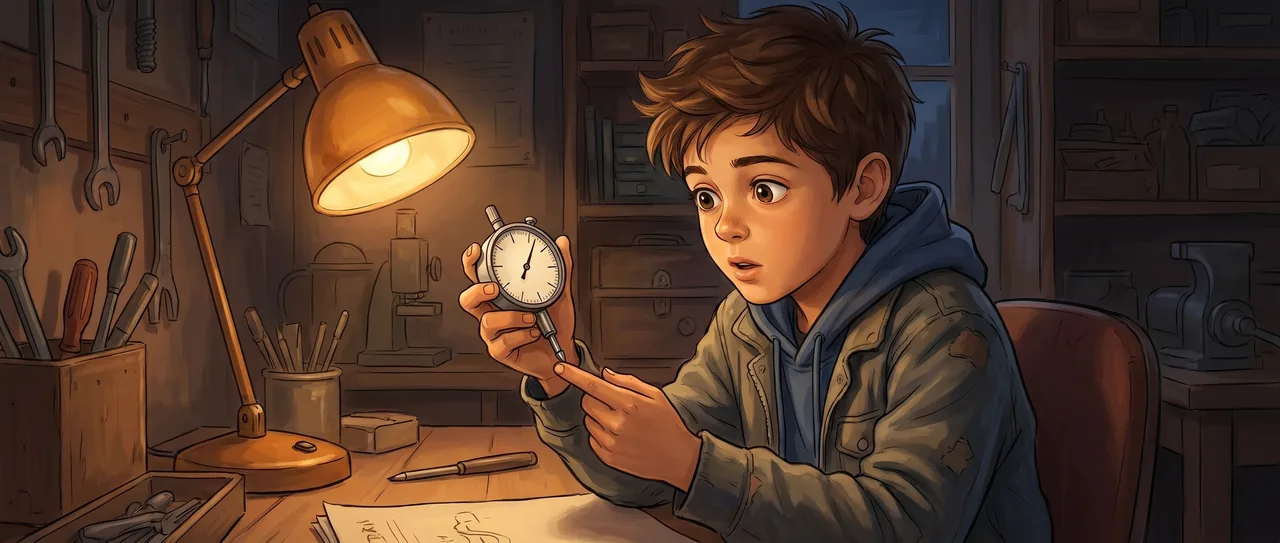
The shop smelled like cut metal and old coffee, and the light came in sideways through the dusty window, landing on the thing Soren could not stop touching.
It was a dial indicator. His grandfather called it a thousandth gauge. You pressed its little spring-loaded tip against something and the needle swung around the face, and every mark on the dial was one thousandth of an inch. Soren pressed his thumbnail against the tip and watched the needle leap.
"That's the finest measure in this whole building," his grandfather said, not looking up from the lathe. "A thousandth of an inch. You can't feel a thousandth with your fingers. The gauge feels it for you."
Soren put a slip of paper under the tip. The needle jumped almost all the way around. One sheet of paper was three thousandths. He could see it now, a thickness his own hands would never have known was there.
He liked that. He liked when a tool reached past the edge of his own body and brought something back.
"What's the smallest thing it can see?" he asked.
"One thousandth. That's the bottom. Past that, the needle's just shivering at nothing."
Soren breathed on the tip and watched the needle drift as the metal warmed and grew. Heat had a thickness too. Everything did, if you had a fine enough needle.
He thought about that on the bus home, the gauge borrowed and heavy in his coat pocket. A thousandth of an inch was the bottom of the world his grandfather could measure. But it could not be the bottom of the world. There had to be something underneath the bottom.
That night he found the recording.
It was a sound, on a page about something from 2015, two black holes that had fallen into each other a billion years before there were people. The page said the crash had sent a ripple out through space itself. Not through air, not through water. Through the shape of distance. Through the thing rulers are made of.
He played the sound. It was nothing, a low slide, a chirp, up and gone in less than a second. He played it again. Such a small noise for two suns of darkness eating each other.
Then he read the number, and the inside of his head went very quiet.
The ripple had reached Earth. It had stretched the whole planet and squeezed it again. And the amount it stretched by was less than one thousandth of the width of a proton.
Soren took the gauge out of his coat and set it on the desk under the lamp.
A proton. He knew how small that was, the way you know a word is large without being able to lift it. A proton was so much smaller than an atom that the atom was mostly empty around it. And a thousandth of that. And they had measured it. Somebody had built a needle that could feel a thousandth of a proton.
He pressed the gauge tip with his thumbnail and watched the needle swing its proud little swing, one thousandth of an inch, the finest thing in the shop.
Then he tried to climb down.
From a thousandth of an inch to the width of a hair. From a hair to a cell. From a cell to the things inside the cell. From those down to a single atom, and the atom mostly nothing, and inside the nothing the tiny hard speck of the proton. And then keep going. Take that speck and slice it a thousand ways and measure one of the slices.
That was the size of the stretch. That was how much the Earth had changed shape when the wave passed through.
He sat back. His skin felt strange, the way it does when you have been holding still too long.
The gauge could feel a sheet of paper. It could not feel a hair split in half. And the measurement on the page was smaller than the gauge by more times than there were marks on the dial, more times than there were dials in every shop in the world.
And here was the part that would not let him sleep.
The wave had not pushed on the Earth. A wind pushes. A hammer pushes. The wave had not pushed anything. It had stretched the distance between things. For a fraction of a second the space between Soren's two hands had been a hair's hair's hair longer, and then shorter, and his hands had ridden along because there was nothing else to do, because the ruler itself had breathed.
He held his hands apart over the desk. The lamplight lay across the gap.
It had happened to this gap. Right here. In 2015 and a billion years before that and probably a hundred times since, ripples sliding through the room, through him, through the gauge, stretching the desk and the lamp and the distance from his eyes to the page, all by the same impossible thousandth of a proton, and nothing in the shop, nothing in his body, no needle his grandfather owned would ever twitch.
The finest measure in the whole building could not feel the universe rolling through it.
But the universe was rolling through it anyway. That was the thing. It did not wait to be felt. The black holes had fallen together whether or not anyone built a needle fine enough, and the wave had come whether or not anyone was listening, and it had passed through every shop and every sleeping kid and every dial gauge on the bottom shelf of every drawer, unfelt, unmeasured, and completely real.
Soren played the sound one more time.
The chirp slid up and stopped. A billion years of falling, ending in less than a second, in a noise smaller than a bird's.
He picked up the gauge and pressed the tip against the soft pad of his fingertip, slow, until the needle swung all the way to its proudest mark. One thousandth of an inch. The bottom of his grandfather's world.
He held it there and looked past it, down through all the floors underneath the bottom, to where the real needle was, the one made of mirrors and lasers and four kilometers of patience, the one that had reached down further than his grandfather's gauge could imagine and touched the trembling of space itself.
The needle on the dial sat still against his finger. Somewhere under it, too small to show, the room was breathing.
Read the interactive version, listen to the narration, and earn a gold star →
A science-verified short story for curious kids · Curiosity Land