The Skeleton That Isn't Yours Anymore
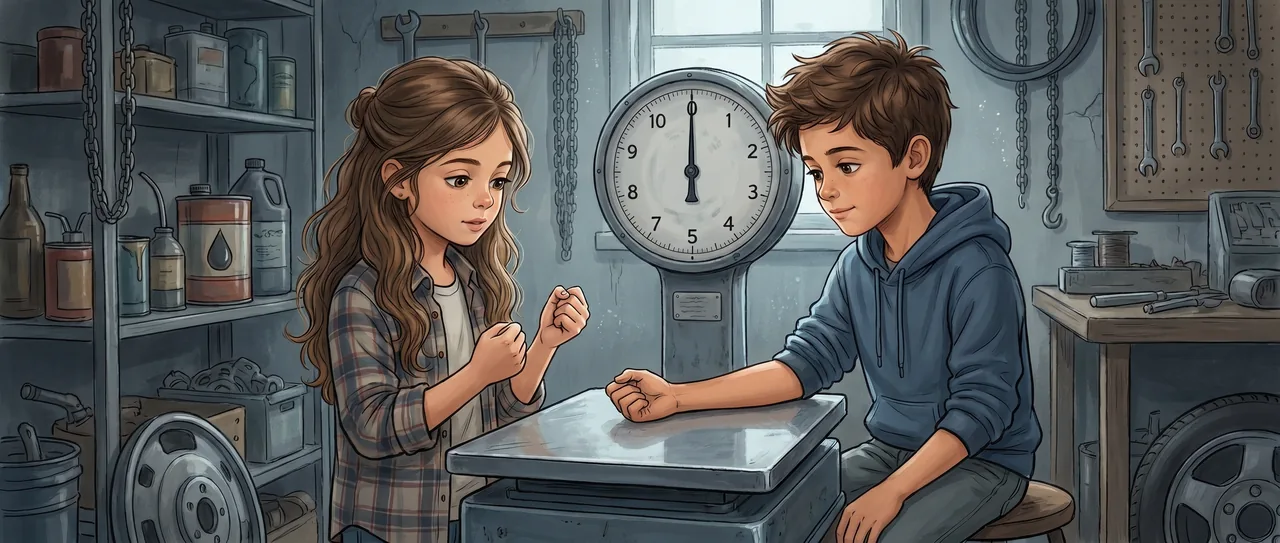
The freight scale in Soren's garage could weigh a small car. They had found it behind the recycling depot, missing one foot, and propped it level with a hockey puck.
"Concrete," Maya said. She dropped the chunk on. The needle jumped to forty pounds. "That's a brick of road. My dad poured the patio out of that."
"It's strong," Soren said. He wrote forty down. "But heavy. Per pound it's not even that good."
"Per pound," Maya repeated. She liked that. She put the brick aside. "Okay. So what beats it."
Soren had a chart he had printed from the library. He smoothed it on the workbench. "Steel beats it. Titanium beats it. And this one." He tapped a line near the bottom. "A cubic inch of this can hold nineteen thousand pounds before it crushes."
Maya leaned over the chart. The line had no picture next to it, just a name.
"Bone," she said.
"Bone."
She sat back on the cold floor. "Nineteen thousand. That's, what, the whole scale times a hundred."
"More." Soren did the division in the margin. "It would take a truck. A loaded truck, balanced on one inch of it."
Maya put her hand flat on her own shin, over the long bone there. She pressed. It did not feel like a truck-holder. It felt like a leg.
"That's inside me," she said. "Right now. That's just walking around in my leg holding up a sandwich."
"Holding up you," Soren said.
They were quiet. The garage smelled like motor oil and cold metal.
"Here's the part that doesn't fit, though," Maya said. She had been chewing on something since the word concrete. "Concrete is dead. You pour it, it sets, it sits there. My dad's patio is cracking because nothing fixes it. It just slowly loses."
"Right."
"But the bone's stronger. And the bone's alive." She turned to him. "So who fixes the bone."
Soren stopped writing.
"Like, when you crack it," Maya went on, faster now. "It heals. The patio doesn't heal. Steel doesn't heal. You bend a paper clip back and forth and it snaps and it stays snapped forever. But bone is the strongest one on your whole chart and it's also the one that fixes itself. That's backwards. Strong things are supposed to be the ones that don't change."
Soren flipped the library page over. There was more on the back. He read it twice, the way he did when he wasn't sure he believed it yet.
"It's worse than fixing," he said slowly.
"Worse how."
"It doesn't wait for you to crack it." He put his finger on the line and read it out. "Your body has cells that dissolve old bone on purpose. All the time. Little ones that eat tunnels through it. And other cells right behind them that lay new bone back down."
Maya stared at him.
"On purpose," she said.
"Constantly. Tearing it down and building it back. While you sleep. While we're sitting here." He looked up. "It says if you add it all up, the whole skeleton gets replaced. The entire thing. Every bone in you, swapped out, about every ten years."
The scale ticked as the metal cooled. Neither of them touched it.
"Ten years," Maya said.
"Roughly."
She held up her hand and looked at the back of it, at the bones she could see moving when she made a fist.
"So when I was one," she said. "The hand I had then."
"Gone."
"This isn't it."
"No." Soren was working it out as he said it. "That hand got taken apart. A cell at a time. And rebuilt. This is a different hand. Same shape. New stuff."
Maya opened and closed the fist. Watching the knuckles. The bones rose and fell under the skin, and they were the strongest material on the whole chart, stronger than the road her father poured, and they were not even a year old. They were brand new. They were being unbuilt and rebuilt right now and she could not feel a thing.
"That's not creepy," she said carefully, testing whether it was. "That's the opposite of creepy."
"Why."
"Because the patio cracks because it can't change. Right? It's stuck being whatever my dad poured. So it loses, slowly, forever." She stood up. "But I'm not stuck. The strong thing in me is strong because it never stops taking itself apart. If it ever stopped, that's when it'd get brittle. That's when it'd crack like concrete."
Soren wrote that down. His hand moved fast on the page.
"So the bone is strong," he said, still writing, "not even though it keeps dissolving itself."
"Because it does." Maya was almost laughing now. "It's strong because it's never finished."
She walked a slow circle around the garage, on the new shins, on the new feet that were not the feet that learned to walk.
"My grandma," she said suddenly. "She's seventy-something. She's had, like, seven whole skeletons. Seven completely different sets of bones, one after another, same shape every time."
"The shape's the thing that stays," Soren said. "Not the stuff. The stuff all leaves. The plan stays."
That landed in Maya somewhere quiet. She thought about everyone she had ever stood next to in a photograph. None of them made of the material the photograph caught. All of them already swapped out, traded away cell by cell, the way a river is still called the same river while every drop in it keeps moving downstream.
"Put your arm on the scale," she said.
Soren looked at her, then laid his forearm flat across the cold steel plate. The needle swung to nine pounds and held.
"Nine pounds," he said.
"Of the strongest thing on the chart," Maya said. "And it's nine days into being made, or nine months, you can't even tell. It won't tell you. It just keeps building."
Soren left his arm there a while longer, feeling the chill of the plate come up into bones that, in ten years, would not be these bones, and watched the needle not move.
Read the interactive version, listen to the narration, and earn a gold star →
A science-verified short story for curious kids · Curiosity Land