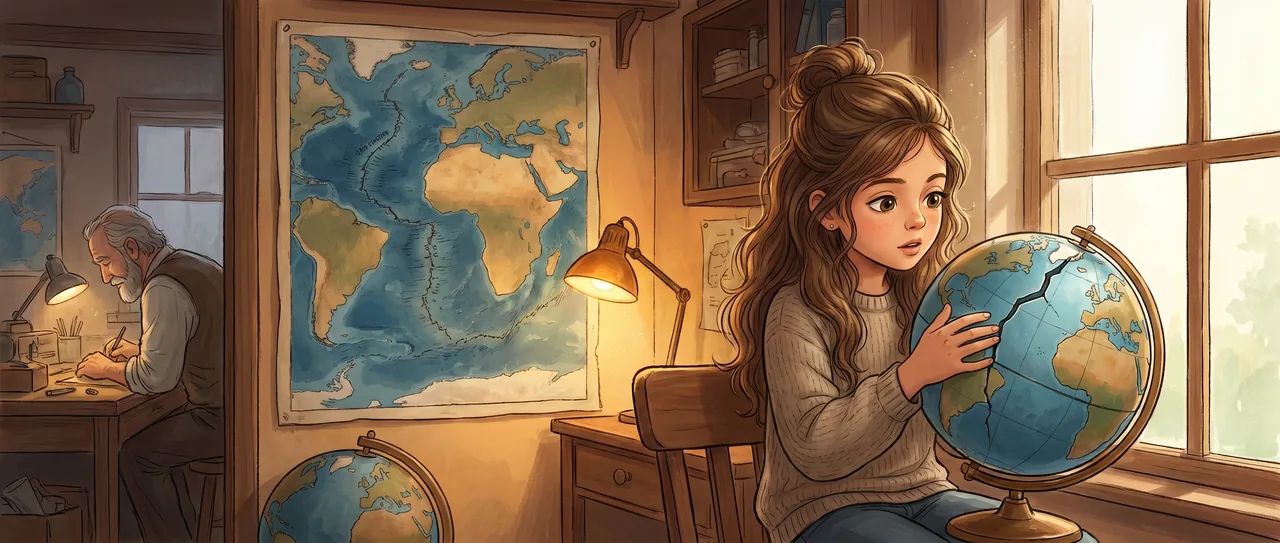
The Seam
The globe had a split in it.
Maya found it in the back of her grandfather's shop, behind the broken radios and the clocks he kept meaning to fix. The split ran along a seam where two halves of the printed metal had been glued, and the glue had given up. When she pressed the halves together they almost matched. When she let go they sprang apart by the width of a fingernail.
Her grandfather was bent over a kettle that wouldn't whistle. He did not look up. He fixed things one at a time, and the kettle was first.
Maya spun the globe slowly with the split under her thumb. The crack ran down the middle of the Atlantic Ocean. Not along the coast of anything. Down the empty blue, exactly between the bulge of South America and the bulge of Africa, dead center, as if someone had drawn it on purpose.
That was the first thing that didn't fit. A factory crack should go anywhere. This one went somewhere.
She took the globe to the window where the light was better. The painted seam wandered, but it wandered evenly, keeping the same distance from each coast the whole way down. She put one fingertip on Brazil and one on the bulge of Africa and slid them toward each other across the blue. They wanted to meet at the crack. Brazil fit into the dip below Africa's elbow. The whole ocean closed like a book.
"Grandpa," she said. "Were these two stuck together once."
"The halves of the globe? They're molded separate and joined."
"No. These." She held it up, thumb on the two coasts. He glanced over the top of his glasses for half a second, then went back to the kettle.
"That's the old idea," he said. "Continents drifting. People laughed at the man who said it. Then they stopped laughing."
He did not say why they stopped. He was a one-at-a-time man and the kettle was still first.
Maya turned the globe over in her hands. If the two coasts had once been joined, then they had pulled apart. And if they had pulled apart, the crack down the middle was not damage. The crack was where the pulling happened.
But that made no sense, because between two things pulling apart there should be a gap. A hole. An emptiness getting wider. There was no hole in the middle of the Atlantic. There was ocean floor, solid, all the way across.
She sat with that. The list of things that didn't fit yet got one longer, and she did not mind it there.
On the wall above the workbench her grandfather kept a flat map, a real one, the kind that showed the bottom of the sea as if the water had been poured out. She had looked at it a hundred times without looking at it. Now she stood on the stool and put her face close.
There it was. Running down the exact middle of the Atlantic, the same place as the crack on the globe, a mountain range. Not a small one. A spine of mountains down the floor of the ocean, with a notch running along the very top of it, a valley at the peak, like a seam that had never fully closed.
She followed it with her finger. It did not stop at the bottom of the Atlantic. It curved around the bottom of Africa and ran up into the Indian Ocean. It branched. It threaded into the Pacific. It went into every blue space on the map and kept going. She traced until her arm ached and she still had not found the end of it.
"Grandpa. How long is this." She tapped the underwater mountains.
He came over, drying his hands, because a question about a number was a different kind of question. He looked where she pointed.
"The mid-ocean ridge." He said it slowly, like a name he respected. "That's the longest mountain range on Earth. Sixty-five thousand kilometers. It runs through every ocean."
"Longer than the Andes."
"Longer than every mountain range on land put together. And most people have never seen one stone of it. It's all underwater."
Maya looked at the notch running along the top of the ridge, the valley at the very peak. A mountain with a crack down its spine.
And then the thing that hadn't fit turned over and fit.
The coasts pulled apart. They did not leave a hole. Because the crack down the middle was not empty. It was where the new floor came from. The plates moved away from each other and the gap between them did not stay a gap. It filled. Something rose into the seam and hardened and became new ground, and then that new ground was pushed aside too as more rose behind it, so the seam was always there and always being filled, forever, the youngest rock in the whole ocean sitting right at the crack and getting older toward the shore on both sides.
The ocean floor was not old and finished. It was being made. Right now. Tonight. Along sixty-five thousand kilometers of mountain in the dark under all that water, the Earth was opening a seam and pouring itself into it and the planet was, very slowly, building more of itself.
"It's making it," she said. "The crack isn't where it broke. It's where it's growing."
Her grandfather looked at the map for a long moment. "I've had this map forty years," he said. "I never thought about it that way."
Maya took the broken globe back to the window. She held the two halves and let them spring apart, that fingernail width, and watched the empty blue where the crack ran straight down the center of the sea.
She thought about the man they laughed at. He had only the coasts. He did not have the map of the bottom. He looked at two shapes that fit and said they were once together, and everyone told him it was impossible, because how could continents plow through solid ocean floor.
They couldn't. That was the part he was missing. The floor wasn't a thing they pushed through. The floor was the thing pushing them, spreading out from the seam in the middle, carrying the continents on its back like two people standing on a widening raft.
She pressed the broken globe together. Then she stopped pressing and let it open, slowly, the way the real one never stopped doing, and she held it that way and watched the seam.
Read the interactive version, listen to the narration, and earn a gold star →
A science-verified short story for curious kids · Curiosity Land