The People Who Remember
Great-grandmother Ada was ninety-eight years old, and she remembered the winter the town went quiet.
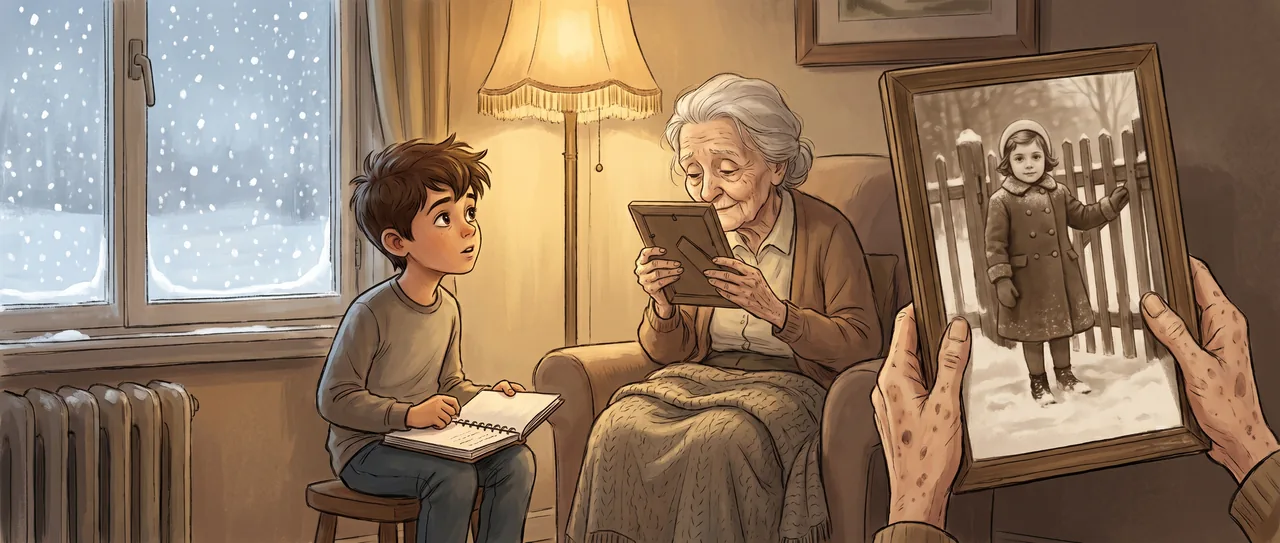
Soren sat on the low stool by her chair because the stool was old and did not creak, and Ada did not like things that creaked. On the table between them was a cup of tea going cold and a photograph in a frame, a photograph of a girl in a heavy coat standing in snow with her hand on a gate.
"That's me," Ada said. "I was six. The flu came through and took my mother and my baby brother and the man who drove the milk wagon. I got sick too. I remember the ceiling moving. Then I got better, and most people didn't."
Soren had heard the story before, but never sitting this close. He looked at the girl in the photograph and then at the old woman in the chair and tried to fit them into the same person. It would not quite fit. There was too much time in between.
"Why did you get better?" he asked.
Ada laughed, a dry small sound. "Lucky, my mother would have said. But she didn't get to say it."
Soren turned the cup a quarter turn on the table without drinking. He was thinking about luck, which was a word people used when they had run out of better words. He did not think a body got better by luck. A body got better by doing something. And if it did something, then there was a mechanism, and a mechanism could leave a mark.
"Ada," he said slowly. "Have you had the flu since?"
She thought about it. Her eyes went up to the corner of the room where people keep the years they are not currently using.
"Colds," she said. "Plenty of colds. But that flu, the bad one? No. Ninety years and it never came back for me. Funny. I always thought it might."
Soren took out his notebook. His hand found the pencil in the spiral and he wrote a date, 1918, and under it he wrote ninety years, and under that he wrote the word still, and he stopped with the pencil resting on the page because he did not yet know what came after still.
"What are you writing," Ada asked. Not unkindly. She liked that he wrote things.
"I'm trying to work out where it went," Soren said. "The thing that made you better. It didn't just leave when you stopped being sick. If it left, the flu could have come back and finished the job. It didn't. So it stayed."
Ada was quiet. The radiator ticked.
"Stayed where?" she said.
That was the question. Soren put his hand flat on the table and looked at the back of it, at the blue lines under the skin, the rivers that went everywhere and came back.
"In you," he said. "Somewhere in you there are still little pieces that remember that exact flu. Not flu in general. That one. The one from the photograph."
He meant it as a guess, the kind you commit to out loud and let someone knock down. But saying it, he felt the size of it arrive. The girl in the snow had met something terrible when she was six, and her body had taken its measurements, the shape of it, the chemistry of it, and had kept those measurements ready ever since. Through two world wars. Through every year Soren's whole family had been alive. The girl was ninety-two years gone. The memory of the flu was not.
"That can't be right," Ada said. "I forget where I put my glasses."
"That's a different kind of remembering," Soren said. "This one isn't in your head."
He thought about the school nurse last autumn, the cold swab, the small ache in his arm for a day. They had told him the vaccine taught his body a face to watch for. He had not really believed teaching could last. Lessons faded. He forgot the capital of half of Europe within a week.
But this was not that kind of lesson. This was a body that had been shown a killer once, at six years old, and had never once put the description down.
"Ada," he said, and his voice had gone careful, "if a doctor took a drop of your blood right now, today, they could probably still find it. The pieces that know the 1918 flu. They've found it in other people who were there. After all this time."
Ada looked at her own hand then, the way he had looked at his. She turned it over. The skin was thin as paper and spotted brown, and the blue rivers ran under it just the same as under his, only slower.
"You're telling me," she said, "that the worst week of my life is still in here. Filed away. Like a soldier who never got the message that the war was over."
"Standing at the gate," Soren said, before he could stop himself, and they both looked at the photograph, the girl with her hand on the gate in the snow.
Ada did not say anything for a long moment. Soren worried he had taken her somewhere sad. But when she spoke her voice was not sad. It was startled, the way his own voice got when something true turned out to be bigger than the words he had used to reach it.
"All these people who died," she said. "And the ones of us who lived, we've been carrying the proof of them. This whole time. Without knowing."
"That's why they study people like you," Soren said. "You're not just remembering it. You are the record. The only place that flu still exists that isn't dangerous anymore is inside the people it didn't kill."
Ada reached out and picked up the photograph. She held it close to her face, then far away, the way you do when your eyes have stopped agreeing with you about distance.
"Little soldier," she said to the girl in the snow. "Still at your post."
Soren wrote one more line in the notebook and closed it. Outside, the first real cold of the year was coming down, and Ada watched the window where the snow had started, the same fat slow flakes from the photograph, falling now onto a street where almost everyone who remembered the last time was gone, except the one in the chair, who remembered it in a place deeper than memory.
Read the interactive version, listen to the narration, and earn a gold star →
A science-verified short story for curious kids · Curiosity Land