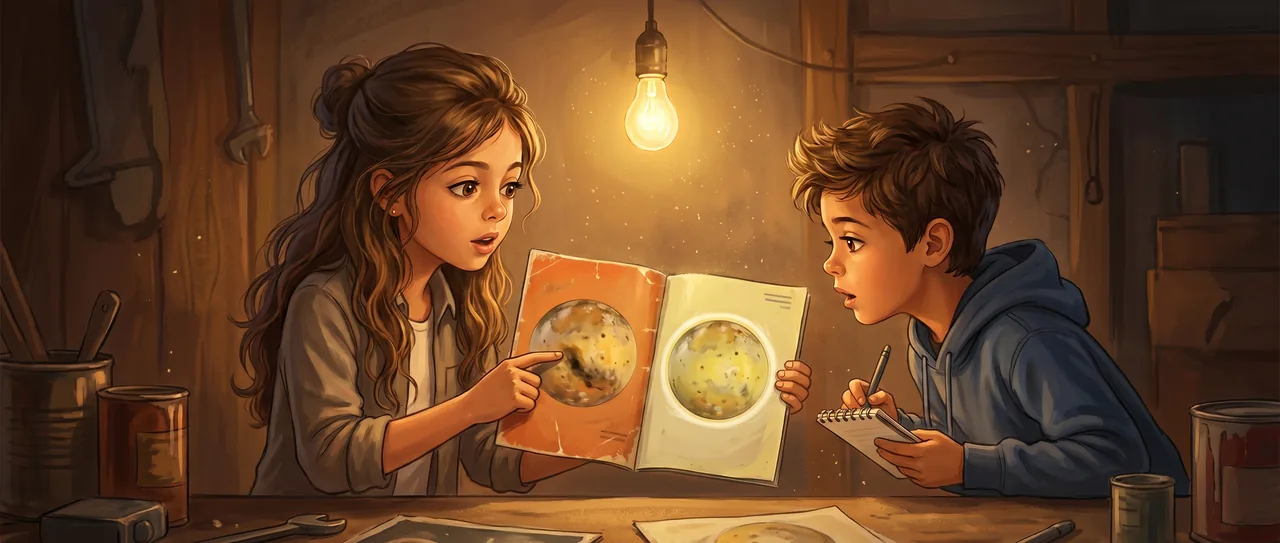
The Moon That Forgets Its Own Face
The garage smelled like dust and motor oil and old paper. Soren's grandfather had labeled every box in handwriting that leaned backward. This one said ASTRONOMY, 1979 TO PRESENT.
"Look at this one," Maya said. She held up a magazine cover. An orange moon, blotchy, like a pizza somebody had dropped.
"Io," said Soren. "Voyager took that. Jupiter's moon."
"It's hideous. I love it."
Soren kept digging. Near the bottom he found another magazine, glossier, newer, and on its cover was the same moon. Same name printed under it. Same orange. But the blotches were in different places.
"Maya. These don't match."
She took both covers and held them side by side, close to the bare bulb hanging from the ceiling.
"That's the same moon," she said.
"Same moon. Different spots."
She was quiet. Her finger moved from a dark smear on the old cover to a smear that was not there on the new one.
"Somebody printed it wrong," Soren said. "Or one's upside down."
"No." Maya turned the new one. Turned it back. "It's not upside down. Look at the bottom. There's a yellow ring on the new one. A big circle. It's not on the old one at all."
Soren leaned in. She was right. A pale ring, like something had splashed and dried.
"Maybe it's a different moon and they printed the wrong name," he said.
"They wouldn't get the name wrong twice." Maya set the covers down on the workbench. "What changes a whole moon between two pictures?"
Soren pulled his notebook out of his back pocket and flipped to a clean page. He wrote the years off both magazine spines. Eighteen years between them.
"Eighteen years," he said out loud. "That's a long time for us. For a moon that's nothing. The Moon, our Moon, has had the same face for billions of years. The man in the Moon doesn't change."
"So Io should look the same."
"It should look exactly the same."
They both stared at the two covers that refused to be the same.
Maya picked up the old one again. "What if it's the moon doing it. Not the camera. Not the printer. The moon."
"Moons don't repaint themselves."
"This one did. Between these two pictures, something covered that dark smear up. Something put a yellow ring where there wasn't one."
Soren chewed the end of his pen. He didn't say she was wrong. He never said she was wrong. He asked, "What could bury a smear that big? That smear is bigger than a country."
Maya looked at the orange and the pale rings and the blotches, and something arrived in her face.
"Volcanoes," she said. "That's what a fresh ring is. Something erupted and it spread out and landed in a circle."
"You can't have a volcano spread that wide. That circle is hundreds of kilometers across."
"Then it went up hundreds of kilometers."
Soren stopped chewing the pen.
"Up," he said.
"Up. Off the moon. Into space. And then the stuff fell back down in a ring and that's the splash mark." Maya tapped the pale circle. "That's not a stain. That's where it landed."
Soren was already doing it in his head, the way you do when something is too big and you reach for a number to hold onto. A volcano on Earth, the biggest, throws ash maybe forty kilometers up if it really tries. To make a ring that wide on the picture, the stuff would have to go up much, much higher than that. Higher than any mountain. Higher than the sky goes.
"That can't be right," he said, but he said it slowly, the way he said things when they were turning out to be right.
"Why not?"
"Because nothing on Earth does that. Nothing comes close."
"Io isn't on Earth." Maya was leaning over both covers now, breathing on them. "Io's right next to Jupiter. Jupiter's the biggest planet. It's huge. It pulls on Io. And the other moons pull on Io from the other side. So Io's getting squeezed and unsqueezed, over and over, like a stress ball."
Soren's pen was moving. "And when you squeeze something over and over it gets hot."
"Bend a paperclip back and forth. It gets warm right at the bend."
"Io's the bend." He underlined something. "The whole moon is the bend. It never gets to stop."
They looked at the old cover. Then the new one.
"So this picture," Maya said, "and this picture, are the same moon. But it erupted so many times in between that it covered its own face. It forgot what it looked like."
"It's doing it right now," Soren said quietly. "While we're standing in a garage. There's a moon out there throwing sulfur three hundred kilometers up into the dark, right now, and it's been doing it the whole time, and these two covers caught it forgetting."
Maya straightened up. She looked at the dusty garage, the labeled boxes, the backward handwriting, and then up, like she could see through the ceiling.
"There's no picture of Io that's true for very long," she said. "Every picture is already old. Every one's already wrong."
"Somebody could take a new one tonight," Soren said. "And it would already be a moon that doesn't exist anymore."
Maya laughed, but it came out shaky. "We can't even keep up with it. It changes faster than we can look."
Soren wrote one more line. Then he stopped writing, because the rule he kept for himself was that when the thing got too big you put the pen down and just let it be too big.
Maya took the two covers and pinned them to the garage corkboard, side by side, the old face and the newer face of the same moon. Then she pulled out her phone and started searching for the most recent picture anyone on Earth had taken of Io.
Read the interactive version, listen to the narration, and earn a gold star →
A science-verified short story for curious kids · Curiosity Land