The Grass That Breathes Underwater
The water was so cold it made Maya's ankles ache, but she did not come out.
The bus was idling up on the road. Their teacher, Mr. Adeyemi, had counted heads, found two missing, and was now standing at the top of the boat ramp shouting that they had four minutes, that the tide tables waited for no one, that he had said look but not touch.
He had also, an hour ago, pointed across the bay and said, somewhere out there is the most important grass in the world, and then he had checked his watch and herded everyone toward the rock pools instead. He liked the rock pools. They had crabs in them, and crabs photographed well for the school newsletter.
Maya had been thinking about the grass ever since.
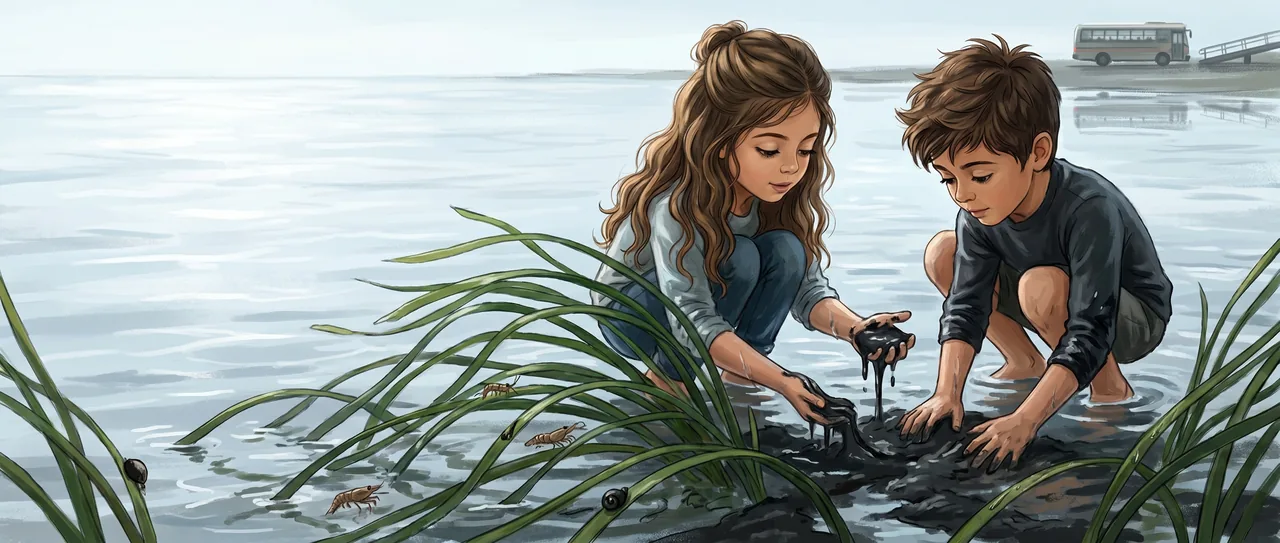
"There," Soren said. He was bent over, sleeves dark to the elbow. The water around his hands had gone still and clear, and underneath it lay a meadow.
It was green going on brown, long flat ribbons of it, each blade as wide as a shoelace, all of them leaning the same way the water leaned. When a small wave passed, the whole field bowed together and stood up again. It made no sound. It was the quietest moving thing Maya had ever seen.
She crouched and put her face close. The smell came up at her, salt and sulfur and something older, the smell of mud that had been mud for a very long time.
"It's warm down in it," Soren said. He had his hand pushed into the roots. "Like the water up top is one thing and the grass is keeping its own."
Maya pushed her hand in beside his. He was right. Among the stems the water held a thickness, a held breath. Tiny shrimp the size of rice grains flicked off her wrist. A snail no bigger than a peppercorn rode one blade like a green road. A flatfish she had not seen at all until it moved peeled itself off the bottom and was gone in a puff of silt.
"There's so much," she said. "There's more here than the whole rock pool."
"Count," Soren said, which was his way of agreeing.
She tried. She got to eleven kinds of living thing in one square the size of a dinner plate before a crab she hadn't counted ate something she hadn't counted and she lost the number. On the rocks she could have counted everything in a minute. Here she would have needed the whole afternoon and she still would have missed the ones holding still.
Up on the ramp Mr. Adeyemi shouted three minutes.
Maya dug her fingers deeper, past the roots, into the mud itself. It came up black. Not brown like garden dirt. Black, and slick, and it did not crumble. It held together like clay, like something packed down and saved.
"Soren. Smell this."
He leaned in. "That's the old smell," he said. "That's where it's coming from."
"It's not rotting," Maya said slowly. She knew rotting. Rotting was the smell of the compost bin, fast and sour, things falling apart. This was the opposite of that. This was things going down and staying. "The grass drops leaves and they go in the mud and the mud just keeps them. Holds them. Forever, almost."
Soren went quiet over the black handful. Then he said, "That's carbon."
"What?"
"The leaves are carbon. The grass pulls it out of the water and the water pulls it out of the air, and when the leaves fall in here the mud doesn't let them rot, so the carbon can't get back out." He turned his hand. The mud sat in it, heavy, refusing to dry. "It's been doing that the whole time. Under everyone's feet. While we were looking at crabs."
Maya looked at the meadow again, and it had changed, the way a word changes when you suddenly understand it. The grass was not pretty grass in the shallows. It was a machine running slower than patience and faster than a forest, breathing in the sky and folding it into the dark, blade by blade, leaf by leaf, year by buried year, and nobody on the bus knew, and the newsletter would say crabs.
"Mr. Adeyemi said most important grass in the world," she said. "And then he took a picture of a crab."
"He doesn't know," Soren said. "Or he knows the sentence but not the thing." He was still holding the mud. "There's almost none of it left. He said that part too. Ninety out of every hundred meadows, gone. And it's the fastest carbon in the ocean and we're standing in the leftover ten."
Maya felt something then that was not quite happiness and not quite fear. It was the feeling of a room she thought was empty turning out to be full, full of work being done in the dark by something that asked for nothing and got nothing, not even a photograph.
Two minutes, said the ramp.
She didn't move. She watched the meadow bow and stand, bow and stand, each blade handing the water along to the next, ten thousand green ribbons all doing the one quiet job, and she understood that she had spent her whole life walking past the most important thing in the place and calling it nothing, calling it weeds, calling it the brown stuff before the good rocks.
"We have to tell him," Soren said. "Not the sentence. The thing."
"He won't stop the bus."
"Then we tell the next person. And we come back." Soren let the mud slide off his palm into the water. It sank straight down, black through green, and the meadow closed over it without a ripple. "It kept all of that without anyone watching. It'll keep going if we watch."
Maya pulled one finger free of the roots. A single blade came with it, then sprang back into the field, joining the others mid-bow, indistinguishable, swallowed back into the count she could not finish.
Up on the road the bus horn sounded, long and flat across the water, and neither of them turned around. They stayed crouched in the cold, hands in the warm dark of the grass, watching the meadow breathe the sky down into the mud, one slow ribbon at a time.
Read the interactive version, listen to the narration, and earn a gold star →
A science-verified short story for curious kids · Curiosity Land