The Wrong Way to Bend
The whole thing had gone wrong, which was why it was sitting on the far bench where nobody would look at it.
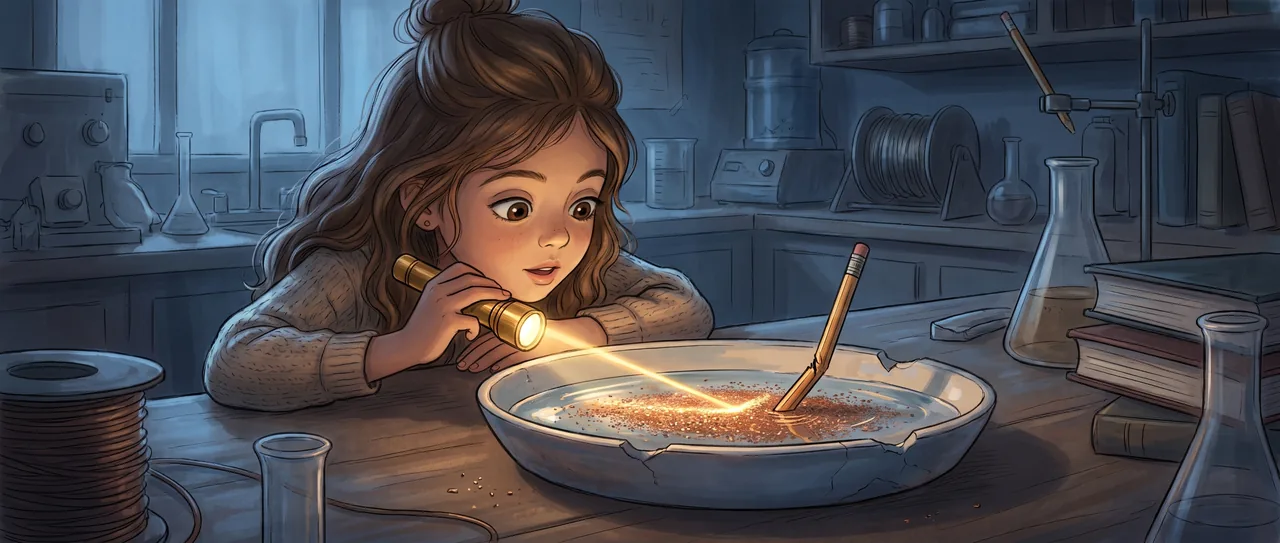
Maya knew it had gone wrong because of the sticky note. Her mother's handwriting, all capitals, pressed hard enough to dent the paper. FAILED, GLASS CONTAMINATED, REDO MONDAY. The note was stuck to a shallow dish of water with a straw standing up in it.
Her mother was two rooms away with a stack of exams and a cup of coffee gone cold twice. Maya was supposed to be reading. She was reading, in a way. She was reading the straw.
A straw in a glass of water bends. Everybody who has ever had a drink knows this. The part underwater looks shoved sideways from the part above, like the water grabbed the bottom and slid it over. Maya had drawn it a hundred times. Bottom slides one way. Always the same way.
This straw slid the wrong way.
She blinked. She moved her head. She crouched until her chin touched the cold bench and looked along the surface of the water. The bottom of the straw was not shoved toward the near wall of the dish. It was shoved toward the far wall. Backward. As if the water were pushing the light in the opposite direction from every glass of water she had ever seen.
Her stomach did a small cold flip.
She told herself it was the dish. Curved sides could do things. She lifted the straw out and set it on a paper towel and looked at the water, which looked exactly like water. Then she found a pencil in her pocket and stood it in the dish and lowered her eye to the surface again.
The pencil bent backward too.
Maya sat very still. Water bent light one way. This water bent it the other way. She had never in her life seen a thing bend light the wrong direction, and now it was happening in a chipped glass dish somebody had labeled a failure.
She touched the water with one fingertip. Cool. Ordinary. Her finger came out wet and looked like a finger. She dipped it again and this time she felt it, a faint grit against her skin, like the last of the sugar at the bottom of a cup that won't dissolve. She rubbed her thumb across her fingertip. Tiny somethings. Too small to see. Slippery and hard at once.
The dish was not full of water. It was full of water and a cloud of pieces so small she could only feel them as roughness.
She leaned close. Down at the bottom, where light came through the side, the water had a faint sheen to it, a coppery shimmer that slid when she moved, the way an oil patch on a puddle throws colors. Not oil. She sniffed. No smell. Just the shimmer, and the grit, and the pencil pointing the wrong way.
Maya lowered her head one more time and did something careful. She moved her eye slowly along the surface and watched the bent part of the pencil track with her. When light came through normal water, the world underneath drifted the way you expected. This world underneath drifted against her, sliding opposite to the way her head moved, sliding the way a reflection in a spoon flips when you turn it over.
The light was coming out the wrong side. It was leaving the water aimed backward from where it should be aimed. Something in that grit was catching the light and handing it back turned around.
She thought about a lens. Every lens she had ever held gathered light toward a point, and the point was always fuzzy at the very center, always a little smeared no matter how good the glass. Her mother said that smear was a wall you couldn't get past. A limit. The world's smallest things stayed blurry forever because light itself refused to be squeezed finer.
But a wall only stops you if everything pushes the same direction. If light could be made to bend the other way, then a lens could pull it in from both sides at once and pinch it down past the smear, down to a point with no fuzz in it at all.
And if light could be sent around the wrong way, it could be sent around a thing entirely. Around and back together on the far side, so the thing in the middle threw no shadow, made no reflection, sat in the beam and left it looking untouched.
Maya's hands were cold. She wanted to run and get her mother. She did not run.
Instead she found a flashlight in the drawer, the little one, and she clicked it on and set it flat on the bench so the beam skated across the top of the water at almost nothing, a low gold line. Normal water would have thrown that beam down and forward. She got her eye to bench level and watched where it went.
The beam went down and backward. It slid into the coppery grit and came out the far side pointing toward the flashlight, toward the source, as if the water had said no thank you and returned it to sender.
She understood then why the note said contaminated. Something had gotten into the glass her mother was cooking, some scatter of structured specks too small and too regular to be an accident of the wrong bottle. Her mother had been building glass and had built, without meaning to, a smear of stuff that told light to go the wrong way, and had thrown it to the far bench and called it garbage.
Maya turned the flashlight off and sat in the dark blue lab with the dish in front of her and the grit still on her fingertip.
Down the hall a chair scraped and her mother called that it was time to pack up.
Maya picked up the sticky note. She peeled it off slowly so the FAILED came away clean. She held it a second, then she crossed to the doorway, dish balanced flat in both hands so nothing spilled, and she said into the lit room, "Come look at this before you throw it out. The straw goes the wrong way."
Read the interactive version, listen to the narration, and earn a gold star →
A science-verified short story for curious kids · Curiosity Land