The Wrong Kind of Quiet
The lounge had the wrong kind of quiet. Not peaceful. Held.
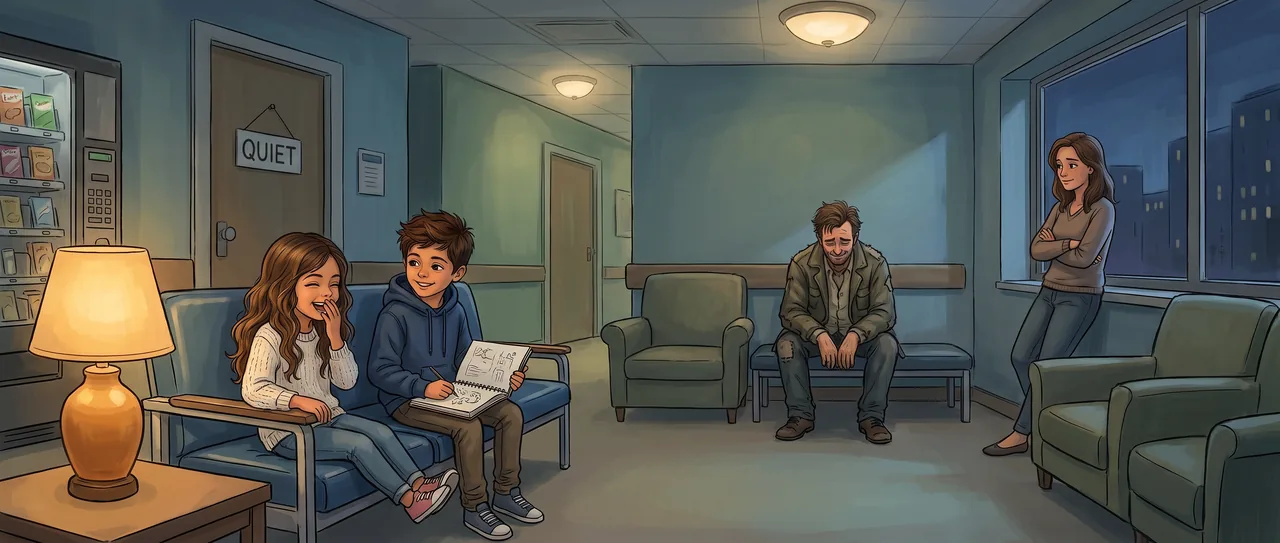
Maya sat with her knees pulled up on the vinyl chair. Soren had the notebook open on his lap and had not written anything in twenty minutes.
"They said an hour," Maya said. "It's been two."
"An hour was an estimate."
"An estimate is a guess wearing a nicer shirt."
Soren almost smiled. He caught it before it happened, because smiling felt wrong in a room like this, and put it away.
Across the lounge a man in a rumpled jacket was doing the same thing. Waiting for someone. Jiggling his foot. Everyone in the room was doing the small careful movements people do when they are trying not to fall apart.
"Say something," Maya said.
"About what?"
"Anything. It's too quiet in here. It makes my chest tight."
Soren thought about that. "That's real, actually. Quiet like this. Your body reads it as danger."
"See, you're doing the thing."
"What thing?"
"The thing where you know something and I feel it and we meet in the middle." She pressed her hand flat on her chest. "My grandma. When she came out of the ambulance. She was scared, and she looked at me, and you know what she did?"
"What?"
"She made a joke. About the paramedic's mustache. It was a terrible joke."
"Did you laugh?"
"I laughed so hard I cried. Right there. And I couldn't figure out why, because nothing was funny." Maya turned her head. "Why did I do that?"
Soren opened his mouth and then closed it, because the honest answer was that he did not entirely know.
"Okay," he said slowly. "Here's what I know. When you laugh, your brain lets go of a bunch of stuff. Cortisol goes down. That's the stress chemical. Endorphins go up. Those are the ones that make pain smaller."
"So it's like a switch."
"Kind of. But that's not the weird part."
"What's the weird part?"
Soren looked at the man across the room, still jiggling his foot. "The weird part is who it's for. Laughing isn't for you. If it was just for you, you'd do it alone. But almost nobody laughs alone. You're like thirty times more likely to laugh when someone else is there."
Maya went still. "Thirty times."
"Something like that. It's a signal. It's for the other person."
"So when Grandma made the terrible joke"
"She wasn't trying to be funny. She was trying to tell you something. Without saying it."
Maya's eyes went wide and wet at the same time. "She was telling me it was going to be okay."
"She was telling you you were safe. Her mouth couldn't say it because she was scared too. So she used the older thing."
"The older thing."
Soren finally wrote something. Just three words. He turned the notebook so Maya couldn't see and kept talking. "Laughing is older than talking, Maya. Way older. Animals that can't say a single word still do it. You tickle a rat and it makes a sound too high for us to hear, and it comes back for more. Apes pant when they play. It was here before language. Before words existed, this is how you told somebody, I'm not a threat, I'm with you, we're together."
Maya sat with that. "So it's like" She stopped. "It's like a word from before there were words."
"Yeah."
"And everybody still speaks it."
"Everybody. You never had to learn it. Babies do it before they can sit up."
Maya looked around the held-quiet room, at the man with the foot, at a woman by the window with her arms wrapped around herself. "That's why the quiet feels bad. Nobody's sending the signal."
"Right."
"So somebody should send it."
"Maya."
She was already thinking. "The paramedic's mustache. Tell me a terrible joke. A really bad one. The worst one you have."
"This is a hospital."
"That's exactly why. You just said it makes the pain chemical smaller. Everybody in here is in pain. So."
Soren looked at her. He looked at his notebook. He was not the kind of person things happened to, but Maya was looking at him like he was the kind of person who could change the temperature of a room, and something about that made him brave.
"Okay," he said. "Why did the skeleton stay home from the party?"
"Why?"
"He had no body to go with."
It was so bad. It was so genuinely, catastrophically bad, that Maya made a sound she was not planning to make, a real one, sharp and surprised, and slapped her hand over her mouth.
And here is the thing Soren wrote down later, the thing he watched happen in real time.
The man with the jiggling foot looked up. He didn't know the joke. He hadn't heard it. But the sound reached him, and something moved across his face against his will, and he huffed out a breath through his nose and shook his head, smiling at the floor.
The woman by the window unwrapped her arms.
"He didn't even hear it," Maya whispered. "He just heard me."
"That's the synchronizing part," Soren whispered back. "When you hear someone laugh, your brain starts matching theirs. Lining up. Like it wants to be in the same place as them. You caught it and passed it to him and he didn't even choose to catch it."
"We changed the room."
"You changed the room."
"With a signal from before there were words."
A nurse appeared in the doorway with her clipboard, and she looked at the lounge, and whatever she had expected to walk into, it wasn't this, three strangers loosely smiling at nothing in a room that had unclenched.
"She's awake," the nurse said to Maya. "She's asking for you. And she wants to know if anyone's heard a good joke, because the one she's got is apparently terrible."
Maya was already on her feet, laughing before she reached the door, and the man with the foot laughed too, at nothing, at everything, catching the sound the way you catch a thing thrown gently to you across a great and ancient distance.
Read the interactive version, listen to the narration, and earn a gold star →
A science-verified short story for curious kids · Curiosity Land