The Thing That Won't Sit Still
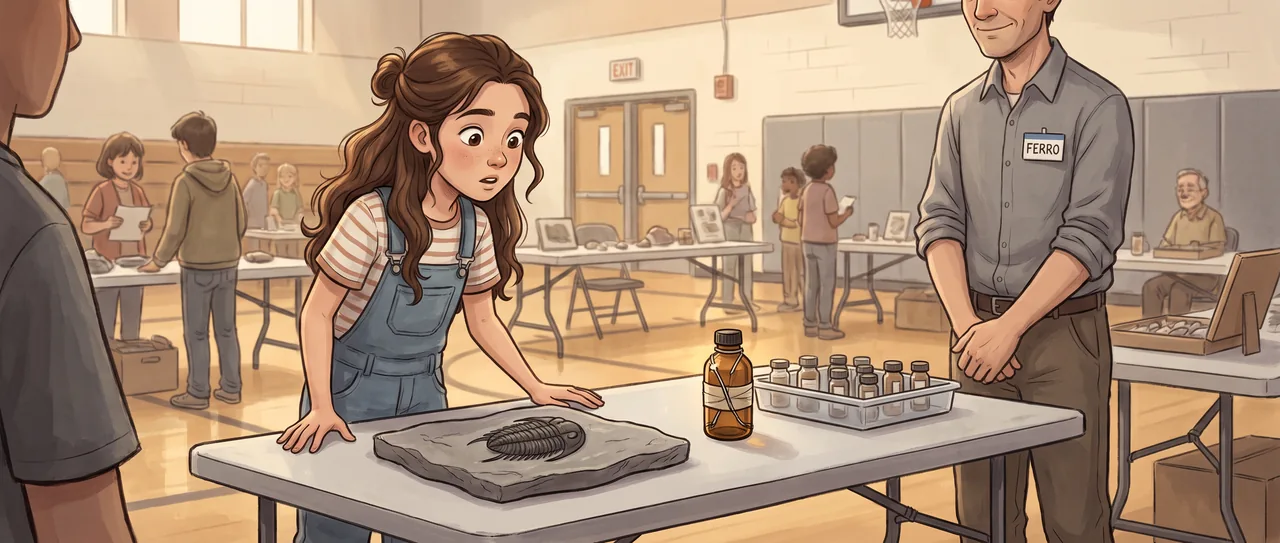
Maya was supposed to be watching her aunt buy a geode. Instead she was watching the man at the next table, who kept his hands very still.
His name tag said Ferro. In front of him sat a slab of gray stone with a curl of something dark trapped inside it, like a comma written by an animal. A trilobite, the little card said. Five hundred million years old.
Next to that, on the same folding table, a plastic tray held vials of powders and crystals, and one small brown bottle with a rubber stopper wired down tight.
"Why is that one taped shut," Maya asked.
"Because it doesn't want to be a molecule anymore," Ferro said. He didn't touch it. "Some things fall apart the second you look at them. That one, if it warmed up, would come apart faster than you could say the word apart."
Maya looked at the trilobite. Then at the bottle. Then back at the trilobite.
"How fast," she said.
"Millionths of a second."
Her aunt was still turning the geode over, asking about the price of the purple one versus the price of the blue one. Maya's brain had already left the geode behind.
"That's the same table," she said.
Ferro raised an eyebrow.
"You've got a thing that lasted five hundred million years," Maya said, pointing, "and a thing that lasts less than a heartbeat. On the same table. In the same room. Same air."
"Same physics too," said Ferro. He seemed pleased that she was annoyed. Adults were often pleased when she was annoyed, which annoyed her more.
Maya did not like it when two things that should behave the same behaved completely differently. It felt like a rule was being broken somewhere she couldn't see. The trilobite and the brown bottle were both just atoms stuck to other atoms. Carbon. Oxygen. Ordinary stuff. So why did one of them hold still for half a billion years and the other one couldn't manage a second.
"Is the fast one weaker," she said. "Like, glued together worse."
"Guess," said Ferro.
She hated guessing at people. She loved guessing at things. "Yes," she said. "The fast one's glue is worse."
"Wrong," Ferro said, cheerful. "The bonds in that bottle can be strong. Strong isn't the same as staying."
Maya stopped.
She picked up a chunk of quartz from his display so her hands had something to do while her head worked. Strong isn't the same as staying. That was two different things she'd been treating as one thing.
"Okay," she said slowly. "So a molecule holding together isn't about how tight the glue is. It's about whether there's somewhere better to go."
Ferro's cheerful face changed a little. He hadn't expected that.
"Say more," he said.
"A rock on a shelf," Maya said, going faster now. "It could fall. Gravity's pulling it. But it doesn't fall, because the shelf's edge is up a little. It'd have to go up before it could go down. So it just sits. Forever, basically." She set the quartz down. "And a rock already tipping off the edge, that one falls now. Same gravity. Different edge."
"The trilobite," said Ferro, very quiet now, "is on the shelf."
"And there's a wall in front of it," Maya said. "A little uphill wall. It would have to climb before it could fall apart. And nothing's giving it the push to climb. Not for five hundred million years."
"We call that wall the barrier," Ferro said.
Maya wasn't really listening to the name. She was looking at the brown bottle with new attention, the way you look at a dog that seemed calm and now you're not sure.
"So that one," she said. "The fast one. Its wall is basically flat. There's nothing to climb. So the second it can go, it goes."
"Microseconds," said Ferro.
"But that means," Maya said, and here she felt the floor of the gymnasium get a little less solid under her sneakers, "that the trilobite isn't actually finished. It's not done. It's still falling. It's just falling so slowly that five hundred million years isn't enough to see it move."
Ferro didn't say anything.
"Everything on this table is coming apart," Maya said. "All of it. The quartz. The geode. You. Me. We're all going downhill toward something. It's only the size of the wall in front of us that makes one thing look permanent and another thing look like an accident."
"That's it," said Ferro. "That's the whole thing."
Maya wanted to know what set the height of the wall. Why one arrangement of the same carbon and oxygen got a tall wall and another got a flat one. Ferro started to say a word, quantum, the shapes the electrons were allowed to make, the rungs they were and weren't allowed to stand on, and she could tell from how his voice slowed that this was the part even he held carefully, the part that went down further than the table, down past the trilobite, into rules nobody got to vote on.
She didn't need him to finish it. She'd found the door. The door was enough.
Her aunt appeared with the blue geode in a paper bag. "Ready," she said. "You didn't touch anything, right?"
Maya looked at the trilobite, five hundred million years into a fall that hadn't finished, sitting a hand's width from a bottle that would end before she could blink.
"I touched the quartz," she said. "It's fine. It's got a really tall wall."
Her aunt gave her the look. Ferro laughed out loud.
On the way out, Maya stopped at the gymnasium door and turned around. The two tables looked ordinary again from across the room, folding tables with rocks on them, a man selling old dead things and small dangerous ones.
She watched the brown bottle sitting perfectly still in its tray, taped and wired and quiet, holding on, holding on, holding on to the top of a wall that wasn't there.
Read the interactive version, listen to the narration, and earn a gold star →
A science-verified short story for curious kids · Curiosity Land