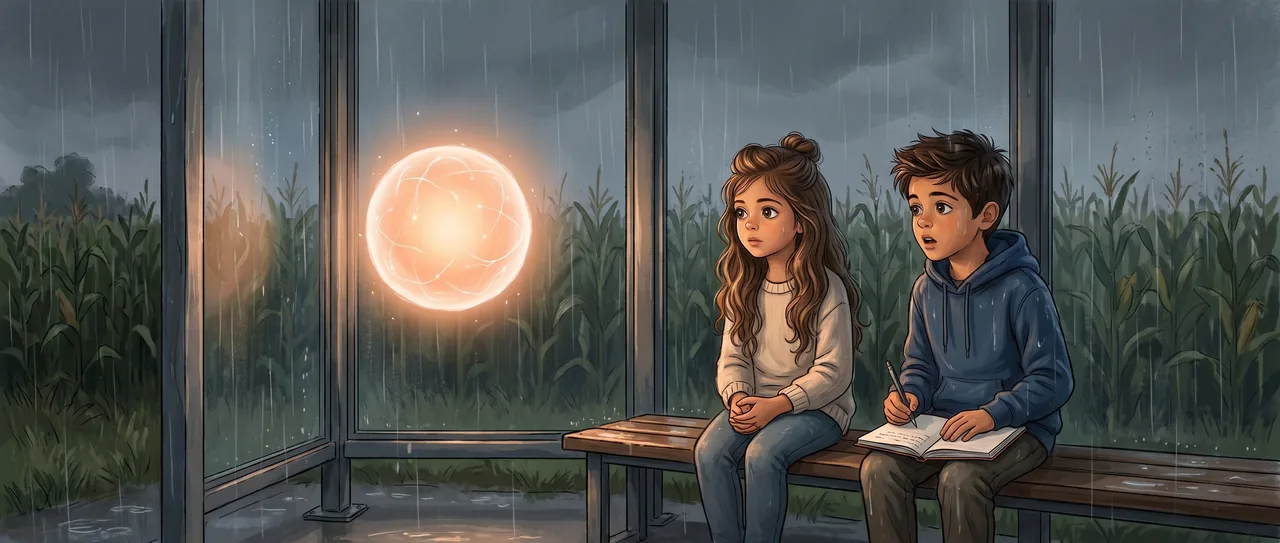
The Thing That Came Through the Window
The rain came sideways, and the bus did not.
Maya and Soren sat in the little metal shelter at the crossroads, watching water sheet down the plexiglass wall. Soren had his notebook open on his knees but he wasn't writing. He was counting the seconds between the flashes and the thunder, the way his grandfather had taught him.
"Two," he said. "That one was close."
Maya pulled her knees up onto the bench. She was watching the field across the road, where the corn stood flat-green and shivering. She liked storms. She liked the way the whole sky decided something all at once.
Then the sky did something she had not seen it decide before.
A ball of light came out of the rain.
It was about the size of a grapefruit, and it glowed a soft orange-white, like the inside of a lightbulb but slower, gentler, wrong. It did not fall. It did not shoot. It drifted, low over the road, moving at exactly the speed of a person taking a walk.
Soren stopped counting.
Neither of them said anything. There was a smell, sharp and clean, like the air right after a match is blown out.
The ball crossed the road. It came toward the shelter. Maya felt her whole body go still on the bench. It reached the plexiglass wall.
And it came through.
Not around the edge. Not through the gap at the bottom. Straight through the solid panel, the way light comes through a window except this was not light, this had a shape and a size and it was inside the shelter with them now, floating at chest height, humming so faintly that Maya felt it in her teeth more than heard it.
Soren's pen had stopped on the page. His mouth was open.
The sphere drifted between them. Maya could have touched it. She held her hand very still in her lap instead. Up close the surface moved, tiny threads of light turning over and over inside it, like the way sunlight moves on the bottom of a swimming pool.
It lasted maybe five seconds.
Then it was gone. Not fading. Gone, the way a soap bubble is there and then is only a wet spot in the air. There was a small pop, softer than a knuckle cracking, and the burnt-match smell got stronger for a moment, and then the shelter was just a shelter again, with rain on the roof and two children not breathing.
Soren let his breath out first.
"It went through the wall," he said. His voice was careful, like he was setting each word down on a shelf. "Maya. It went through the wall, and the wall is fine. Look. There's no hole."
Maya got up and put her fingers on the plexiglass where the thing had passed. Smooth. Cool. Solid. No mark. No melt. Nothing.
"Say what it was," she said. "Say it out loud so we both remember we said it."
"Ball lightning," Soren said. "I think. I read about it. In a book about weird weather." He was flipping pages now, fast, not to find anything, just because his hands needed a job. "But the book didn't say how. That was the whole thing about it. The book had a chapter and the chapter didn't have an answer."
"What do you mean it didn't have an answer."
"I mean nobody knows." Soren looked up at her, and there was something in his face she had never seen there before, not when he solved a puzzle, not when he was right about something. "Maya, that's real. People have seen it for hundreds of years. Sailors. Farmers. Pilots. It floats, it goes through glass, it vanishes. It's in the science, it's documented, and there is no accepted explanation. None. The scientists wrote it down and then they wrote, we don't know."
Maya sat back down slowly.
She thought about every time an adult had told her that the important things were already figured out. That the mysteries were in books, solved, filed away, and her job was to learn the solutions. She had believed them a little, even while it disappointed her. She had thought the not-knowing was just for her, a temporary thing, a gap in her own head that school would eventually fill in.
And a ball of light had just walked through a solid wall two feet from her face, and there was no page anywhere on Earth that could tell her how.
"So nobody knows," she said.
"Nobody knows."
"And it just happened. To us. In a bus shelter."
"To us," Soren said. "In a bus shelter."
The list Maya kept in her head, the running list of things that did not make sense yet, had always felt like a list of homework. Things she would get to. Things somebody would eventually explain. She felt the list change shape. She felt it become something else, something with no bottom, something that grown scientists with lifetimes and instruments were still standing at the edge of, looking down, writing we don't know.
There was room in that. There was so much room in that.
Soren was writing now, fast, and she let him, and she watched the field instead. The rain was easing. The corn had stopped shivering. Somewhere down the road a set of headlights was finally coming, throwing yellow across the wet.
"Soren," she said. "How many people do you think have seen one and never told anybody because they thought no one would believe them?"
He stopped writing.
"A lot," he said quietly. "Probably a lot."
The bus came around the bend, its brakes hissing in the rain. Neither of them moved to stand. On the plexiglass wall in front of them, where a ball of impossible light had passed through solid plastic and left nothing at all behind, a single drop of rain slid down the outside and pooled at the bottom of the frame.
Read the interactive version, listen to the narration, and earn a gold star →
A science-verified short story for curious kids · Curiosity Land