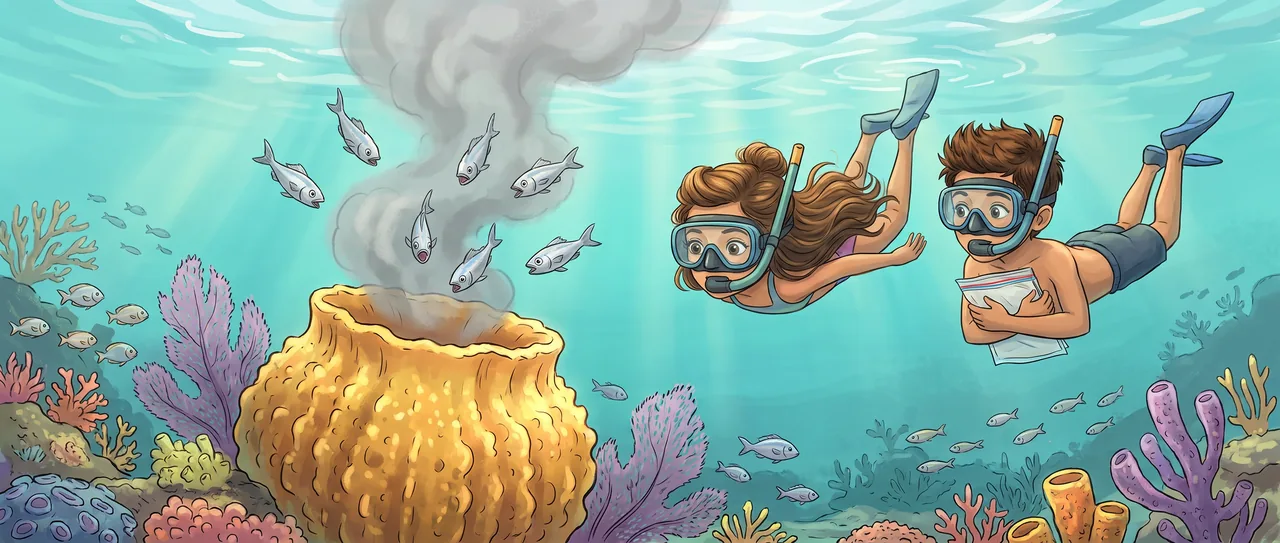
The Slowest Sneeze in the Sea
The engine had died twice already, so the guide was elbow-deep in it, swearing softly, and had told them to stay above the yellow sponge and not touch anything.
Maya was floating face-down, breathing through the snorkel, watching a barrel sponge the size of a laundry basket.
"Soren," she said, spitting out the mouthpiece. "That sponge is going to do something."
"Sponges don't do things," said Soren. He was hanging onto a float, keeping his notebook dry against his chest inside a ziplock bag. "They filter. They just sit there and filter."
"There's a bunch of little fish parked next to it. Waiting."
"Waiting for what?"
"That's what I'm asking you."
Soren put his face in the water. She was right about the fish. Six or seven of them, small and silver, hovering at the sponge's rim like they had reservations.
"They're probably just eating stuff that floats off it," he said, coming up.
"Then why are they all looking at the top? Watch the top."
They watched the top. Nothing happened. Nothing kept happening for a long time. Soren's neck got cold where the water lapped it.
"Maya. Nothing is happening."
"Something's happening. It's just slow."
"How do you know?"
"The edge," she said. "The top edge. It was wider a minute ago."
Soren looked hard at the top edge. He couldn't tell. That was the problem with a thing that big. You couldn't hold the whole shape in your head to compare it.
"Pick one bump," he said. "One spot on the rim. Line it up with something behind it and don't blink."
Maya lined up a knob of the sponge with a purple sea fan waving behind it. Soren lined up a different knob with the shadow of a coral head. They floated. The guide banged something metal against the boat.
"Mine moved," Maya said. "The sea fan. There's more of it now. The bump got out of the way."
"Mine too," Soren said, and his voice had changed. "The whole thing is getting smaller. It's pulling in."
"Like a breath."
"Like a really, really slow breath."
They watched the barrel sponge squeeze. It happened at the speed of a shadow crossing a wall. If you looked away and looked back, it looked the same. If you refused to look away, it was unmistakable. The entire animal was contracting, folding into itself, tightening like a fist made of the softest possible thing.
"Okay," Soren said slowly. "Okay. Muscles do that. You clench a muscle, it gets shorter. But muscles only work if something tells them to clench."
"So something's telling it."
"That's the part that's wrong," Soren said. "A sponge doesn't have the something. No brain. No nerves. Not one nerve cell in the whole body. We learned it. They're the animal that comes before nerves."
Maya lifted her face out. "Say that again."
"No nerves. Zero. It's the classic fact. Sponges are animals with no nervous system at all."
"Then who's telling the muscle to clench?"
Soren opened his mouth to answer and found he didn't have one. He reached into the ziplock, worked the notebook out, and wrote something with the pencil stub, the page going soft and gray under his wet fingers.
"That's not a muscle," he said. "It can't be a muscle if there's nothing to fire it. It has to be the cells deciding. Each one. On their own."
"All at once, though," Maya said. "They're all squeezing at once. How do they agree if nobody's in charge?"
"They pass it along. One cell shoves, its neighbor feels the shove, it shoves. Like the wave at a stadium. Nobody's running the wave. Everybody just does their neighbor a beat late."
"That's why it's slow," Maya said, and now she was talking fast, the way she did when the pieces were snapping. "A nerve is fast because it's a wire. This isn't a wire. This is a whole animal passing a message hand to hand with no words and no boss, and it takes half an hour to get across the room because the room is the animal."
They both put their faces back down.
The sponge had reached the tightest part of the clench. The little fish drifted closer, up over the rim, fins trembling.
"Watch the fish," Maya said into the water, bubbles carrying it. "The fish know. They've done this before."
And the sponge sneezed.
It was not fast even now. It was a long, pushing release, the whole body loosening and driving a cloudy plume up and out of the wide opening at the top, a slow gray breath of everything the animal had strained out of the sea and wanted gone. The plume unrolled into the water like smoke in no hurry.
The silver fish went into it. All of them at once, mouths working, eating the cloud the way you'd catch snow on your tongue.
"It's feeding them," Soren said, coming up for one gulp of air and going straight back down. "The garbage. Its garbage is their lunch. It's been holding the sneeze the whole time we watched and we didn't know that's what we were watching."
Maya didn't come up. She was watching the fish clean the water where the cloud had been, watching the barrel sponge sit there, plain and dumb and enormous, having just moved its entire body without a single thought to move it with.
When she finally lifted her head her eyes were huge behind the mask.
"Soren. It did all that with nobody home."
"Nobody home," he agreed.
"There's a whole way of being alive that doesn't need a driver. It just needs everybody to feel their neighbor and pass it on. And it works. It's slow, but it works, and the fish figured out the schedule." She was breathing hard through her nose. "How many things in the ocean are running with nobody home and we just call them rocks?"
Soren looked at his soggy notebook page, then back down at the reef, at all the sponges he had been ignoring since the boat dropped them, every one of them a lump he had filed under scenery.
The barrel sponge began, so slowly it could have been the light changing, to fill itself back up.
Read the interactive version, listen to the narration, and earn a gold star →
A science-verified short story for curious kids · Curiosity Land