The Program That Learned to Lose
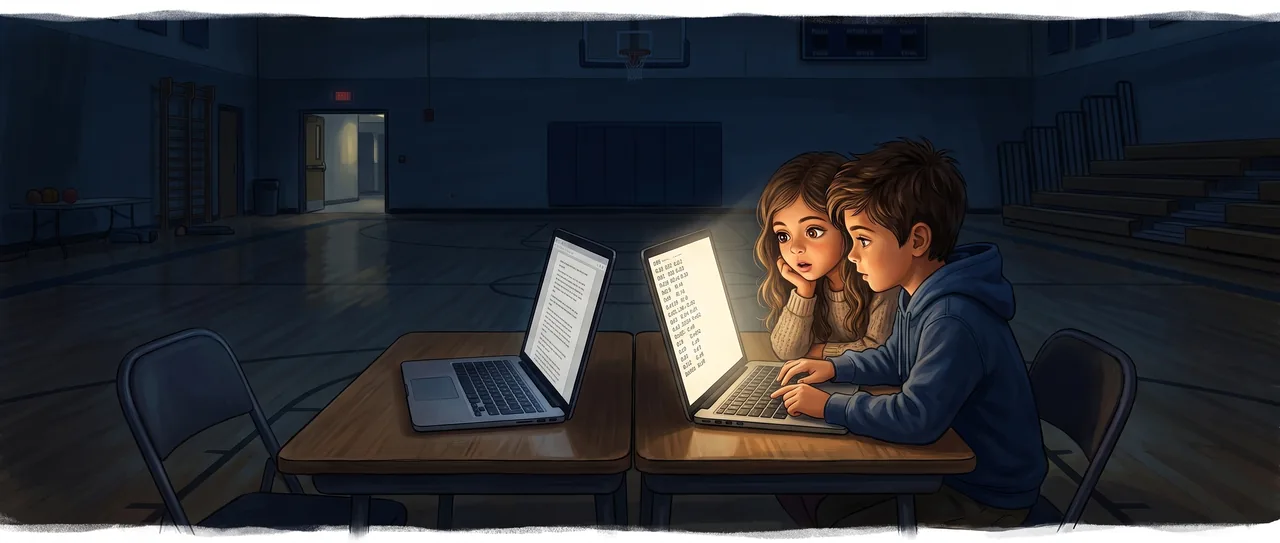
The gym still smelled like glue and orange peels. Everyone else had gone home. Two laptops sat open on a folding table nobody had folded yet.
"Play it again," Maya said.
Soren tapped the key. On the left laptop was the program they had spent six weeks building, the one that had lost every single game at the fair. They had named it Rooky. On the right was a program Soren had downloaded the night before, almost by accident, because he wanted something for Rooky to practice against. That one had no name. It was tiny. It was fifty lines long.
Rooky lost in nineteen moves.
"That is embarrassing," Soren said. "We taught Rooky everything. Control the center. Knights before bishops. Do not bring your queen out early. It knows two hundred and forty rules. I typed all of them."
"I remember," Maya said. "My thumb still hurts from reading them to you."
"And the little one knows nothing. It has no rules. It just plays itself over and over and keeps whatever wins."
Maya pulled the nameless laptop closer. "How many times has it played itself?"
Soren checked. "Since last night. About four hundred thousand games."
Maya went quiet for a second. Then she said, "Play it a hundred more times against Rooky. But show me the moves where Rooky's rules kick in."
So they did. It was slow and it was not slow. On move seven, over and over, Rooky pulled its knight back to defend the center, because rule forty-one said the center was sacred. And over and over, the nameless program did something that looked stupid. It gave up the center. It let Rooky have it.
"There," Maya said. "Rooky thinks it's winning."
"It always thinks it's winning on move seven. Then it dies on move nineteen."
"Because the little one learned something you didn't tell it." Maya leaned in. "It learned that the center is only worth having sometimes. Rooky thinks it's worth having always. That's the difference. Rooky believes you. The little one doesn't believe anybody."
Soren opened his notebook and drew two boxes, one big, one small. His pencil stopped over the small one.
"Okay but that feels backward," he said. "We know things about chess. Real things. Grandmasters wrote those rules down. The center is important. That's true."
"It is true," Maya said. "Just not the whole truth. And Rooky can only ever be as smart as the rule you gave it. It can't get smarter than your thumb typing."
Soren looked at that for a while. "So the rules are a ceiling."
"For Rooky, yeah. Two hundred and forty rules, two hundred and forty is the most it can ever know. The little one doesn't have a ceiling. It just has last night. And tonight. And tomorrow night."
Soren wrote four hundred thousand games in the small box. Then he crossed out the two hundred and forty in the big box and wrote it smaller.
"Try something," he said. "Let's help the little one. Let's add one of our rules to it. The center one. It's our best rule. Then it'll be even stronger, right? Our knowledge plus its practice."
Maya grinned. "Do it."
He added the rule. It took four minutes. He set the improved little program against the plain little program, the one that still knew nothing, and let them play three hundred games while the janitor stacked chairs at the far end of the gym.
The plain one won. Not every game. But more.
Soren stared. "We made it worse. We gave it a true fact and we made it worse."
"Say why," Maya said. "Because our rule is always on," Soren said slowly. "Control the center, every time, no exceptions. But the plain one already figured out that the center is worth it four times out of five and a trap the fifth time. Our rule can't tell the difference. It just shouts the same thing forever. So we glued a loud dumb thing onto a quiet smart thing."
"You handed a genius a rule from a beginner," Maya said, "and told the genius the beginner was in charge."
Soren laughed, but it came out strange, because something underneath it had shifted. He looked at the two hundred and forty rules scrolling up Rooky's screen. Six weeks of them. His handwriting, then his typing, then Maya reading numbers off a printout while her thumb went sore.
"All that work," he said.
"It wasn't nothing," Maya said. "You had to know chess to even know what to let it practice. You built the board. You wrote the part that says who won. It just plays the game better than the person who taught it the game. That's allowed."
That landed somewhere in Soren's chest and did not settle. He had always been the kid who read the whole manual. The kid who wanted the mechanism first, who wrote everything down because the inside of his head got too crowded otherwise. He was good at holding a lot of careful rules at once.
And here was a thing fifty lines long that held zero rules and beat him anyway, not by being cleverer, but by being wrong four hundred thousand times and keeping only the parts that stopped being wrong.
"Maya," he said. "If that's true for chess, it's true for the rest of it."
"The rest of what?"
"Everything people are teaching computers. Reading. Faces. Which cells are sick. Every time somebody's grandmaster wrote down the rules by hand. And every time a thing that just practiced on a mountain of games caught up and went past." He was talking faster now. "So the ceiling. The two hundred and forty. That's not just Rooky. That's what a person knows. All of it. Written down. It's a box."
"And the mountain isn't," Maya said quietly.
The janitor flicked off the lights at the far end of the gym. Their two laptops glowed on the folding table, one bright and one dim.
Soren reset the nameless program and pressed the key that made it play itself. The board flickered. A game finished in under a second. Another started. Another finished. He didn't stop it this time.
They sat and watched it get better in the dark.
Read the interactive version, listen to the narration, and earn a gold star →
A science-verified short story for curious kids · Curiosity Land