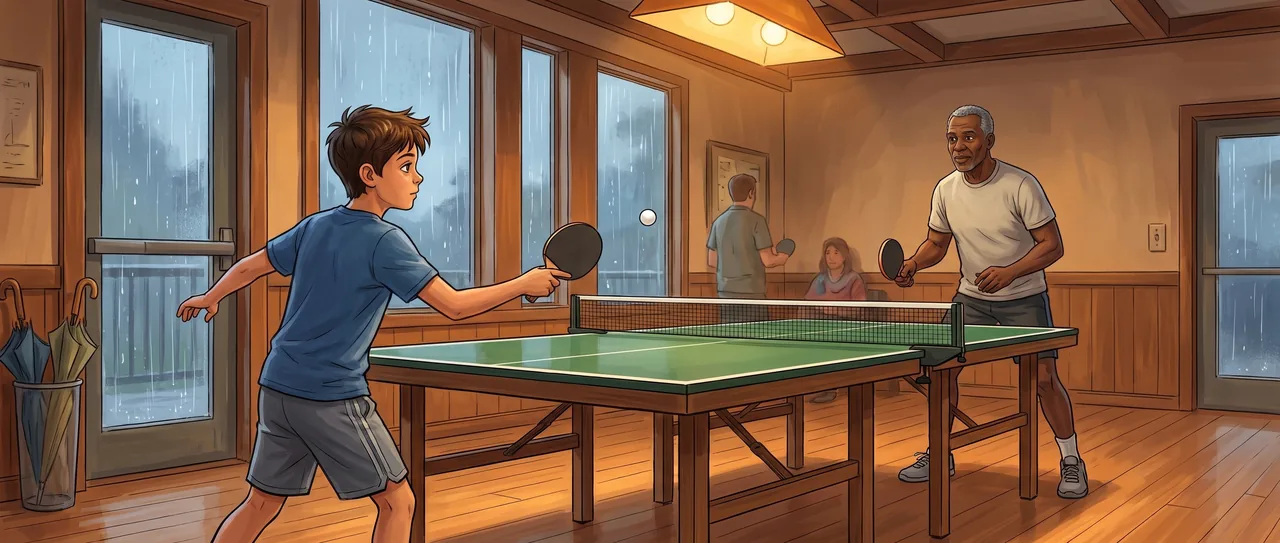
The Part of Him That Already Knew
The ball came at Soren's face and his arm did something without asking him.
It was a good something. The paddle met the ball, the ball dropped over the net, and the old man across the table nodded once, like Soren had passed a small test he didn't know he'd taken.
"Again," said the old man. His name was Mr. Okafor and he ran the Tuesday ladder. He had a way of sending the ball back at exactly the same spot every time, tock, tock, tock, so that Soren's arm could learn it.
That was the thing. Soren's arm was learning it. Not Soren.
He noticed this the way he noticed most things, by noticing something was wrong. When he thought about the return, when he actually watched the ball and told his hand where to go, he missed. The paddle arrived late. The ball skipped off the edge and rolled under the radiator. But when he let his eyes go soft and thought about nothing, about the rain on the high windows, his arm handled it fine.
He stopped. He picked the ball off the floor and held it.
"Do it wrong on purpose," he said.
"What?"
"Tell me before you hit it. Say left or right. So I know where it's going."
Mr. Okafor shrugged. He served. "Left."
Soren knew it was going left. He aimed for it. He was ready. And his arm, given all that warning, all that careful conscious steering, sent the ball into the net.
"Right," said Mr. Okafor.
Soren thought right, went right, and missed again.
"Now stop telling me," Soren said. "Just hit it."
Tock. Soren wasn't ready. Soren didn't know. And the ball came back clean over the net.
He stood there with the paddle hanging from his hand. Something had reversed itself. Knowing made him worse. Not-knowing made him better. That was backward. That was completely backward from how everything else in his whole life had ever worked.
"You're overthinking," Mr. Okafor said, in the bored voice adults use for things they believe are settled. "Everybody does at first. You have to let your muscles remember."
Soren rolled the ball across his palm. That phrase sat wrong in his mouth like a word spelled almost right.
"Muscles don't remember," he said.
"Sure they do. That's why you practice."
"No." Soren wasn't arguing to win. He was arguing to find out. "A muscle just pulls. It's a rope. You can pull a rope smart or dumb, but the rope doesn't know anything. If the remembering was in my arm, then telling me left or right shouldn't wreck it. My arm would just do its thing."
Mr. Okafor opened his mouth and then didn't say anything, which for an adult is a kind of listening.
Soren looked at his own forearm. Same arm as an hour ago. It hadn't grown a new part. It hadn't gotten stronger in one rainy afternoon. And yet it was doing something now it couldn't do when he walked in, but only when he got out of its way.
So the learning wasn't in the arm. The learning was somewhere that could be interrupted.
He served the next one himself, softly, and watched what his body did. His shoulder set the angle before he'd decided anything. His wrist adjusted a hair. All of it happened under the floor of his attention, in some basement of himself he had never been allowed to visit. The front office, the part of him that thought in words and knew his own name, was up on the top floor telling the ball where to go and getting it wrong every single time.
And when he shut the front office down, the basement ran the whole building better than he ever had.
"There's a part of me," Soren said slowly, "that already knows how to do this. And it's faster than the part that's me."
"That's a funny way to put it."
"It's not funny." He wasn't upset. He was somewhere past upset, out in the open where the air was thinner. "When you say left, the me part hears it and grabs the controls. And the me part is slow. It has to think each thing in order. Watch, decide, move. By the time it's decided, the ball's gone. But the other part doesn't think in order. It already has the whole move packed up, like one word instead of a sentence. It just plays the word."
Mr. Okafor was leaning on the table now, not serving, watching Soren the way you watch weather change.
"That's why the good players look asleep," Soren said. "You always say the good ones look calm. They're not calm. They've got the front office turned off. They handed the whole thing to the basement a long time ago."
He thought about every kid who had ever told him to stop thinking so much, stop asking why, just do it. He had always heard it as an insult, a door being shut on the exact part of him that was most himself. Now he turned it over and it wasn't a door at all. It was two rooms. The asking room and the doing room. Both of them his. He'd just never noticed the second one because it worked best when he wasn't looking.
Everybody had that basement. Every person walking around had a whole silent expert down there, running things faster than the person could think, packed with thousands of moves so old and so practiced they didn't feel like knowledge anymore. They felt like nothing. They felt like just being able to walk.
"Serve to me," Soren said. "Don't tell me where."
Mr. Okafor served. Soren did not watch the ball, exactly. He let his eyes go soft and thought about the rain.
His arm woke up before he did. The paddle met the ball. The ball went over. And Soren, standing in his own body, felt for the first time the size of the stranger who lived there with him, patient and quick and already, always, quietly at work.
Read the interactive version, listen to the narration, and earn a gold star →
A science-verified short story for curious kids · Curiosity Land