The Ocean With No Sky
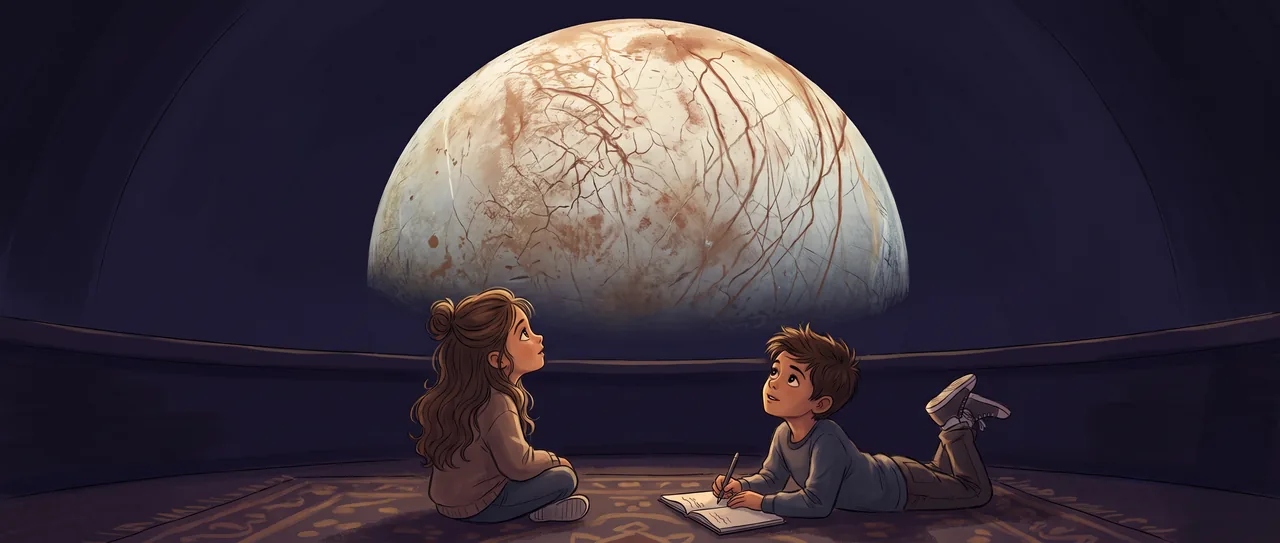
The projector had frozen on a single moon. Cream and rust colored, cracked all over like a dropped egg somebody had tried to glue back together.
"She said she'd be five minutes," Soren said. The guide had gone to find someone who understood the machine. The rest of the class had drifted to the lobby for the gift shop.
Maya lay flat on her back on the carpet, looking straight up at the stuck moon. "Those cracks are wrong."
"Wrong how?"
"They don't go anywhere. On a rock they'd start somewhere and stop. These just keep going around." She traced one with her finger in the air. "Like the whole surface got pulled and then let go."
Soren sat down beside her and opened the folded pamphlet from the front desk. "Europa. Says the surface is ice."
"Ice on top of what?"
He read down the little paragraph. Then he read it again, slower, because the number in it did not want to fit in his head. "It says under the ice there's an ocean. Liquid water."
"How much."
"Twice as much as all the water on Earth. All of it. Every ocean we have, doubled, and then that's what's under there."
Maya was quiet. Then she said, "It's freezing out there. Jupiter's way past the part of space where the sun does any good. Water should be a rock too."
"That's what I don't get." Soren pulled his notebook out of his jacket and clicked the pen. He wrote the word twice and underlined it. "Cold enough to be frozen solid. But it isn't. So something's keeping it warm."
"Not the sun."
"Not the sun. Too far."
Maya rolled onto her side and looked at the cracks again from this new angle. "Squeeze something enough and it heats up. Bend a paperclip back and forth, the bend gets hot."
"You can't squeeze a whole moon."
"Jupiter can." She sat up. "Look how big it is next to the moon in the picture. That's a huge amount of gravity. And Europa goes around it, so sometimes it's closer and sometimes farther."
Soren followed the thought out loud, which was how they did it, one of them a step ahead and the other checking the ground was solid. "So when it's close, Jupiter pulls harder. Stretches the moon a little. When it's far, it relaxes."
"Every time it goes around. Squeeze, let go. Squeeze, let go."
"Bending the paperclip." He wrote tidal heating in the margin, though he was guessing at the name. "The whole moon is the paperclip. And the bending makes enough heat to melt an ocean under there and keep it melted."
"For how long?"
"As long as it keeps going around Jupiter. Billions of years, probably." Soren stopped writing. "That's the part."
"What part."
"On Earth, the ocean gets its warmth from the sun. Light comes down, water gets warm, things live in the light. That's the whole rule. Down here you need the sky." He looked up at the frozen picture. "Up there the ocean has no sky at all. Miles of ice on top. It's completely dark. Forever dark. And it's warm anyway, from being squeezed."
Maya stood up so she could see the whole moon at once. "So everything we ever figured out about where warm water comes from is only the rule for here."
"Only for here," Soren said.
They both looked at the ceiling. The moon hung there, cracked and patient, not knowing it was being figured out.
"There's no way to get a boat down through miles of ice," Maya said. "So how would anyone ever know what's in it."
"The cracks." Soren said it and then understood why he'd said it. "You said the surface got pulled and let go. If it's cracking, then sometimes the water underneath comes up through the cracks. It'd freeze the second it hit the top. But it came from down there. You wouldn't have to go through the ice. You'd just wait for the ice to hand you a sample."
Maya turned to him with the whole delighted look on her face. "The ocean brings itself up to the surface."
"Some of it. A little. Through the cracks I said didn't go anywhere." He wrote that down too, fast, pressing hard.
"So a machine could land on the ice, way out there past the sun, and scoop up frozen water that was ocean a week ago," Maya said. "And find out what's living in a place that never once had light."
"If anything's living."
"If anything's living." She said it the same careful way he had. "But warm water and billions of years. On Earth that's the whole recipe. Warm dark water near the bottom, no sun, and things live there anyway. There are creatures in our ocean that never see light."
Soren looked back at the moon. "So the one thing everyone thought you needed. The sun. The sky. Maybe you don't need it. Maybe there's a whole ocean out there twice the size of ours, in the dark, warm from being squeezed, and it's been there longer than fish."
"And nobody's looked."
"They're going to." He knew this from the pamphlet, which said a spacecraft was on its way. "There's a thing flying there right now. To look at exactly this."
Maya pressed both hands to the top of her head like she was keeping it on. "It's already going. While we're lying on a carpet."
The projector clicked. Somewhere behind the wall the guide had found the right button. The frozen moon shivered, and the whole ceiling of stars swung back to life around it, and the little rust colored world began, very slowly, to turn.
Neither of them looked at the stars. They watched the cracks come around the edge of the moon and go over the top and disappear, carrying whatever the ocean had handed up, into the light for one moment and then back into the dark.
Read the interactive version, listen to the narration, and earn a gold star →
A science-verified short story for curious kids · Curiosity Land