The Grass That Breathes Underwater
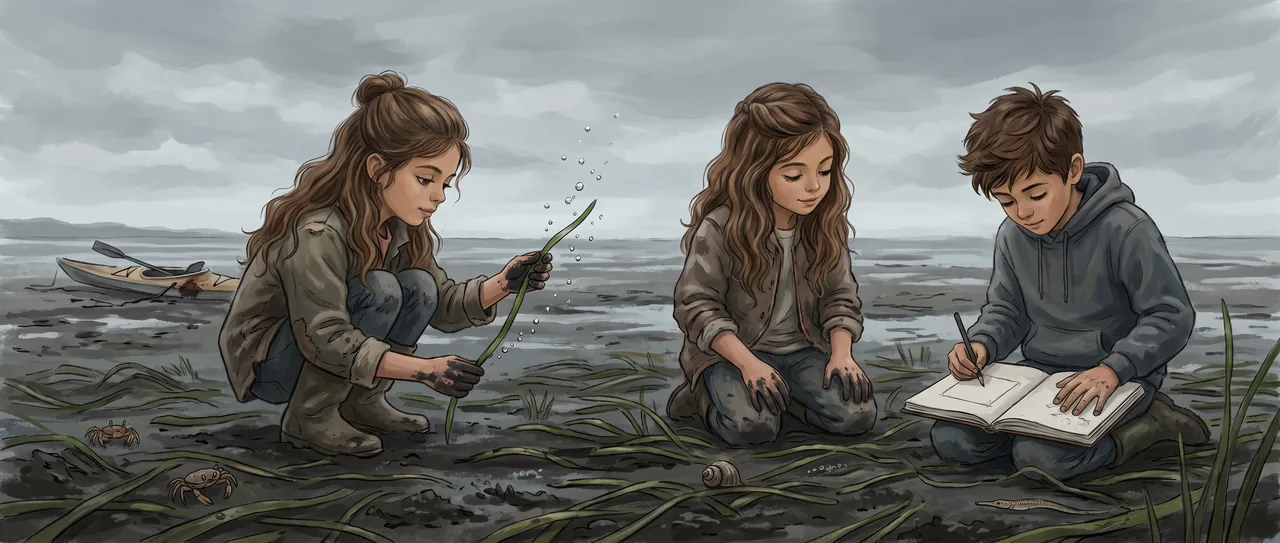
The mud sucked at Maya's boots with a sound like the flat was kissing them goodbye. She and Soren had the busted kayak between them, one handle each, dragging it across the low-tide shallows toward the truck her aunt had parked up on the road.
The shortcut ran straight through the grass.
Not lawn grass. This grass lay flat and dark and dripping, long green ribbons combed all one direction by the tide that had gone out an hour ago. It squeaked underfoot. When Maya stepped on it, tiny bubbles climbed up out of the mud around her boot and popped at the surface.
"Wait," she said, and dropped her handle.
Soren felt the kayak jerk. He set his end down too. "What."
"It's fizzing."
He crouched. Where the eelgrass blades lay against the mud, silver beads clung to them, whole strings of them, catching what little light there was. When he pressed a blade with one finger, a fresh bubble swelled out of the leaf itself and wobbled loose.
"That's coming out of the plant," he said. "Not the mud. Out of the leaf."
The smell down here was green and salt and something older underneath, like the inside of a jar that had been closed a long time. Maya put her whole hand flat into the grass and it was warmer than the water around it, warmer than the air. A crab the size of her thumbnail shot sideways across her palm. Then another. She looked closer.
The grass was crawling.
Not the blades. Everything between them. Pipefish thin as shoelaces threaded through the stems. A snail with a shell like a tiny turban plowed along one leaf. Something with too many legs backed into a hole. In one square of grass no bigger than a dinner plate there was more moving and hiding and eating than Maya had seen in the whole open flat behind them, which was just mud, just brown, just nothing.
"Soren. Count."
He was already counting. He'd stopped saying numbers out loud and gone quiet, and then he said, "I lost count at forty. Different kinds. In here." He held his hands apart, plate-sized. "That's more than the whole tide pool at camp."
The bubbles kept rising. Maya watched one leaf send up a bead, then another, steady, like the plant was exhaling on a schedule. She knew that mud in shallow water was supposed to be a dead zone, a stink of rotten egg gas when you dug in it. She'd dug in it. But her warm hand was resting on the opposite of dead. This patch was breathing out.
"It's oxygen," Soren said slowly. "The bubbles. It's photosynthesis, it's making oxygen even now, even under the clouds." He looked at the strings of silver running off into the grass in every direction. "There's a lot of it. That's a lot of breathing for a plant everybody walks over."
Maya stood up and looked at the meadow properly for the first time. It wasn't a patch. It ran out past the stranded kayak, out past where the water started again, a dark green field going under the sea and not stopping. The clouds sat low. The water was gray. And under the gray, this.
"My aunt said they're going to dredge here," Maya said. "For the new dock. She said it's just eelgrass. She said nobody's going to miss a bunch of underwater weeds."
Soren pulled his notebook out of his jacket, and his cold fingers left damp prints on the page as he drew the plate-sized square and made little marks for every animal he could still see moving in it.
"Feel the mud," he said without looking up. "Under the grass. Push your fingers in."
Maya pushed. The mud between the roots was black, blacker than the mud out in the open flat, and it did not smell like rot. It smelled like nothing. Like it was holding its breath. Her fingers came out coated in it, and the black stayed on her skin, heavy, packed tight.
"It's different here," she said. "The mud's different where the grass is."
"The grass is putting things down there," Soren said. "Every leaf that dies, it goes into that black stuff and it just. Stays. It doesn't rot back into the air like leaves in the woods. The mud swallows it and keeps it." He looked at the black on her fingers, then at the meadow going out under the sea, and Maya watched him do the multiplication behind his eyes, one plate at a time, out and out and out. "How long has this meadow been here?"
"Aunt Ro said her grandmother swam here."
"Then some of what's in this mud is a hundred years old. Two hundred." He was gripping the pencil hard. "It's not weeds. It's a warehouse. It's been packing away carbon under here since before anybody built a single dock, faster than a forest does it, in the dark, where nobody looks, and nobody wrote it down."
He looked up at her.
"Nobody wrote it down," he said again, quieter, and Maya heard the whole shape of it, the meadow that fed everything and breathed for everything and buried the sky's worst mistakes, and got left off the list because it lived where people don't put their eyes.
A bubble popped by her boot. Then three more, all along the leaf, a little run of them, the grass breathing out under the flat gray water like it had every single day for two hundred years whether or not one person on earth was crouched in the mud watching.
Maya looked back at the road, where the truck was, where the dredge would come.
"When does Aunt Ro get here."
"Twenty minutes."
Maya crouched back down and put both hands into the warm crawling green and lifted one blade so the silver strings of oxygen ran off it and up.
"Then we count all of it," she said. "Every kind. We hand her the list."
Soren turned to a clean page. Out past the kayak, the tide had begun, very slightly, to come back in, and the whole dark meadow lifted and stirred and began to stand up under the returning water.
Read the interactive version, listen to the narration, and earn a gold star →
A science-verified short story for curious kids · Curiosity Land