The Cave That Kept the Letters
The exhibit was not open yet. A woman in a raincoat was arguing with a projector, and the projector was winning.
"It's supposed to loop," she said, mostly to herself. "Look at the bone and it plays the animation. That's the whole idea."
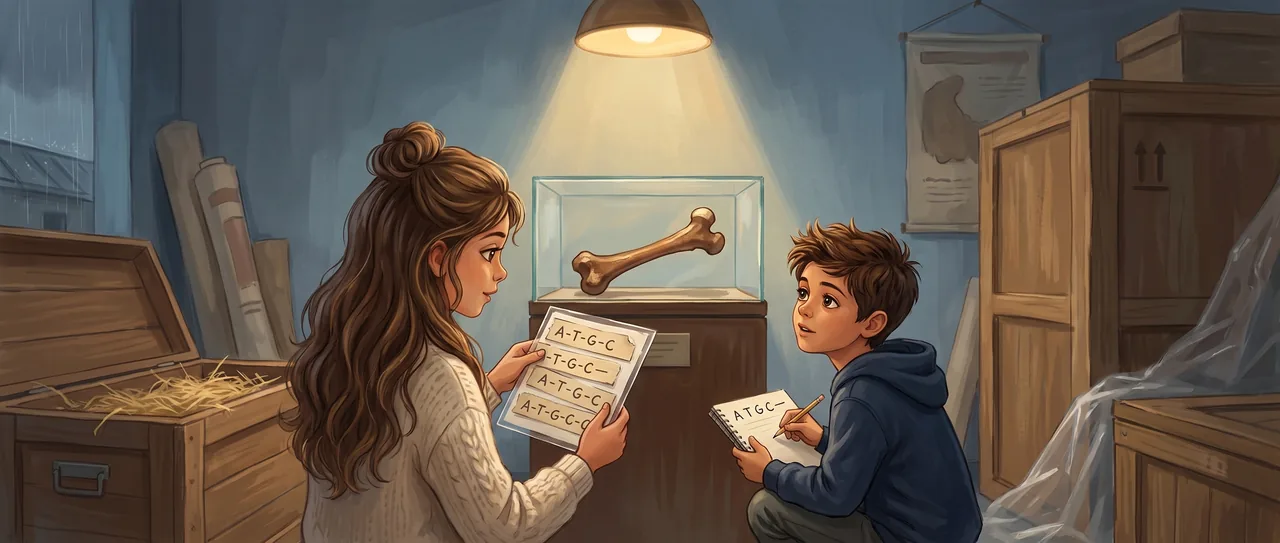
Maya was already looking at the bone. It sat in a case under a spotlight, brown and heavy, a thigh bone from something that used to walk.
"Four hundred thousand years," Maya read off the little card. "That's the oldest one on the table."
"That can't be right," said Soren. He crouched to read the same card. "DNA falls apart. My science teacher said it's like a message written in sand. The tide gets it."
"So how'd they read this one."
"They didn't. That's my point." He tapped the glass. "There shouldn't be anything left to read."
The woman gave up on the projector and came over, wiping her hands. "You two waiting for someone?"
"We're waiting for the rain," said Maya. "He says the DNA should be gone."
"He's mostly right," the woman said. She had a name tag that said GENE LAB, which turned out to be her name, Jean Labbe, badly printed. "Warm places, the message is gone in a few thousand years. Gone gone. But this one came out of a cave. Deep in a mountain in Spain. A cold, wet pit at the bottom of a cave system."
Soren sat back on his heels. "Cold slows it down."
"Cold and dark and steady. No sun. No seasons really, that far down. The bone sat in a refrigerator for four hundred thousand years and nobody opened the door."
Maya was quiet. Then she said, "So the letters are still there. Just torn up."
"Torn into tiny pieces," Jean said. "Millions of them. Shorter than a word."
"Then how do you read a book that's been torn into confetti," said Soren, and it wasn't a challenge, it was a real question, the kind he liked.
Jean grinned and pulled a laminated sheet out of a crate. On it were columns and columns of letters, A and T and G and C, in overlapping strips like torn paper.
"You find where the pieces overlap," she said. "One piece ends with the same letters another piece begins with. You slide them together. Do that a few billion times with a computer and the book comes back."
Maya took the sheet. She read one strip, then found where it matched another, and her finger moved without her deciding to move it.
"It's the same trick you use when a puzzle piece is missing," she said. "You look at the ones next to the hole."
"That is exactly the trick," Jean said. "You are describing a whole building full of scientists."
Soren had his notebook open. His pencil went down the columns, tracking one overlap, then the next. He stopped.
"Wait," he said. "When you put the book back together. What if it doesn't match any book you have."
Jean stopped smiling, but in a good way, the way you stop smiling when someone gets to the real thing.
"Say that again," she said.
"You've got the bone," Soren said, slower. "You know what old bones look like. There's a list, right, of the kinds of people and almost-people that used to be around. Neanderthals and us and the others. So you put the book back together and you go check the list and you find the match."
"Usually," said Jean.
"But what if the book doesn't match anybody on the list."
The rain got loud on the roof and then quiet again.
"That happened," Jean said. "Not with this bone, but with others. Cold caves in Siberia. They put the book back together and it did not match the fossils. It did not match anybody anyone had ever dug up. There was a whole kind of people that nobody had a skeleton for. No skull. No jaw. Just the letters in a fingertip bone, and the letters said: someone was here, and you never found them."
Maya looked up. "You mean the bones ran out before the people did."
"I mean," Jean said, "the fossils only saved a few of them. But the letters got copied into everyone who came after. Some of those letters are still inside living people. Right now. In you, maybe. A whole lineage we would never have known existed, and the only place it survived was written down inside us."
Soren put his pencil flat on the notebook and left it there.
"So there are people," he said, "kinds of people, that we know were real, and we have never seen them. We can't. There's nothing to see."
"There's the message," said Maya. "The message is the whole thing that's left."
She was still holding the laminated sheet, and she held it a little away from herself now, the way you hold something once you understand it's a letter and not a diagram.
"That's what got me into this," Jean said. "I was a kid who couldn't stop pulling on threads. Everyone wanted the answer. I wanted the leftover part. The part that didn't fit." She looked at the two of them. "You'd have driven my teachers the same kind of crazy."
Maya was not listening anymore, not really. She was reading down the strips again, sliding one against the next, matching the ends.
"Somewhere in here," she said, "is a person nobody drew a picture of."
"In that particular bone, no," Jean started. "That one matched a known—"
"I don't mean that bone." Maya lifted her eyes to the crates, the ones still nailed shut, the ones from caves they hadn't opened yet. "I mean the ones they haven't read. There's caves all over the world with the door still shut." "There are," she said. "There are thousands."
Soren picked his pencil back up. He didn't write a sentence. He wrote four letters, A and T and G and C, and then he drew a long dash after them, the kind that means the line keeps going and you don't know where.
Outside, the rain stopped. Jean turned back to the projector, and this time when she tapped it, the animation began to loop over the bone, a small bright light going around and around in the dark.
Read the interactive version, listen to the narration, and earn a gold star →
A science-verified short story for curious kids · Curiosity Land