The Cat Who Learned Too Late
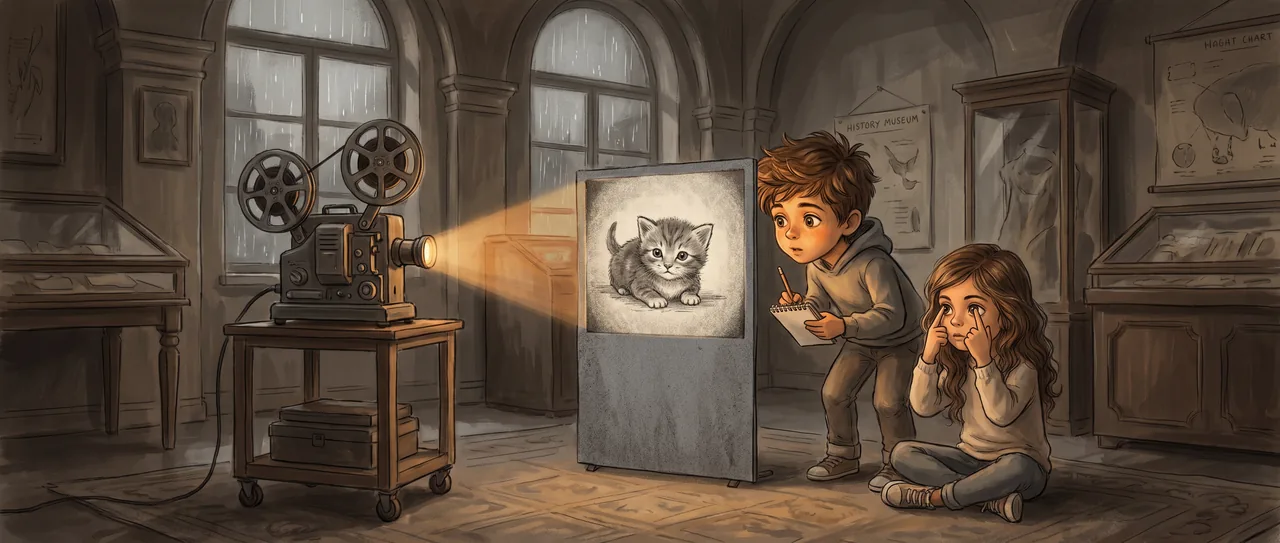
The film was scratchy and gray, and the label under the projector said Vision Research, 1960s. Everyone else had drifted toward the room with the lightning machine. Maya and Soren stayed because the reel showed a kitten.
"It has one eye covered," Soren said. "A little patch, since it was a baby."
The narrator's voice crackled. The kitten was grown now. The patch was gone. Both its eyes were open, both healthy, both pointing at the world.
"So it can see," Maya said.
"Watch," Soren said.
The grown cat walked toward a chair. On the film it bumped the leg of it. Someone waved a hand near the eye that had worn the patch. The cat did not flinch, did not track the hand, did not blink.
"The eye's fine," Maya said. She leaned closer to the little screen. "Look at it. It's clear. It moves. Nothing's wrong with the eye."
"Nothing's wrong with the eye," Soren agreed slowly. "So why can't it see out of it."
The film moved on. Diagrams now, hand-drawn, of a brain sliced thin. Little columns, the narrator said. Ocular dominance columns. Maya read the words on the card taped to the projector stand.
"It says the brain has stripes," she said. "For each eye. Half the stripes for the left, half for the right. Normally."
"Normally," Soren said. "But this cat."
On the screen, a diagram of the deprived cat's brain. The stripes for the covered eye were thin, shrunken, starved. The stripes for the open eye had spread out and taken the space.
"The open eye took the room," Maya said. "While the other one was covered. It just, moved in."
"When the cat was tiny," Soren said. He had his notebook open. His pencil stopped. "But then they took the patch off. Years of the eye being open after that. Years."
"And it never came back." Maya said it flat, the way she said things she already believed and was only now finding the reason for. "The eye works. The eye's been working the whole time. But the part of the brain that was supposed to be its part, that got given away."
"Given away and never given back," Soren said. He wrote something. "There's a window. It says here. A critical period. Weeks. If the eye's covered during the window, the wiring sets one way and it stays."
Maya sat down on the floor in front of the projector. The rain hit the museum's high windows. She was quiet for a second.
"That's not how anything else works," she said finally.
"What do you mean."
"Everything else, you can catch up. You miss a year of soccer, you practice, you get good. You break your arm, it heals. You learn a language late, it's hard but you can." She looked at the shrunken gray stripes. "But this. There's a door. And the door closes. And after it closes, the eye can knock all it wants."
Soren looked at the diagram, then at the film, then back. He was chewing on the idea the way he did, testing where it broke.
"Wait," he said. "That means the brain isn't waiting to see. It's expecting to see. Before the cat even opened its eyes, the brain already had a plan for both of them. Space set aside."
"Blueprints," Maya said.
"Blueprints," Soren said. "And the light coming in is what tells the builders, yes, use this room, keep it. And if no light comes during the building, the builders don't wait around. They take the wall down and use the bricks somewhere else."
Maya turned around on the floor to look at him. "So we all did this," she said.
"Did what."
"This. Us. When we were babies. There was a window and light came in and our brains kept the rooms. We can see out of both eyes because somebody's face leaned over us when we were three weeks old and the light landed and the builders said, keep it." She held up two fingers in front of her own face, one in front of each eye, wiggling them. Both there. Both real. "We passed a test we don't even remember taking."
Soren stopped writing.
"Everybody in this museum," he said. "Everybody in the lightning room. Every single one of them has stripes in their head, split just about even, because the world showed up on time when they were too small to know it."
"And nobody remembers it," Maya said. "It's the most important thing that ever happened to your eyes and you slept through it."
They were both quiet. The film had looped back to the beginning. The kitten was small again, healthy, patch not yet on, both eyes wide and equal, everything still possible.
"That's the part," Soren said. He said it carefully. "That's the part I don't like and can't stop looking at."
"Which part."
"That it's already done. For us. Whatever the window did, it did it. We can't check. We can't go back and see the room being built." He looked at his own hands. "Some things about me got decided before I had opinions."
Maya nodded slowly. She wasn't scared. "Not just eyes," she said quietly. "You know that, right. If eyes have a window, then."
"Then maybe other things have windows too," Soren said. "Sounds. Words. Which way is up."
"Windows we already went through. Doors that already closed. Rooms already built and we're just, living in them. Walking around inside the house of everything the world showed us before we could talk."
The projector clicked and clicked. On the little gray screen the small kitten opened its eyes for the first time and looked, for the first time, into a light that was building it.
Soren leaned in until his face was lit by the film, watching the kitten watch the world back.
Read the interactive version, listen to the narration, and earn a gold star →
A science-verified short story for curious kids · Curiosity Land