The Boot Sequence
The exhibit hall was between school tours, so Soren had it to himself. His mother had said forty minutes. There was a bowl of mints and a wall.
The wall was a timeline. He walked it slowly, the way he read everything, from the left edge toward the right, letting each panel finish before he started the next.
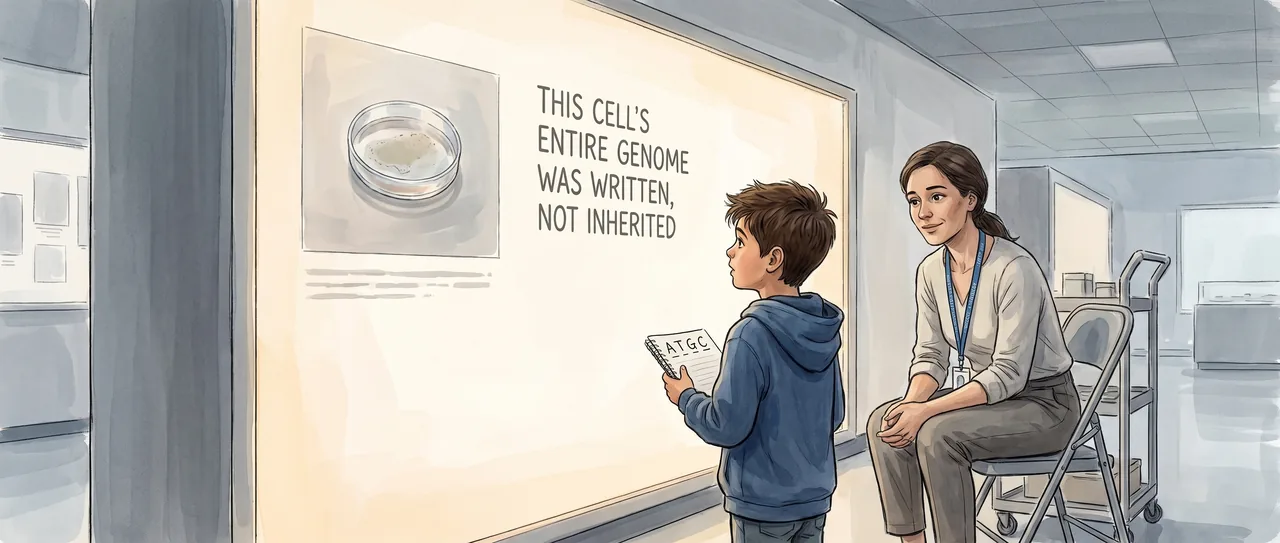
Halfway down was a photograph of a small glass dish. Beside it, a sentence in large letters said: THIS CELL'S ENTIRE GENOME WAS WRITTEN, NOT INHERITED.
Soren stopped.
He read it again. Then he took out his notebook and copied the sentence exactly, comma and all, before he let himself think about what it meant.
There was a woman near the far door, unpacking folding chairs from a cart. She wore a lanyard. She was not looking at him.
Soren read the rest of the panel. The scientists had not found this genome in anything. They had looked up the order of the letters, the A and T and G and C, on a computer. Then they had built the actual molecule in pieces, out of bottled chemicals, stitching the pieces into longer pieces, until they had the whole thing. A complete chromosome. Every instruction a certain bacterium needs to be alive, spelled out and assembled by hand.
Then they put it inside an empty cell, one whose own instructions had been removed.
And the cell started running.
Soren felt the word start snag on something.
He went back to the photograph. It looked like nothing. A smear on a dish. But the panel said the cell had done what cells do. It had eaten. It had split into two. The two had split into four. By morning there were millions, and every one of them was following instructions that, a week earlier, had existed only as text on a screen.
"They wrote it," Soren said, out loud, to no one.
The woman with the chairs looked over. "Sorry?"
"This cell." He pointed. "The instructions came from a computer file."
"That's the idea," she said. She set down a chair. "We call the file the design. The company likes design." She said the word like it was slightly too clean for what it described.
"But the file isn't alive," Soren said.
"No."
"And the chemicals aren't alive. The bottles of A and T and G and C."
"Also no."
"So where does the alive start?"
The woman stopped with a chair half open. "That," she said, "is not on the panel."
Soren looked at the smear in the photograph. He was trying to find the moment. There had to be a moment. Before it, a dish holding an empty cell and a long molecule that was just a molecule. After it, something eating and dividing and building copies of itself.
He worked backward, the way he did when something wasn't behaving right.
The molecule was not alive when it sat in the tube. That was clear. It was a very long word spelled in chemicals, and words do not eat.
The empty cell was not alive either. The panel said its own genome had been taken out. It was a bag of machinery with no instructions, winding down.
So two not-alive things had been put together. And the result was alive.
Soren wrote in his notebook: nobody added the alive. It was not in the file. It was not in the bottles.
He pressed the pen hard on the period.
The machinery in the empty cell had started reading the written molecule. It read it the way it would have read any instructions, because to the machinery there was no difference. Written by a person, inherited from a parent, the letters were the same letters. The machinery could not tell. It had no way to tell. It just read, and building began, and the building included the tools that do the reading, so more reading happened, and it never stopped.
Alive was not a thing you added. Alive was the reading not stopping. "You went quiet," the woman said.
"The cell couldn't tell the difference," he said. "Between instructions a person typed and instructions from an ancestor. It just read them."
"No," the woman agreed. "It can't tell. That's the part that keeps a few of us up at night. In a good way, mostly."
"So every living thing is running instructions," Soren said, slowly, because he wanted to say it exactly. "And nobody was ever there to write the first ones. They just started reading, a long time ago, and haven't stopped."
The woman sat down in the chair she had just unfolded. She looked at him properly now.
"You know," she said, "people come through here all day. They read that panel and they say, oh, we can build cells now, and they think about what we'll make. They almost never say the other thing."
"What's the other thing?"
"That we just proved there's no secret ingredient. That we've been reading the same file every ant and whale and person is reading, and now we can write in it, and the machinery can't tell it's us." She shook her head. "You got there in about six minutes. It took me a graduate degree."
Soren looked down at his notebook, at the line that said nobody added the alive.
He thought about the millions of cells that had woken up overnight in a dish, all of them descended from a sentence someone typed, all of them reading it now without knowing anyone had typed it, without any way of knowing.
"Can I ask you something," he said. "The file they wrote. Did they change anything? Or did they copy it exactly?"
The woman smiled slowly. "Now," she said, "you're asking the question the whole field is asking."
Soren turned the page.
On the fresh sheet he wrote one line, and underneath it he drew four letters in a row, A T G C, and then he left the rest of the page empty, because that was the part nobody had written yet.
Read the interactive version, listen to the narration, and earn a gold star →
A science-verified short story for curious kids · Curiosity Land