The Wrong Way Up the Stairs
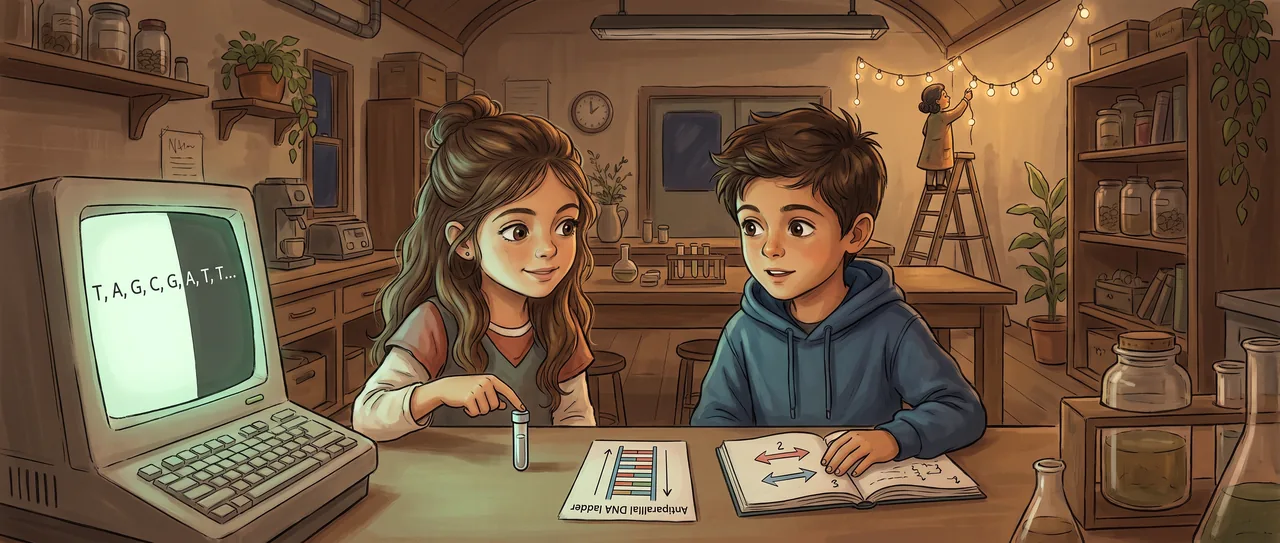
The machine kept saying ERROR: NO TEMPLATE on one half of the screen and printing perfect letters on the other.
"Same tube," Maya said. "Same everything. How can half a thing work and half a thing not work?"
Soren checked the tube again. It was the tomato sample, the heirloom one Ms. Abara had grown out back of the depot. The library let kids run reads on the old bench sequencer as long as somebody supervised, and Ms. Abara counted, technically, even though right now she was on a stepladder untangling holiday lights in July and answering them with the top of her head.
"It's not the tube," Soren said. "Watch. It reads and reads and then it just stops. Like it walked into a wall."
He reset it. The letters marched out again, G, A, T, then a stall, then ERROR.
"It only walks one way," Maya said.
"What?"
"The reader. Look at the good strand. It goes left to right, every time. It never reads right to left. It can't turn around."
Soren pulled the little diagram card the library taped to the bench. Two strands, drawn like a ladder pulled into a spiral. One rail had a tiny five printed at the top and a three at the bottom. The other rail was flipped. Five at the bottom, three at the top.
"They're upside down from each other," he said. "The two rails point opposite ways."
"So if the machine only reads one direction," Maya said, and she went quiet, then fast, "then one rail it can walk straight up. The other rail it would have to walk backward. And it won't. It stalls at the wall."
"Ms. Abara," Soren called, "does DNA have a direction?"
"Everything alive has a direction, sweetheart," she said from the ladder, not turning around. "Ask the machine."
Which was not an answer, and also was.
Soren wrote the two numbers in his notebook, five and three, and drew arrows off them going opposite ways. He tapped the backward one with his pen.
"So the letters are all there," he said. "On both rails. We just can't get at the second rail, because reading it would mean going down the stairs, and the machine only goes up."
"Then don't read the second rail," Maya said.
"It's half the information. We have to."
"No. Listen." She grabbed the diagram. "The two rails aren't random. They're partners. Every A on one side has a T across from it. Every G has a C. If you know one rail, you already know the other. You just have to flip it."
Soren stared at the card. "So the backward rail isn't lost. It's hidden inside the rail we can read."
"But the machine doesn't flip," Maya said. "It's dumb. It only knows how to climb up. So if we want it to read the backward rail the right way up, we'd have to give it a new copy. A copy that runs the other way. A fresh strand built off the backward one, so the fresh one climbs upstairs the direction the machine likes."
They both looked at the little tube.
"That's what the second reagent is for," Soren said slowly. He held up the bottle labeled EXTEND, the one they'd skipped because the protocol was long and Maya had wanted to just push the button. "It doesn't read the strand. It builds a temporary partner. A throwaway copy. Then the machine reads the copy, going up, and we get the backward side."
"We have to unzip it first," Maya said. "You can't build a partner while the two rails are still holding hands. They're wound together. Look, that's the heat step. That's why there's a heat step. It's not sterilizing anything. It's letting go."
Soren flipped back three pages in the protocol to the step they had rushed past. Warm the sample. Let the strands separate. Add EXTEND. He read it out loud and felt the whole thing click into place like a key he'd been holding upside down.
"So it can't just read what's there," he said. "It has to take the ladder apart. Pull the spiral loose. Then copy the side it couldn't reach, and read the copy instead of the real thing."
"It never reads the backward strand at all," Maya said. "Not once. Not ever. It reads a brand new copy it makes on the spot and throws away."
They looked at each other.
"Everything that's ever read that strand," Soren said, "in any cell, in anything alive, had to do this. Unwind it. Copy it. Read the copy."
"Because the real one points the wrong way," Maya said. "Half of you is written in a direction nothing can read straight. So your own cells make a little temporary translation, a million times a second, just to look at their own instructions."
Soren's pen had stopped. "That's in me right now," he said.
"That's in the tomato," Maya said, and almost laughed. "That's in Ms. Abara up the ladder. Half of her can only be read backward, so her body keeps making copies to read forward. She's full of little copies she throws away."
"Are you two going to run it or narrate it," Ms. Abara said, still untangling.
Soren warmed the sample. They watched the tiny window fog, then clear. Maya added one drop of EXTEND and started the count.
The machine hummed. The dead half of the screen, the half that had said ERROR every single time, flickered.
A letter appeared. Then another. Then a whole line of them, climbing, the strand nothing could read finally coming through on the back of a copy that had not existed sixty seconds ago.
Maya put her finger on the tube and felt it, faintly, still warm from letting go.
Read the interactive version, listen to the narration, and earn a gold star →
A science-verified short story for curious kids · Curiosity Land