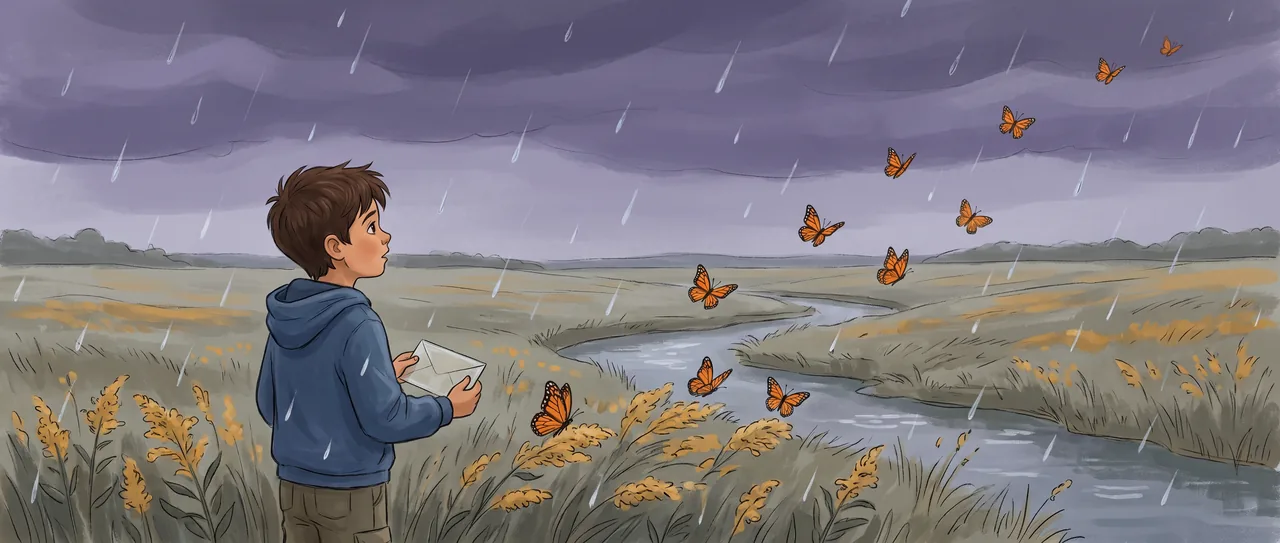
The Wrong Way Home
The little sticker weighed almost nothing between Soren's fingers. It was smaller than his pinkie nail, printed with a code, and it was supposed to go on the discal cell, the flat spot on the underside of a monarch's hind wing. He had already done four. His fingers knew the trick now, how to hold the wings closed and press without crushing.
The butterfly in his hand pumped its wings once, then went still. The morning sun was warm on the back of his neck. When he opened his hand the monarch sat for a second, orange against his palm, and then it went up and slanted away over the goldenrod. Southwest. All morning they had gone southwest, every single one, like water tilting downhill in a direction only they could feel.
Soren had counted. That was the part nobody had told him to do. The clipboard only asked for the tag code and the time. But he had started writing an arrow next to each one, and every arrow pointed the same way, down and to the left, toward Mexico, four thousand five hundred kilometers of it, to a forest most of these butterflies' great-great-grandparents had left in the spring.
He pressed his thumb to his notebook and drew another arrow.
"They're using the sun," said the woman running the station. Her name was Priya and she had a net and a sunburn and a coffee she kept forgetting to drink. "Sun compass. They keep the sun at the right angle and just fly." She said it the way you say something you have said two hundred times.
Soren looked at the sun. It was climbing. By afternoon it would be way over on the other side of the sky.
"But the sun moves," he said.
"Mm," said Priya, already netting another one.
"If they just kept it at the same angle, they'd curve. They'd fly in a circle as the sun went around." He watched a monarch launch off a thistle. Southwest. It was afternoon-ish now and the sun had swung a good distance and the butterfly still went southwest, exactly, stubbornly, the same as the eight-o'clock ones. "They're correcting for it."
Priya glanced at him then. "They've got a clock," she said. "In their antennae, actually. Not their brain. Their antennae keep the time and tell the eyes what angle the sun should be at right now. So they adjust."
Soren stopped moving. The sun on his neck, the clock in an antenna thinner than a thread. A creature the weight of a paperclip carrying a working clock and a working map, correcting the sky for the time of day, the way a sailor corrects for it, except the butterfly had never been taught and had never made the trip before and would never make it twice.
He wrote: clock in the antenna. His pencil pressed too hard and the tip snapped.
That was when the light changed.
It came off the lake first, a shelf of cloud the color of a bruise, and the warmth went off his neck all at once like a hand lifted away. The goldenrod stopped glowing. The whole field dulled. Priya looked up and said a word about the forecast and started packing tubes.
Soren did not pack. He had one butterfly left in a glassine envelope and he had a question standing up inside him with its hair on end.
No sun. The cloud went all the way across now, flat and total, no bright spot anywhere to say where the sun even was. He couldn't have found it himself. He turned in a slow circle looking and there was just gray, gray, gray, the same in every direction.
If the compass was the sun, and the sun was gone, then the butterflies should be lost. They should mill. They should scatter and wait for the clouds to clear like everybody else.
He opened the envelope.
The monarch crawled onto his knuckle, opened, closed. He held his breath. Around him a few others were still going up off the flowers, launching into the flat gray light, and he made himself watch where they went instead of watching his own one.
Southwest.
Under no sun at all. Under a sky that told them nothing, they tilted the same way as the eight-o'clock ones, the same as the noon ones, down and to the left toward a forest they had never seen. His own butterfly left his knuckle and joined them, a small orange chip sliding off into the gray on exactly the same line.
Soren's skin went cold in a way that had nothing to do with the wind.
"They can't see the sun," he said out loud.
Priya was zipping a bag. "Cloudy days they switch," she said, not unkindly, the way you hand a fact to someone whose hands are already full. "Magnetic. They can feel the Earth's field. Backup compass. Same heading either way."
Backup compass. Soren stood in the gray field with the wind pushing the goldenrod flat and felt, for one whole second, the thing the butterflies were feeling. Not the wind. The other thing. The pull that ran through him too, through his shoes and the soil and the rock under the soil, the field the whole planet was sitting inside, that he had never once felt in his life and never would, and that a butterfly the weight of a breath was reading like a road sign.
He had thought he was the one paying attention. He had counted arrows nobody asked for. And the whole time, every butterfly in the field had been paying attention to something he couldn't even detect, something enormous and everywhere, reading two different skies and picking whichever one was talking.
The first rain hit his forearm, one fat cold drop.
He looked down at the last empty glassine envelope in his hand and then out at the gray, where the orange chips were still going, still tilting, all of them, southwest into the coming storm, sure of the direction the way he was sure of the ground.
He turned himself until he was facing the same way they were. He couldn't feel it. He stood there in the rain facing southwest anyway, into nothing he could see, the way the butterflies did, and let the drops come down on the front of him instead of the side.
Read the interactive version, listen to the narration, and earn a gold star →
A science-verified short story for curious kids · Curiosity Land