The Weight of Burning
There was a box labeled PHLOGISTON in careful old handwriting, and inside it was nothing but a rusted iron nail, a candle stub, and a note.
"It's empty," Maya said. "The box, I mean. Except the junk."
Soren picked up the note and read it out loud. "If burning releases phlogiston, why does the ash weigh more? Signed, a very annoyed student, 1952."
"What's phlogiston?"
"I think it's a thing that isn't real," Soren said. "People used to believe fire was a substance. Like, hiding inside wood. And burning let it escape into the air."
Maya turned that over. "So the wood was full of fire the whole time."
"That was the idea. Everything that burns has phlogiston in it. When it burns, the phlogiston leaves. That's why the fire looks like it's flowing out of things."
"Okay." Maya was already looking around the carriage house. "So a burned thing should weigh less. Because a part of it flew away."
"Right. That's the whole theory. Fire is a leaving."
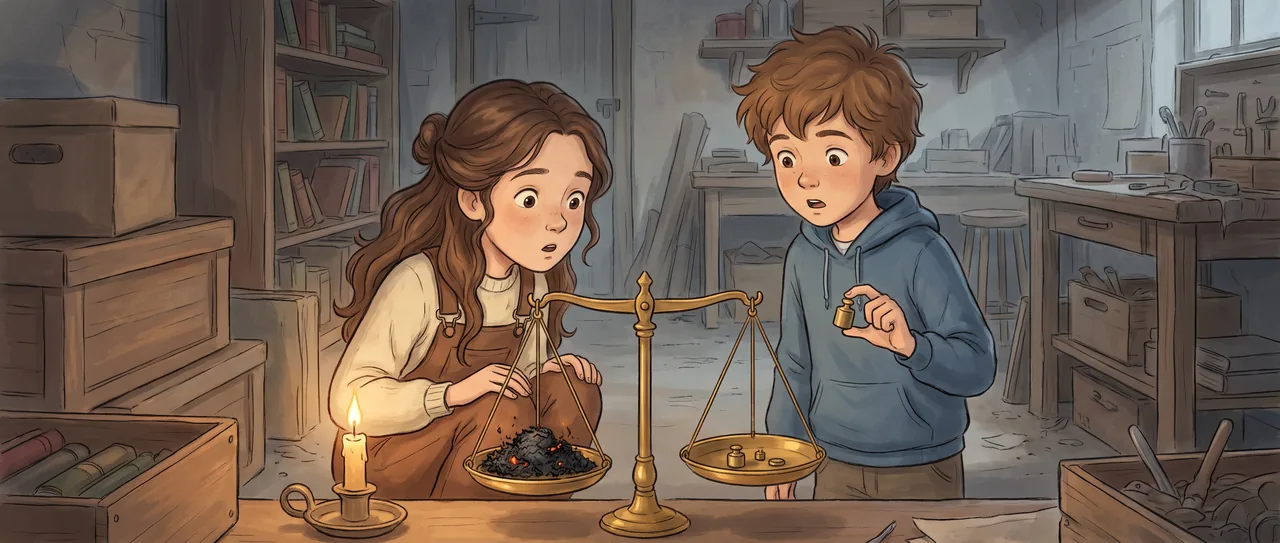
She found the balance on the far bench, a beautiful brass thing with two pans, still level. Beside it were tiny weights in a felt tray, and a coil of steel wool, gray and soft as a cloud.
"The nail's already rusted," she said. "Rust is slow burning. My dad says that. Same thing, just slow."
Soren looked up. "Is it?"
"It's oxygen doing something to metal. Fast is fire, slow is rust." She wasn't sure why she was sure. She just was. "Let's weigh the steel wool."
They balanced a small wad of steel wool against the little brass weights until the two pans hung even. Soren wrote the number down. Then Maya lit the candle stub and held the flame under the steel wool, and the gray strands caught, glowing orange, crackling, tiny sparks running through it like a city seen from an airplane.
"There it goes," Soren said. "There's your leaving. It's burning. Phlogiston is flying out right now, supposedly."
"So it should get lighter." Maya blew out the candle. The steel wool had gone dark and brittle and crumbly, half of it turned to a black crust. "Put it back on the balance."
Soren set the burned wool gently in its pan.
The pan sank.
They both looked at it.
"That's wrong," Soren said.
"That's the note," Maya said. "That's exactly the note."
Soren added weights to the other side, one tiny brass disc after another, until the pans hung even again. He stared at the total. "It got heavier. It burned and it got heavier."
"How does a thing get heavier by losing something?"
"It doesn't. That's the point. It can't." Soren's hands were still. Then he said, slowly, "So nothing left. Something arrived."
Maya crouched down until her eyes were level with the pans. "Something came out of the air and stuck to the steel."
"The air," Soren repeated.
"When it was burning. Something in the air came and grabbed onto the metal and it weighs something and now it's part of the wool." She was talking fast now. "That's why the pan went down. The fire wasn't a leaving. It was a joining."
Soren picked up the note again and looked at it like it was a face. "The student in 1952 knew. They asked the exact right question. Why does the ash weigh more."
"And nobody answered them."
"Somebody did." Soren was already thinking backward. "A long time before 1952. There were people who believed in phlogiston their whole lives. Smart people. Famous people. And the whole time the balance was sitting right there telling them the opposite, if they'd just weighed it."
"Did nobody weigh it?"
"They did. They saw metal get heavier when it burned. And they decided phlogiston had negative weight." He almost laughed. "They'd rather invent a thing that weighs less than nothing than say the air was doing something."
Maya sat back on her heels. "Because you can't see it. The air is just air. It's nothing. Who looks at nothing and thinks, that's the ingredient?"
"Someone did, eventually. They figured out the air isn't one thing. It's a bunch of gases mixed together, and one of them is the part that burns things. The part that joins." Soren wrote the word oxygen and then set the pencil down. "They had to invent the whole idea of what a substance even is. That things are made of a small number of real pieces that join and come apart. Before that, fire was a ghost hiding in the wood."
Maya looked at the dark crumbled wool in the pan. "So every fire is the air feeding on something."
"Or something feeding on the air. Depends how you look."
"And rust is the slow version. And the nail." She held up the rusted nail. "This is heavier than it started too. This nail has been eating the air for a hundred years."
Soren took the nail and set it in the empty pan of the balance, just to watch the arm dip under a hundred years of air.
"There are people right now," he said, "who believe something as wrong as phlogiston. And it feels completely obvious to them. And the thing that proves them wrong is probably sitting on a bench somewhere, level, waiting for somebody to put it on a scale."
Maya was very still. Then she said, "That's the part that gets me. Not that they were wrong. That being wrong felt exactly like being right."
"You couldn't feel the difference from the inside."
"No." She looked at the balance, at the two brass pans, the one holding a hundred years of invisible air. "So the only way to know is to weigh it."
Soren nodded. He picked up the little iron weights and the felt tray and the note that said very annoyed student, 1952, and put them back in the box marked PHLOGISTON, because that was where they belonged, in the box named after the answer that turned out to be wrong.
Maya lit the candle again. She held her hand flat above the flame, not close enough to burn, feeling the warm column of air rise past her fingers, air that was pouring itself into the fire even now, silently, giving up its invisible weight to the light.
The candle flame leaned toward her palm and steadied, drinking the air she couldn't see.
Read the interactive version, listen to the narration, and earn a gold star →
A science-verified short story for curious kids · Curiosity Land