The Two Grandmothers
The two women in the photographs were the same woman.
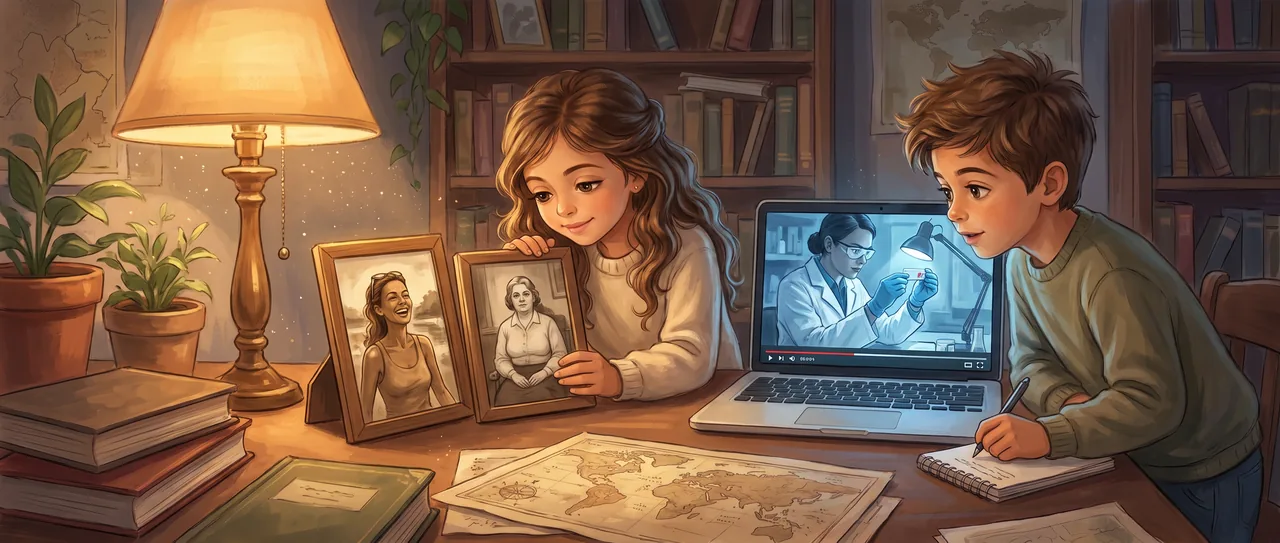
Maya held them side by side under the desk lamp. Same nose. Same gap between the front teeth. Same way of tilting the head, like listening to something behind you.
"That's your great-aunt Rosa," Soren said. He read the little brass plate on one frame. "And that one says Ines."
"Twins," Maya said. "Mom told me. Identical." She put them down flat on the desk, next to each other, and frowned. "But look."
Soren looked. In one photo the woman was thin and brown from the sun, hands rough, laughing with her mouth wide. In the other she was heavier, paler, sitting very straight in a good chair, not quite laughing.
"They got old differently," Soren said.
"Everybody gets old differently."
"You just said they were identical."
"They were." Maya tapped the two glass fronts. "That's the part that doesn't fit. Same everything. Same instructions. So why two different women?"
On the laptop, the paused documentary showed a frozen frame of a scientist holding a glass slide up to a light. A subtitle hung under her chin: identical at birth. Maya reached over and pressed play.
The scientist's voice came back on, mid-sentence. "...begin their lives with the same DNA, letter for letter. Every gene, the same. And yet by the time identical twins reach fifty, we can measure real differences between them. Not in the letters. In how the letters are read."
Soren leaned in. He had his notebook open already, the pen moving. "Read," he said. "She said read. Not changed."
"What's the difference?"
He thought about it. "A book," he said slowly. "Two people have the exact same book. Same words on every page. But one person dog-ears half the pages and crosses things out and leaves other chapters shut so long they get stuck. And the other person reads it totally differently."
"So the book is the DNA," Maya said.
"And the dog-ears are something else. Something on top."
The scientist was saying the word now. Epigenetic. Little chemical tags that sit on the DNA without changing the letters. Tags that tell a cell which genes to switch on and which to keep quiet.
"On top," Maya repeated. "Epi means on top of." She picked up Rosa again, the thin laughing one. "So where do the tags come from? If it's not in the book."
Soren checked his notes. "She said it's what you eat. Where you live. What you breathe. What happens to you." He looked up. "Your life puts them there."
Maya went very quiet, and then she said, "So the twins wrote on themselves."
"They didn't do it on purpose."
"No. Their days did it." She set the photo down. "Every day Rosa was out in the sun and Ines was inside in the good chair. Every meal. Every worry. Every one of them left a little mark. And you can't see any single mark. But after fifty years of marks you get two different women out of one set of instructions."
Soren stopped writing.
"What," Maya said.
"I always thought it was decided," he said. "The DNA. Like, this is you, printed, done. My mom says I get my stubbornness from my dad's whole side, like it came in the box."
"Maybe the box just came with a lot of pages," Maya said. "And you're the one deciding which ones to dog-ear."
They both looked at the two grandmothers.
"Wait," Soren said. "If it's the tags and not the letters, then the tags can be different tomorrow than they are today. The letters can't. But the tags."
"The tags are still happening," Maya said. "Right now. Sitting here. This afternoon is going onto us somewhere."
The documentary had moved on. The scientist was talking about a study of twins, one who exercised and one who didn't, and how after years you could read the difference in their cells, in the tags, in which genes had gone quiet and which had woken up. Same genome. Different music coming out of it.
Maya reached over without looking and paused it again. She was staring at the photographs.
"Here's the part I can't get past," she said. "At the very beginning, in the hospital, on day one, there was no way to tell them apart. Not even under a microscope. Not even in the DNA. There was no Rosa and no Ines yet. There were just two babies with the identical book."
"And then life read them," Soren said.
"And they became different people the whole rest of the way down." Maya put her finger on the glass over Rosa's wide laugh, then moved it to Ines sitting straight in the chair. "You could stand here on day one and you would have no idea which one was going to end up laughing like that. Nobody would. There's no test for it. It hadn't been written yet."
Soren felt the study get quiet around him, the reunion noise far off through the wall, aunts and cousins somewhere down the hall.
"That's kind of huge," he said. "Everyone downstairs thinks they know who they are. Set. Finished. And the whole time there are these little tags going on and coming off, all day, and nobody feels a single one."
"I like that they're identical," Maya said. "That's the good part. It means the difference isn't the book. Two people can have the exact same book and one of them still gets to be the sun one."
Soren wrote sun one in the notebook and then stopped, because he didn't want the pen to be the thing that was moving.
Maya stood the two photographs upright again, side by side, facing each other, so the two grandmothers looked across the desk at the women they hadn't turned into. Then she blew the dust off the top of both frames in one breath, and it lifted and drifted and settled, most of it, back down.
Read the interactive version, listen to the narration, and earn a gold star →
A science-verified short story for curious kids · Curiosity Land