The Bird That Kept the Sound
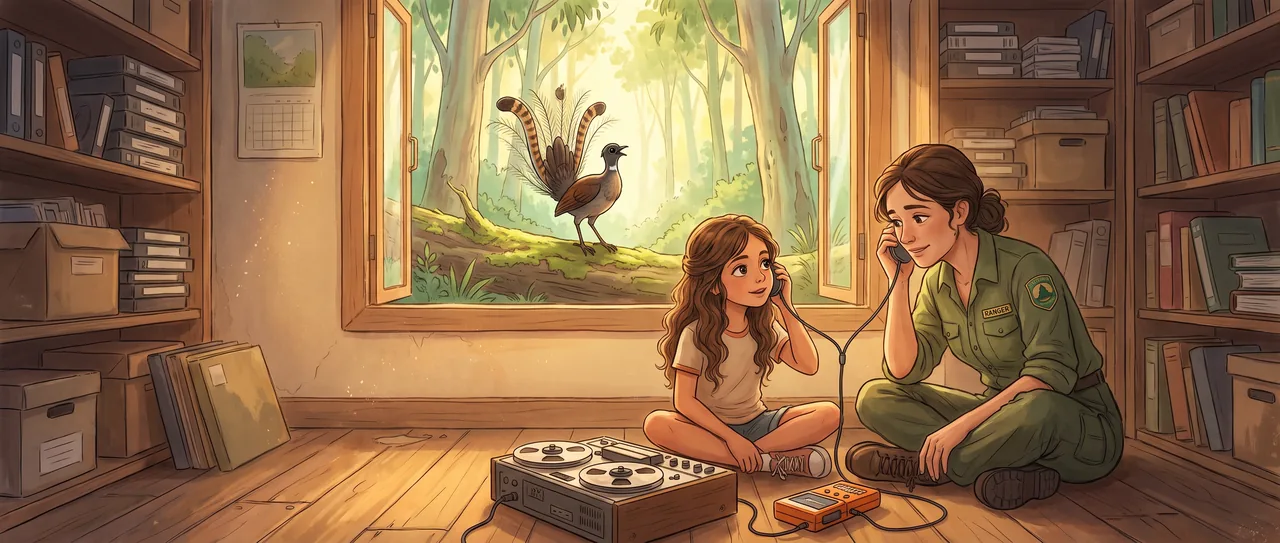
The tape hissed for a while before anything happened. Maya sat cross-legged on the floor of the archive room, one headphone pressed to her ear, the other cupped in her hand, listening to a recording her aunt had made before Maya was born.
Aunt Rosa was at the far desk, labeling boxes, half-listening. She had warned Maya the tapes were mostly nothing. Wind. Rain. A ranger clearing his throat for ten minutes.
But this one had a bird in it.
It started as a kookaburra, laughing the way kookaburras do. Then, without a break, it became a whipbird, that long whistle and the crack at the end. Then two rosellas at once. Then something Maya could not place, a sort of grinding buzz, over and over.
She pulled the headphone off. "What is that? The buzzy one?"
Rosa didn't look up. "Lyrebird. They copy everything. That buzz is probably a camera. Tourists used to stand around clicking at them for hours."
Maya put the headphone back. The bird ran through its list again. Kookaburra, whipbird, rosellas, the camera-buzz. Then a sound like a saw. Then something almost like a human shout, worn smooth, more shape than word.
One bird. All of it was one bird.
She let the tape run to the end and sat with the hiss.
"Can I hear a new one?" she asked. "A recent one. Same place."
Rosa found a small orange recorder in the top drawer. "This is from the same gully. Last spring. I keep meaning to file it."
Maya plugged the headphones into it and pressed play.
Same gully. And there was a lyrebird again, unmistakable, that same restless roll from one sound into the next. Kookaburra. Whipbird. But then the list changed. A car alarm, the whooping kind, note for note. A phone ringing, an old phone with real bells. And underneath everything, faint but steady, that saw sound, longer now, heavier, rising and falling like something with an engine.
Maya took off the headphones and looked at the two machines, the old tape deck and the small orange recorder, sitting side by side on the floor.
"They're different," she said.
"Different birds," Rosa said. "Thirty years apart. Of course they're different."
"No." Maya wasn't arguing exactly. She was checking something. "The old one has a camera in it. The new one has a car alarm and a phone. The old one's saw is small. The new one's saw is big."
Rosa stopped labeling.
"They didn't hear the same things," Maya said. "So they don't say the same things."
"They copy what's around them," Rosa said slowly, the way you say something you know but have never had to hold. "Yes. A young male learns his song from the older males. And from the forest. Whatever's in the forest."
Maya was already reaching for the old tape, rewinding, listening again to the smooth worn shape that was almost a human shout. She played it four times. It never quite became a word. It was the memory of a word, passed through a throat that did not know what words were.
"Some man shouted here," she said. "A long time ago. And the bird kept it."
She set the tape down and picked the new recorder up and played the heavy saw sound again, the one with the engine underneath.
"That's not a saw," she said. "That's a chainsaw. There wasn't a chainsaw in the old one."
Rosa came over and sat on the floor, which she almost never did. She took one headphone. Maya took the other. They listened to the new bird together.
The chainsaw was in it three times. Once you heard it you could not stop hearing it, laid in among the rosellas and the whipbird like a stone in a stream.
"They logged the next ridge over," Rosa said quietly. "Six, seven years back. Before your time."
"The bird wasn't there when they logged it," Maya said. "He's too young. He never heard the actual chainsaw."
"Then how"
"He learned it. From an older one. Who heard it." Maya was watching the little spinning wheels through the window of the recorder. "And that one might learn it from him. And on and on. The chainsaw stops. The bird doesn't stop."
Rosa didn't say anything. The tape hiss filled the room.
Maya thought about the almost-word on the old tape. Some man, standing in this gully before she was born, before Rosa was old, had made a sound. He was gone. His voice was gone. But a bird had been listening, and had handed the sound to another bird, who handed it to another, and here it was, a little worn each time, still traveling.
"How long," Maya said. "How long does a sound last. If they keep passing it."
"Nobody knows," Rosa said. "Honestly. Nobody's ever measured it. A lyrebird can live twenty, thirty years. And they learn from the ones before them, who learned from the ones before them."
"So a sound could be older than the bird singing it."
"A sound could be older than the bird singing it," Rosa repeated, and Maya could hear that she was hearing it for the first time herself, this thing she had known for years.
Maya picked up the old tape one more time. She thought about all the tapes in all the boxes, wind and rain and rangers clearing their throats, and how her aunt had almost never played them because they were mostly nothing.
"They're not nothing," she said. "They're what the forest used to sound like. And the birds still have some of it. The parts we lost, they kept."
She wanted to hear the two of them at once. She set the old tape deck and the orange recorder side by side, cued them both, and pressed play at the same moment.
For a second it was chaos, thirty years of forest talking over itself. Then her ear found the seam. The old bird's worn shout. The new bird's chainsaw. The kookaburra in both, thirty years apart, the same laugh handed down the whole way.
Maya closed her eyes and listened to a forest remembering out loud, in two voices, across a gap of years, neither of them human, both of them full of us.
Somewhere out in the actual gully beyond the window, a real lyrebird began to sing. First a kookaburra. Then a whipbird. Then, faint and steady under everything else, the sound of an engine that was not there.
Read the interactive version, listen to the narration, and earn a gold star →
A science-verified short story for curious kids · Curiosity Land