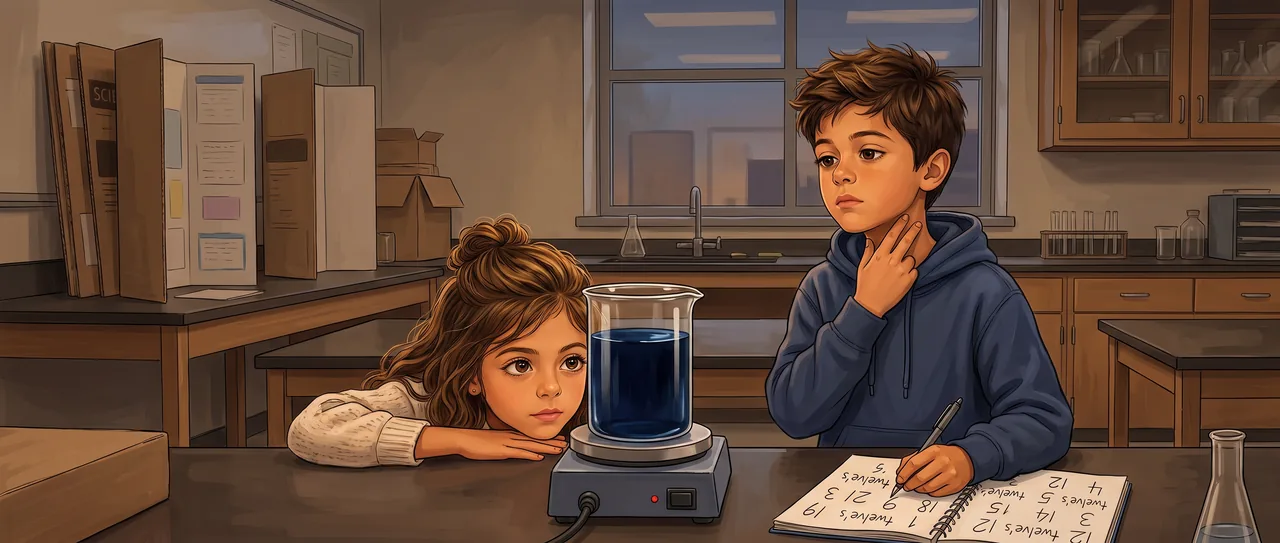
The Beaker That Kept Time
The fair was over. Everybody had gone home except the two of them, because Maya had said she would help stack chairs and Soren had said he would help Maya, and neither of them had done any stacking.
They were standing at the back counter, watching a beaker.
"It went blue again," Maya said.
"How long that time?"
"I don't know. I wasn't counting the last one."
Soren pulled his notebook out of his back pocket and clicked his pen. The liquid in the beaker was the color of dark blue ink, so dark it looked almost black against the white counter. Nobody was stirring it. Nobody was near it. The magnetic stirrer underneath had been switched off ten minutes ago, and the little bar inside had stopped spinning.
"Watch," Maya said.
The blue faded. Not slowly. It went from ink to nothing in about a second, like somebody had rinsed it clean from the inside. Now the beaker looked like plain water.
"Okay," Soren said. He wrote down clear and drew a little line. "Count it out loud this time."
"One. Two. Three."
She got to eleven. On twelve the whole beaker slammed back to dark blue, all at once, top to bottom.
"Twelve," said Soren, and wrote it.
"Do it again."
They did it again. Blue held for a few seconds, then dumped to clear. She counted. Eleven, twelve. Blue.
"That's the same," Maya said. She wasn't asking.
"That's the same," Soren agreed. He looked at the two numbers on the page. "Nobody's touching it."
"I know."
"There's no stirring. There's no timer. There's nothing plugged in." He put his hand flat on the counter to feel for a vibration, a motor, anything. Cold laminate. Nothing.
Maya leaned down until her eyes were level with the liquid. "So what's counting?"
That was the part. That was the whole part. A clock had to have something in it that kept time. A gear. A pendulum. A crystal that buzzed. Her mom's kitchen timer had a little dial you wound. Every clock Soren could think of had a piece inside whose only job was to go back and forth, and everything else just watched that piece and marked it down.
"There's no piece," Maya said, like she'd heard him thinking. "It's just chemicals. It's just stuff in water."
"Stuff can't count."
"It's counting."
Blue dumped to clear. She started again without being told. One, two, three. Eleven, twelve. Blue.
Soren stared at the page. Twelve. Twelve. Twelve. His handwriting was very neat and the numbers were all the same and that was the thing making the back of his neck feel strange.
"Okay, think," he said. "When it's clear, something is building up. It has to be. It's getting ready."
"Ready to go blue."
"Right. And it builds up and builds up and when there's enough of it, it can't hold, and it flips. All at once." He tapped the counter. "Like when you fill a cup too full. It doesn't leak slow. It holds, holds, holds, and then it all goes over."
"But then it'd only flip once," Maya said. "It'd go blue and stay blue. Why does it come back?"
He didn't have that one. He wrote why come back and underlined it.
Maya was quiet, watching the clear liquid the way you watch water you know is about to boil. "Because going blue uses something up," she said slowly. "The flip eats its own fuel. So after it flips, there's none left, and it goes clear again, and then it has to build the fuel back up from the start. And that takes—"
"Twelve seconds," said Soren.
"Every time. Because it's the same amount of building every time."
Blue. They both jumped a little even though they'd known it was coming.
Soren looked at his notebook. Two things fighting. One made the fuel. One burned it. Neither one won. They just kept handing the beaker back and forth between them, over and over, and the handing-back-and-forth was the tick.
"There's no piece that keeps time," he said. "The keeping-time IS the two things. It comes out of them fighting."
Maya stood up straight. "So you could make a clock out of anything," she said, "if you had two things that push against each other and never finish."
Neither of them said anything for a second. The beaker sat there being clear, working on its twelve.
"My heart does that," Maya said suddenly.
Soren looked at her.
"It's not a clock. There's no gear in it. It's just muscle and stuff pushing." She put two fingers on the side of her own neck. "And it keeps time. All by itself. Nobody winds it."
Soren put his pen down. He hadn't thought about that. His own heart was doing it right now, right this second, and had been doing it every second he'd ever been alive, and he'd never once told it to, and there was no little piece in there ticking, just stuff pushing against stuff and never finishing.
"That's why I always feel like I'm behind," Maya said, very quietly, not to him exactly. "Everybody's counting on something. A clock, a bell, a schedule. And I never am. I just go when the thing inside is full and then I stop and fill back up. That's why I'm never on time the way they mean." She laughed a little. "I'm on my own time. I'm this." She pointed at the beaker.
Soren looked at her, and then at the beaker, and he thought that was possibly the truest thing anyone had said all day.
"How long can it keep doing it?" he asked.
"Until the fuel's all gone," Maya said. "The real fuel, the stuff underneath, not the flip stuff. When that runs out it goes to one color and stops. It's dying the whole time it's ticking. That's how it can tick."
Soren wrote that down. He wrote it slowly.
"How much fuel is left?"
"I don't know," Maya said. "Count."
The liquid was clear. Soren left his pen on the page and put his fingers on his own neck the way she had, and found the beat, and started counting under his breath, matching his heart against the beaker, waiting to see which one of them would flip first.
Read the interactive version, listen to the narration, and earn a gold star →
A science-verified short story for curious kids · Curiosity Land