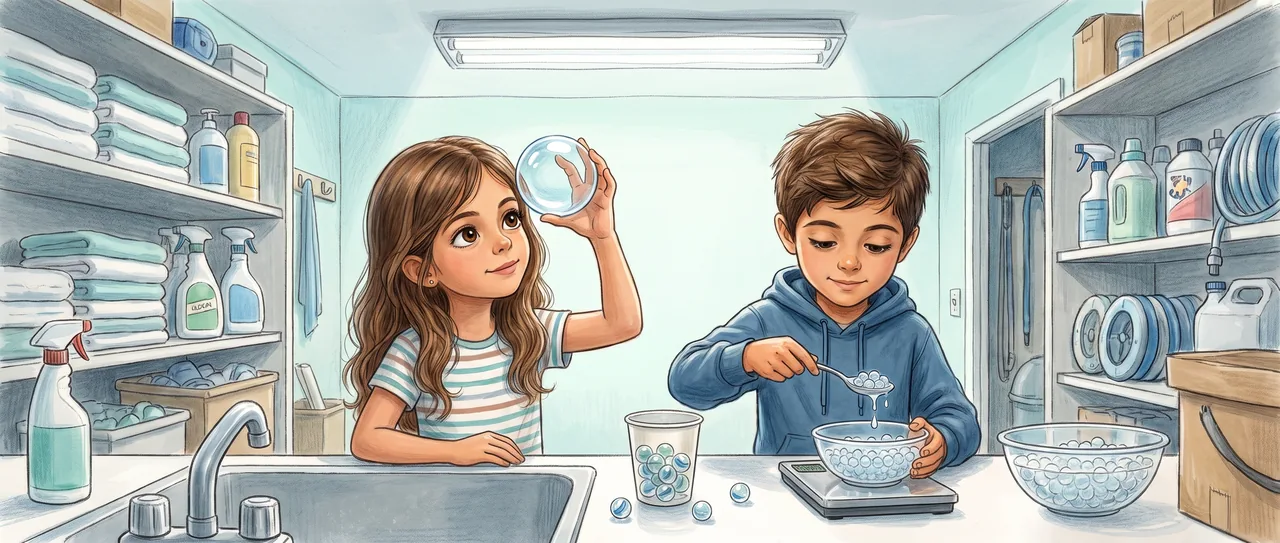
The Almost-Water
The pump was making a noise like a cough, and Maya's dad said it would be twenty minutes, which meant an hour. So Maya and Soren went looking for something to do in the supply closet behind the lifeguard chair.
"Sand," said Maya, tipping a jar of tiny clear beads into her palm. They were smaller than salt, hard, catching the light.
"Not sand," said Soren. He read the label. "It says do not eat and it says polymer. Sand doesn't need a warning."
Maya was already at the utility sink. She held her hand under the tap and let the beads get wet.
"Wait," said Soren, but she didn't, and then neither of them said anything for a while.
The beads were growing. Not fast, not like a magic trick. Slow, the way a cloud gets bigger if you actually watch one. Each little grain swelled into a soft ball the size of a marble, then bigger. Clear as glass. When Maya poured them into a cup they filled it, wobbling, catching the fluorescent light like a cup of frozen bubbles.
"Feel one," she said.
Soren picked one up. It was cold and firm and slippery and it held its shape in his fingers.
"It's a ball," he said. "A solid ball."
"It's water," said Maya.
"It's a solid ball that used to be a grain of sand."
"No." Maya was frowning. . "Where did the water go?"
Soren looked at the sink. Looked at the cup. "Into them."
"How much?"
He weighed the ball in his hand. Then he found the dry jar, and a paper cup, and the scale from the chemical shelf that measured pool doses. He tipped a small spoon of dry beads onto it. The number barely moved.
"Almost nothing dry," he said.
Then he dropped the same spoon into a second cup of water and waited. Maya bounced on her heels. Soren did not rush waiting. Waiting was part of it.
When the beads had swelled he lifted them out with the spoon, let them drip, and set them on the scale. The number climbed and climbed.
"Okay," said Soren slowly. "So the ball is mostly the water. The bead part is almost none of it."
"How much almost none."
He did the arithmetic on his hand with a pencil, the two numbers, the dry and the wet. "If this is right," he said, and then he stopped, because the answer looked wrong. "The solid part is less than one out of a hundred. The ball is more than ninety-nine parts water."
Maya took the ball back and held it up to the light. You could see the sink through it. You could see her own fingers on the other side, bent and swimming.
"So it's basically water," she said. "But you can pick it up. Water can't do that. Water goes through your fingers. This just sits there."
"There's a net," said Soren. He said it before he was sure, and then got sure while he said it. "The polymer. It's a net so fine you can't see it. The water is caught in the holes. It's water that got told to stay still."
Maya went very quiet, and then she squeezed the ball, gently, and let go. It sprang back.
"Water you can build with," she said.
"Water with a shape."
"Water with a shape," Maya repeated, and there was something in her voice, like she had walked into a room she hadn't known was in the building. "Soren. You're mostly water. I'm mostly water. Like this much. Like ninety-something."
Soren looked at his own hand, at the ball sitting in it, clear and cold, holding its shape.
"And I don't fall apart," he said.
"Because you have a net too."
Neither of them said anything again for a while. The pump coughed in the next room.
"So if you knew how to build the net," Maya said, and now she was talking fast, following it, "you could build a shape out of almost-water. You could build a soft thing. A wet thing. A thing shaped like a part of a person."
"A scaffold," said Soren, though he didn't have the word yet, only the idea of it, a frame you fill. "You'd make the net in the shape you want. Then the water goes in. Then maybe. Maybe the living part grows into the net."
"And the net holds it up until it can hold itself up."
"Like these." Soren looked at the cup of clear marbles, wobbling. "Except a real one. Except a shape that matters."
Maya put her ball down on the counter. It sat there, a little dome of caught water, not evaporating, not spreading, just being solid because something too small to see was holding on.
"People are making these," she said. "Right now. Somewhere. People figured out the net."
"Contact lenses," said Soren, remembering suddenly. "My cousin's are soft. Wet. She sleeps with them in a case of water. That's this. That's the same thing."
"On your eye," said Maya. "There's almost-water sitting on your eye and you can see through it because it's almost-water." She laughed, once, surprised. "It was already everywhere and I never asked what it was."
Soren was writing now, the pencil moving, the two weights, the dry number and the wet number, and the word net with a box drawn around it and question marks beside the box because he did not know how the box was tied together, only that it was, only that someone knew and someone else was still figuring out and both of those were true at the same time.
"The person who grows the first heart," Maya said. "They'll do it in one of these. A net full of almost-water."
The closet was quiet. Both of them looked at the row of clear marbles in the cup, each one more than ninety-nine parts water and none of them running away.
Maya reached out and pressed the flat of the spoon against one. It gave, and held, and gave, and did not break, and slid slowly back into a ball when she lifted the spoon away.
Read the interactive version, listen to the narration, and earn a gold star →
A science-verified short story for curious kids · Curiosity Land