The Two That Wouldn't Sit Still
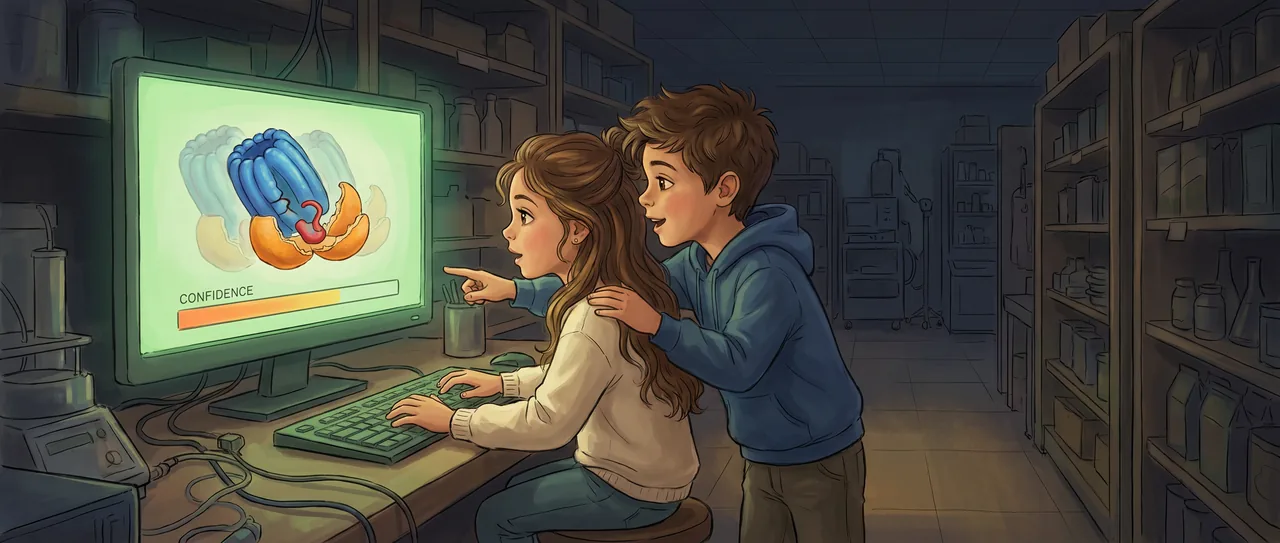
The last volunteer had switched off the big wall screen and gone home, but the little folding station in the corner was still awake, its screen glowing green in the dark grocery-store aisle that used to hold cereal.
"They left it logged in," Maya said.
"They left everything logged in," said Soren, coiling a cable. "That's how you know it was a good demo. Everybody forgot to be careful."
Maya pulled the stool over and typed a protein sequence she half remembered from the poster, just letters, twenty of them repeating in a pattern she liked. The companion, a folding model named Wren that lived in the station, drew the shape in under a second. A ribbon curled into a tidy knot on the screen.
"Two seconds," Maya said. "That used to take a supercomputer a year."
"It still can't do the thing I actually wanted it to do," Soren said. He set the cable down. "I asked it earlier. I gave it two proteins and asked what happens when they touch."
"And?"
"It folded each one perfectly. Then it just showed them next to each other. Not touching. Like it didn't want to guess."
Maya turned. "Show me."
He loaded his two sequences. Wren painted them instantly, one a fat blue barrel, one a thin red hook. They sat side by side, still, correct, and completely separate.
"Make them bind," Maya said.
"That's the part," Soren said. "Watch what it says."
He clicked the two shapes together. A message came up in small letters: Binding prediction: low confidence. Structures may rearrange on contact.
"May rearrange," Maya read. "That's the whole thing? That's the answer?"
"That is the answer," Soren said. "It knows the shape of one. It knows the shape of the other. It doesn't know the shape of the two of them together. Nobody does, really. When proteins grab each other they change. They bend into shapes they never make alone."
Maya stared at the blue barrel and the red hook.
"So we're at the edge," she said quietly.
"Of what?"
"Of what it knows. This little screen. Right here in the cereal aisle."
Soren felt something go cool along his arms. He had thought the edge of what was known lived far away, behind locked doors, in the big screen, not in the corner nobody cleaned.
"Try it," Maya said. "Bind them anyway. Make it guess."
"It hedges. It always hedges."
"Then make it stop hedging." She was already typing. She asked Wren to run the binding a hundred times and show every answer at once.
The screen filled. A hundred faint ghosts of the two proteins, overlapping, each one slightly different. In some the blue barrel stayed fat. In some it split down the side like a peeled orange. In some the red hook straightened into a spear.
"It doesn't know," Soren breathed. "Look. It's showing us a hundred maybes because it can't pick one."
"No," Maya said. "Look again."
Soren looked. His whole method was to look at the thing behaving wrong, and something here was behaving wrong.
"They're not spread out evenly," he said slowly. "Most of the ghosts are doing one thing. The barrel opening. Over and over. The others are just noise around it."
"It thinks it doesn't know," Maya said. "But it kind of knows. It's leaning."
Soren counted, quietly, the way he counted stars when he didn't trust his own eyes. He grouped the ghosts. Sixty-some of them showed the barrel splitting open and the hook sliding inside. The rest scattered.
"Sixty out of a hundred say the same story," he said. "That's not nothing. That's a lean."
"So run those sixty again," Maya said. "Just the ones that agree. Feed them back in."
Soren did. He took the shapes where the barrel had opened and asked Wren to fold the pair again starting from there, as if the contact had already happened, as if the proteins had already begun to change each other.
This time the confidence bar moved. Not all the way. But it moved, up, into a color it had refused before.
They both sat back.
"We didn't teach it anything," Soren said. "We just made it look at its own guesses."
"It had the answer scattered inside it the whole time," Maya said. "It just didn't trust the loud part of itself."
Soren stared at the barrel, cracked open now on the screen, cradling the red hook in a shape neither protein had worn a second ago. A shape that existed only because two things had touched.
"This is real," he said. "This isn't a demo protein. These are your sequences."
"They're not mine," Maya said. "I pulled them off the poster. They belong to somebody's actual experiment."
They looked at each other.
"So somewhere," Soren said, "in a real fridge, in a real tube, those two proteins might be doing exactly this. Opening. Wrapping. And nobody has watched it yet."
"Nobody knows if we're right," Maya said. "That's the part I can't get over. There's no one to check with. The screen doesn't know. The person who made the poster doesn't know. We could be the first to guess it correctly and there's no way to be sure."
"That's horrible," Soren said.
"That's the best thing that's ever happened to me," Maya said, and she was grinning.
Soren found that he was grinning too, in the green light, in the aisle that used to hold cereal. He had spent his whole life feeling like the boy who wrote things down while everyone else already knew the answer. And here was a machine that could fold any lonely protein in the world in two seconds, sitting beside two children, all three of them equally in the dark about what happens when two things reach for each other.
"Save it," Maya said. "The whole run. So when someone finally opens that tube, we can find out."
Soren reached for the notebook in his bag, then stopped, and instead typed a filename into Wren, letter by letter, and pressed enter. The barrel and the hook held their new shape on the screen, locked together in a pose no one had asked for and no one could yet confirm, waiting in the dark for the world to catch up to it.
Read the interactive version, listen to the narration, and earn a gold star →
A science-verified short story for curious kids · Curiosity Land