The Thing in the Petri Dish Remembers
The room smelled like old oatmeal, which was the smell of the slime mold nobody had cleaned up.
"They just left it," Maya said. She lifted the lid off the big plastic tray. "Fair's over. They took the poster and left the actual thing."
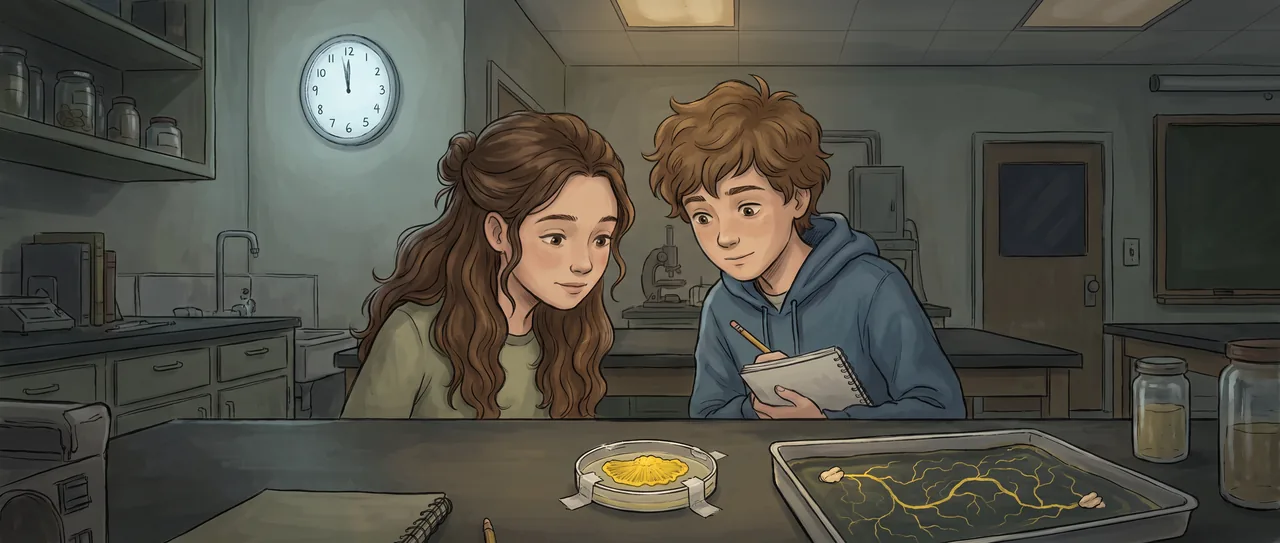
Soren leaned in. The tray held a maze cut into agar, walls of jelly and open lanes, and threaded through it was a spread of yellow. Not a blob. A network. Fine yellow veins running the corridors like a map of a subway that had drawn itself.
"The card said it would connect two food dots," he said. "Oat flakes at both ends. It did."
"It did more than that." Maya pointed. "Look at the path."
Between the two oat flakes the mold had pulled most of itself back into a single thick strand. The strand did not wander. It cut the corners. It took the shortest legal route through the maze and abandoned every dead end.
"Okay," Soren said slowly. "That's the famous thing. It finds the short way." He crouched to eye level with the tray. "But how does it know where the dead ends are? It doesn't have eyes. It doesn't have a brain. It doesn't have one single nerve."
"It filled the whole maze first," Maya said. "Then it decided."
"Things without brains don't decide."
"Then what's a better word."
Soren didn't have one. He got out his notebook and drew the maze, the two oat flakes, the thick line between them. His pencil stopped over the dead ends where the yellow had thinned to almost nothing.
"It pulled out of the wrong turns," he said. "Like it un-chose them."
Maya was already somewhere else. She was staring at a smaller dish on the counter, one with a lid taped shut and a strip of masking tape labeled in the fair kid's handwriting: DO NOT MOVE. COLD 9:00, 10:00, 11:00.
"What's this one," she said.
Soren read the lab printout clipped beside it. Somebody, a student, had copied an experiment from a paper. Every hour on the hour they'd blown cold dry air across the dish. Slime molds crawl slower when it's cold and dry. So every hour, the mold slowed down.
"They did it three times," Soren said. "Nine, ten, eleven. Then they stopped. Then they went home."
"So it should just crawl normal now," Maya said. "No more cold. Nothing telling it what time it is."
Soren checked the clock on the wall. Eleven fifty-eight.
"Watch it," he said. "Just watch it."
They put their faces close. The mold was a small fan of yellow, easing forward so slowly you couldn't see it move, only tell that it had moved. Maya held her breath. The second hand swept up.
At twelve o'clock the mold slowed down.
No cold air. No dry air. Nobody touched it. The room was the same temperature it had been for an hour. And the little yellow fan pulled itself in and hesitated, right on the hour, the way it had been taught to hesitate by three cold mornings that were already over.
"It's waiting," Maya whispered. "It's waiting for the cold that isn't coming."
Soren's pencil was not moving. "Do it again," he said. "I mean, we can't do it again, we didn't set it up. But it'll do it again. If it's really keeping time it'll slow down at one too."
"We're not staying till one."
"I'm staying till one."
Maya looked at him, then at the dish, then at the maze, then back.
"It counted," she said. "With what."
That was the question that made Soren put the pencil down entirely.
Because there was no with what. There was no clock inside it, no little cell that was the timekeeper, no wire from the memory to the muscle, because there was no memory and no muscle and no wire. There was a bag of yellow goo that was one single cell, or sort of one cell, spread out thin across a dish. And that bag of goo had noticed that something happened every sixty minutes, and had gotten ready for it happening again, and was now standing on the corner of noon holding an umbrella for rain that had stopped.
"The maze is the same trick," Maya said. She said it fast. "It's the same trick as the clock."
"How."
"It doesn't plan the short path. It can't, it's got no head to plan in. It just, everywhere it grows, the tubes that are useful get fatter and the tubes that go nowhere get thin and dry up. So the answer shows up. It doesn't get figured out, it grows itself into the shape of the answer." She turned to the taped dish. "And the time thing. It didn't remember nine, ten, eleven. It got shaped by them. The cold pushed it into a rhythm and now the rhythm is just how it is. It's the shape it's in."
Soren sat back on the cold floor. "So the thinking isn't in a place," he said. "It's the whole thing. All of it at once. There's no part of it that's the brain because every part of it is a tiny bit of the brain."
"There's no in," Maya said. "That's the part. We keep looking for where it keeps the answer. There's no where."
Soren thought about his own head, the bone box he carried the world around in, the one place he assumed all his knowing lived. He thought about a thing that knew things and had no box. That solved a maze by becoming the maze's solution. That felt Monday coming in its body without a body part to feel it with.
"People say I've got too many questions for one head," he said.
"Yeah," Maya said.
"This thing doesn't have any head. And it's still got a question. Every hour. Where's the cold."
They stopped talking. The clock on the wall ticked toward one. On the counter the small fan of yellow crept forward again, faster now, warmed up, back to normal, forgetting nothing because it had never been remembering, only being.
At twelve fifty-nine Maya and Soren both leaned in without deciding to.
The second hand climbed. Reached the top.
The yellow fan drew itself in and went still.
Read the interactive version, listen to the narration, and earn a gold star →
A science-verified short story for curious kids · Curiosity Land