The River Nobody Swims
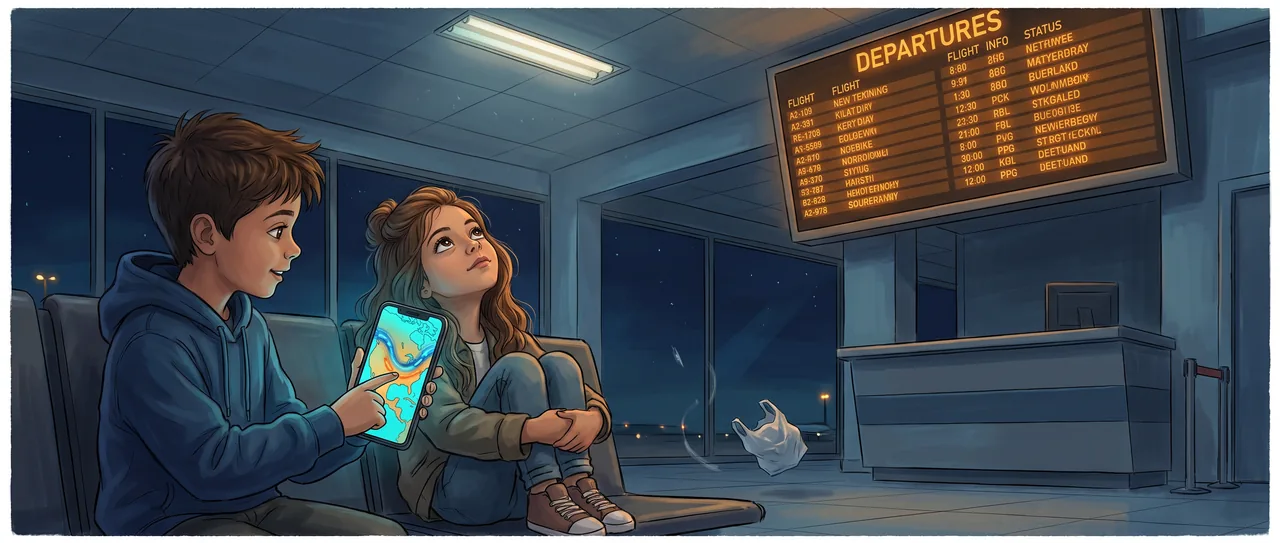
The flight board said their plane had landed early. It also said the plane going the other way, to the same city they had just left, was running late.
"Same plane," Maya said. "Same distance. One got here fast. One is slow."
"It's not the same plane," Soren said. "It just says the flight number."
"Same distance, though." She was watching the screen "Six hours going. Five hours coming back. Look. It's on every row."
Soren looked. She was right. Every flight heading east ran shorter than the one heading west. Not by a little. By close to an hour, over and over, all the way down the board.
"Wind," he said. "Has to be wind. Something pushing them one way."
"Wind down here doesn't do that. Wind down here is a mess." Maya waved at the black window, where a plastic bag was skittering across the tarmac in loops. "It goes every direction. It wouldn't help every single flight the same way."
Soren pulled out his notebook and drew a line across the bottom of the page. Ground. Then he drew a plane up high, near the top.
"So the wind that helps them isn't down here," he said. "It's up where they fly."
"How high do they even go?"
He found it on his phone. Cruising altitude, ten to twelve kilometers. He said the number out loud and then sat with it. "That's higher than any mountain. There's nothing up there. No trees, no buildings. Just air."
"And the air up there is doing something the air down here isn't." Maya pulled her knees up onto the seat. "It's going one way. Fast. East."
A man across the aisle lowered his newspaper. He had a lanyard from some airline and the tired face of someone who flew too much. "Jet stream," he said, like he was doing them a favor, and lifted the paper again.
Maya looked at Soren. "That's a name. That's not an answer."
"It's a start," Soren said, already typing. He read for a while. Then he stopped reading and just held the phone.
"What," Maya said.
"It's a river." He turned the phone so she could see the map. A ribbon of color wound across the whole continent, west to east, curling and looping like a thrown rope. "A river of wind. Way up high. It moves faster than the plane sometimes. Like two hundred, three hundred kilometers an hour."
"So flying east you jump in the river." Maya's hands started moving. "And flying west you have to climb up it. Against the whole thing."
"That's the hour," Soren said. "That's the missing hour, right there."
They both stared at the ribbon on the little screen. It was not straight. That was the part Maya kept coming back to. It bulged south in one place and hooked back north in another, like a rope somebody had shaken.
"Why is it wiggly," she said. "A river in the ground stays in its bed. This one is all over the place."
Soren read more. "It's the temperature difference. Cold up north, warm down south. The river runs along the line between them. When the difference is strong, it runs tight and straight and fast. When it gets weak, it goes loose. It starts to loop."
"Weak how?"
"When the north warms up." He slowed down. "When the Arctic isn't as cold as it used to be, the difference shrinks, and the river gets lazy and wavy."
Maya was quiet. She was looking at the loop on the map, the one that dipped way down south, far below where it should have been.
"Soren. That dip." She put her finger under it. "That's a bag of cold. Look where it reaches."
He looked. The southern loop hung down over cities that never expected cold. He checked the weather for one of them. A freeze warning. In a place with palm trees on the arrival photos.
"When it loops," he said slowly, "it drags the north down with it. It carries polar air south and dumps it somewhere it doesn't belong."
"So the same thing that makes our flight home fast," Maya said, "is the thing that decides whether people two thousand kilometers away wake up to frost." She was not smiling. She had the look of someone whose picture of the world had just gotten a whole extra floor.
"It's steering the weather," Soren said. "All of it. The storms ride along it. It pushes them across the whole continent." He wrote steering wheel and crossed it out and wrote river that steers instead.
The man with the lanyard had lowered his paper again. He was listening now, not correcting.
"Nobody feels it," Maya said. "That's the part. It's right there, all the time, over everybody's head. Bigger than any storm. And you can't see it. You can't even feel it unless you go ten kilometers straight up."
"The planes feel it," Soren said. "That's how we found it. It was hiding in the flight times."
Maya turned back to the board. The delayed flight, the one going west, updated as they watched. Later still. Fighting the river the whole way.
"So somewhere over us right now," she said, "there's a river three hundred kilometers an hour and it's got a bend in it, and the bend decides who's cold tomorrow."
"And nobody in this whole airport is looking up," Soren said.
They both looked up. There was only the ceiling, gray tiles and a flickering light. But above the tiles was the roof, and above the roof the dark, and above the dark, higher than weather, higher than clouds, the thing they could not see moving faster than anything on the ground could chase.
Over the intercom a voice called their flight. Eastbound. The fast direction.
Maya stood up and kept her eyes on the ceiling as she walked toward the gate.
Read the interactive version, listen to the narration, and earn a gold star →
A science-verified short story for curious kids · Curiosity Land