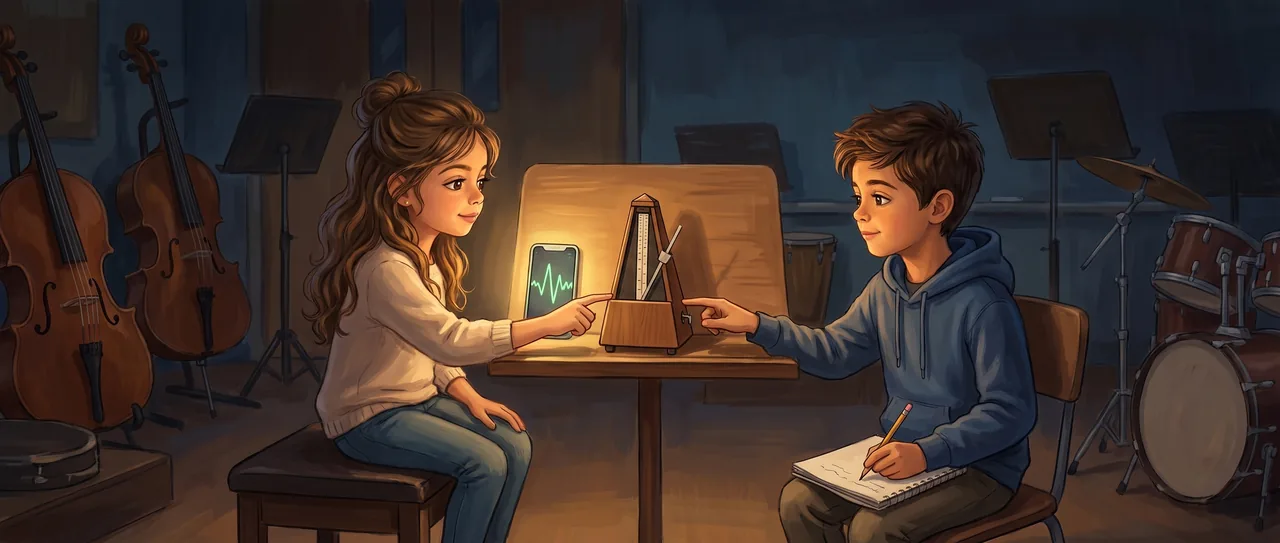
The Metronome in the Dark
The music room was empty except for the two of them and a metronome that would not stop lying.
"Play it again," Soren said. "The scale. Just up."
Maya played it on the piano, eight notes climbing. She watched the metronome arm tick beside her.
"I'm off," she said.
"You're not off. You start on it and then you drift. Same drift every time."
"How do you know it's the same?"
Soren held up his phone. He had been recording, and there was a little app on the screen with a jumping green line. "Because I can see it. You speed up in the middle and slow down at the end. Every single time. Like a wave."
Maya leaned over the phone. The green line rose and fell in a shape that repeated. Up, over, down. Up, over, down.
"That's not me being bad at piano," she said slowly. "That's too neat to be bad. Being bad is random."
"That's what I thought too."
She played the scale again without the metronome, eyes closed. Soren watched the line.
"Same wave," he said. "You made a rhythm even when there wasn't one."
"So I've got a metronome in my head."
"Everybody does, kind of. Try this." He set his pencil on the music stand. "Tap your finger. Any speed. Just comfortable."
Maya tapped. Tap. Tap. Tap.
"Now I'll tap too, my own speed, and don't look at me."
He started tapping the pencil against the stand. For a while the two sounds argued, his against hers, close but not together. Then, without either of them trying, the two taps slid into one sound.
Maya opened her eyes. "Wait. We're doing it together now. I didn't do that on purpose."
"Neither did I."
"Do it again." They separated the taps and started fresh. Same thing happened. The two rhythms drifted, argued, and then locked, like two swings on a playground you weren't even pushing.
"That's spooky," Maya said, and she was grinning when she said it.
Soren had his notebook open. His hand moved across the page, sketching two wavy lines that started apart and came together. "There's a word for it. When two things that swing find the same beat. My uncle told me. He works on brains."
"Your uncle works on brains."
"He studies why some people's brains have seizures. He said a seizure is kind of the opposite problem. Too much together. All the parts firing on the same beat at once, when they're supposed to be doing different jobs."
Maya stopped tapping. "Say that again."
"He said the brain has rhythms. Different parts, different speeds. And they have to talk to each other, but the front part of your head and the back part are pretty far apart, for a brain. So how do they line up?"
"The way our taps lined up."
"That's what he said. They find each other's beat. That's how the far-apart parts work as one thing. It's not wires carrying a message. It's timing."
Maya looked at the piano, then at the green line still sitting frozen on the phone. "So when I play the scale, the part of my brain that hears and the part that moves my fingers, they're not sending letters back and forth. They're humming the same note. That's how they stay a team."
"And when they can't line up right," Soren said "that's some of what he studies. Not a broken piece. A rhythm that won't sync. Or syncs too hard."
The room felt different to Maya suddenly. Bigger. She put her hand flat on the piano keys without pressing them.
"Everything I've ever thought," she said. "Every idea I ever had. That was parts of my head finding a beat together."
"Fast beats for some things. Slow ones for others. He said when you're really focused, there's a fast rhythm. When you sleep, big slow ones. They're going right now. In both of us. We can't hear them."
Maya was quiet. Then she said, "That's why it never worked."
"What never worked?"
"My cousin. He's autistic. When we play music together he does this thing, he loves the pattern part, the exact repeating part, and he hates it when I speed up or slow down like I do. He wants the metronome to be perfect. And everybody keeps saying he needs to loosen up." She turned to Soren. "But if it's about rhythms syncing, maybe his brain just syncs different. Not wrong. Different beat."
Soren didn't answer right away. His uncle had said something close to that, and he wanted to say it exactly. "He said they're finding that some brains have the parts, all of them, everything works, but the timing between parts runs on a different pattern. So it's not that a piece is missing. It's the rhythm connecting the pieces that's tuned to something else."
"A different beat," Maya said again. She liked it. "He's not out of time. He's on his own time, and everybody keeps trying to make him play mine."
She reached over and moved the metronome to a slower setting. Then she started the tapping game again, alone this time, one finger on the wood.
"What are you doing?"
"Seeing if I can match his beat instead of mine. If I can sync to slow." She tapped, listening to the metronome, letting her finger settle into its patient tick. It was hard. Her hand wanted to rush. She held it.
"You're doing it," Soren said. He was watching her finger, not the phone now. "You changed which beat you find."
"Anybody can, maybe. If they slow down enough to hear the other one." Tap. Tap. Her finger stayed with the metronome, and the two sounds had become one sound, and she understood she had crossed over to meet it.
Soren picked up his pencil. He didn't tap his own beat this time. He set the pencil to the metronome too, and now there were three things keeping the same slow time, the machine and both of their hands, in a dark room full of silent instruments and two skulls quietly humming their invisible rhythms.
Maya listened to the three of them agree.
"Somewhere in your uncle's lab," she said, "there's a screen with lines like your green one. Off a real brain. Right now. Moving."
The metronome ticked, and their two hands stayed with it, and neither of them looked away from the small arm swinging in the half-dark.
Read the interactive version, listen to the narration, and earn a gold star →
A science-verified short story for curious kids · Curiosity Land