The Empty Kelp
"There are too many urchins," Maya said.
Soren looked up from the survey card. It had little boxes. Snails, five. Anemones, three. Crabs, two. "There's no box for urchins," he said.
"I'm not counting them for the box. I'm counting them because there are too many."
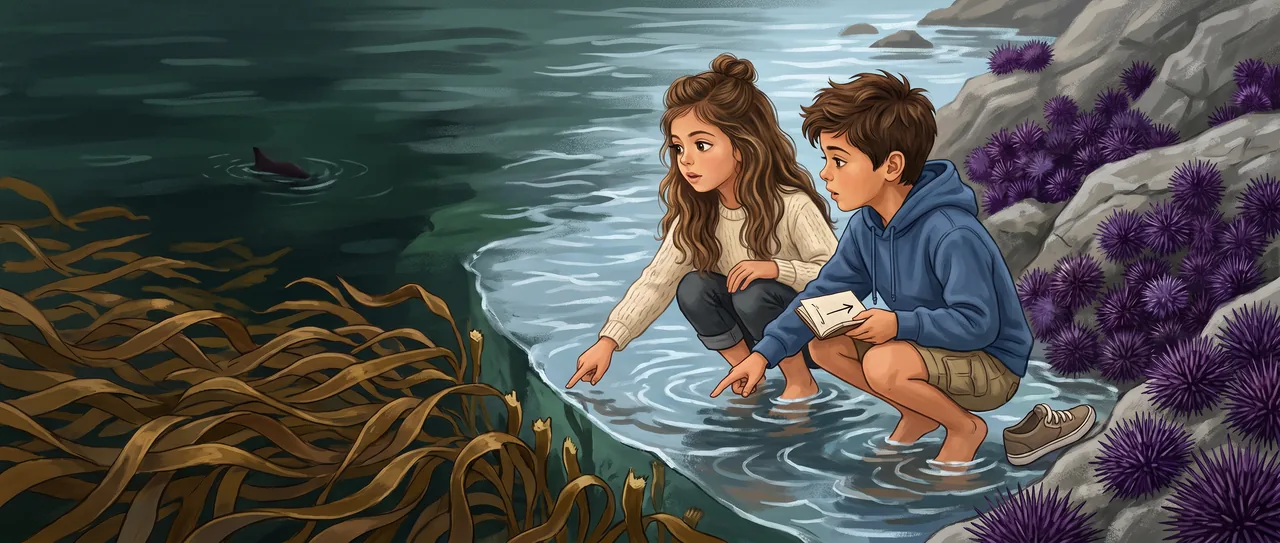
He waded out to where she stood, knee-deep, the cold pushing at his ankles. Under the water the rock was purple. Not purple-colored rock. Purple with animals. Urchins packed so close they touched, spines moving a little, like a field of pincushions somebody had shoved together on purpose.
"How many is too many?" he asked.
"I don't know the right number," Maya said. "But this is wrong. Look what they're standing on."
He looked. The rock was clean. Not clean like scrubbed. Clean like bare. Gray stone and purple urchins and nothing else, going out and out until the water got too deep to see.
"It's rock," he said.
"It shouldn't be rock." She pointed sideways, to the far end of the cove, where something dark swayed under the surface. "Over there it's a forest."
Soren pulled off his shoe and sock, which was not in the survey instructions, and went to look. At the far end the water was full of long brown ribbons. They came up from the bottom on stems as thick as his wrist and spread into blades near the top, and small fish flicked between them, and something silver hung in the shadows underneath. Kelp. A whole standing forest of it, moving when the water moved.
He walked back along the shore. Halfway, the forest just stopped. Ribbon, ribbon, ribbon, then bare rock and purple. A line you could stand on with one foot in each.
"Maya," he called. "There's a line."
She came. They stood on the line together.
"Forest," she said, tapping her left foot.
"Desert," he said, tapping his right.
He crouched and looked at the edge of the kelp. The nearest stems were chewed. Not torn by waves. Chewed low, gnawed down to little stumps, and the urchins were right up against them, and past that first row the stumps got shorter, and past that there was nothing.
"They're eating it," he said. "The urchins are eating the forest. This line is where they've gotten to."
"So the line moves." Maya crouched too. "Every day it's a little more that way." She nodded at the forest. "Until it's all rock."
Soren sat back on his heels. "Then why hasn't it always been rock? Urchins have been here forever. If they eat kelp, why is there any kelp left anywhere?"
That was a good question. Maya went quiet, turning it over, and then she said, "Something used to stop them."
"Stop them how?"
"Eat them."
They looked at the urchins. Spines like needles, in every direction.
"Who eats that?" Soren said.
A woman in a green volunteer vest was working the next pool over, scraping data into a tablet. Maya waded toward her. "Excuse me. What used to live here that ate urchins?"
The woman didn't look up. "You mean otters. Sea otters. Haven't seen one in this cove in years." She scraped at the tablet. "Are you the snail count? I need the snail count."
"Five," said Soren.
"Great." She moved to the next pool.
Maya waded back. Her eyes were doing the thing they did when a piece landed.
"An otter," she said. "One animal."
"A lot of otters, probably," said Soren.
"No. Listen." She grabbed his arm. "It's not just that otters ate urchins. It's what happens next. Otters eat urchins, so there aren't too many urchins, so the kelp grows, so the fish live in the kelp, so the silver thing under the kelp has fish to eat." She was pointing at the forest with her whole hand. "All of that. The fish, the forest, the shadow thing, everything over there is only there because of the otter. Take away the one animal and the whole thing falls."
Soren looked at the forest end of the cove. Then at the desert end. Then at the line under their feet, where the chewed stumps met the standing stems.
"That can't be right," he said. But he said it the way he said things he was testing, not things he believed. "An otter is small. The forest is huge."
"So test it," Maya said. "If I'm wrong, the forest and the desert should be random. Some urchins here, some kelp there, all mixed up."
Soren looked again. It was not mixed up. It was forest, then a line, then desert. It was as sharp as if someone had drawn it.
"It's a line," he said slowly. "A moving line. And on the far side of the forest, where you couldn't get a straight edge like that by accident, something's holding it."
"Or was."
"Or was." He pulled his notebook out of his back pocket, still dry, and drew the cove: the ribbons, the bare rock, the line between. He drew a small arrow at the forest edge and did not know yet what to write next to it.
Maya was watching the deep water past the kelp, where it went from green to almost black. "That's the part I can't hold," she said. "Under there, right now, there's a forest that only stands up because somewhere, some year, one kind of animal was hungry. And it doesn't know that. The fish don't know it. The kelp doesn't know it."
"We know it," Soren said.
A wave came in and covered the line, forest and desert together for a second, then pulled back and left it exactly where it was.
Out past the kelp, far out where the water went black, something small broke the surface, rolled once on its back, and was gone before either of them could be sure.
Soren stood very still with the pencil off the page.
"Did you see," Maya whispered.
They both watched the black water and did not blink.
Read the interactive version, listen to the narration, and earn a gold star →
A science-verified short story for curious kids · Curiosity Land