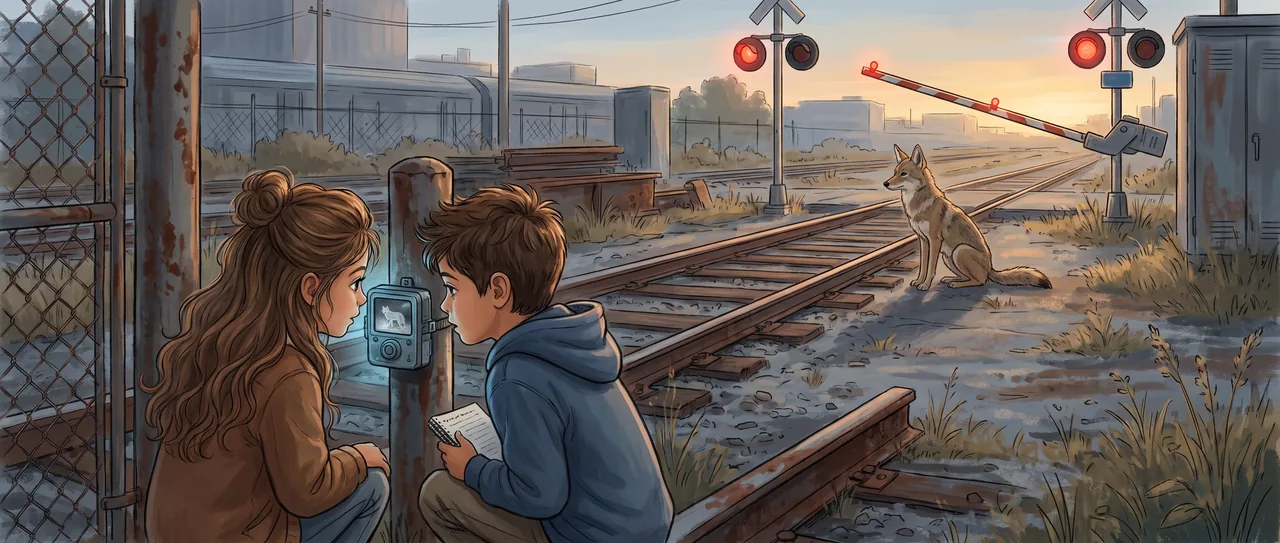
The Coyotes That Learned the Lights
The camera was strapped to a fence post with two zip ties and a lot of hope. Soren crouched in front of the little screen while it woke up, throwing pale light on his face. Maya sat on an overturned bucket beside him, chin on her knees, watching the empty yard where the tracks split off into weeds.
"Dr. Okafor said there'd be nothing," Soren said. "She said the yard's too busy. Trains all night."
"She also left before it got dark," said Maya. "So."
"She had a grant thing."
"She always has a grant thing."
The screen finished loading. Two hundred and eleven photos. Soren started clicking through. Empty. Empty. A cat. Empty. A raccoon dragging something shiny.
"There," said Maya.
Photo eighty-something. A coyote, mid-yard, caught in the flat gray of the infrared. Then the next one. Same coyote, sitting. Just sitting, in the middle of the tracks, facing the crossing gate.
"It's waiting," said Maya.
"You don't know that."
"Click."
He clicked. The coyote, still sitting. The timestamps ran three minutes apart. In the fourth photo the crossing gate lights had come on, two bright blooms in the corner of the frame, and the coyote was already standing, already turned, already halfway to the edge of the yard.
"It moved when the lights came on," said Soren. "Before the train."
"Before the train," Maya said. "It didn't wait for the train. It waited for the lights that mean the train."
Soren clicked back. Forward. Back. "That could be one smart coyote."
"Keep going."
He kept going. Another night, further into the memory card, a different coyote, smaller, notch out of one ear. Same spot. Sitting. Gate lights. Gone before the train. And a third, weeks earlier by the date, doing the same thing at the same crossing, the same pause, the same read of the lights.
"Three," said Soren. He wrote the dates down the margin of his page, the ear-notch, the times. "Three different coyotes all doing the exact same thing at the exact same gate."
"So it's not one smart one," said Maya. "It's the whole family knowing it."
"Or the whole family being the kind that figures it out."
Maya lifted her chin off her knees. "Say that again."
"The kind that figures it out," said Soren, slower. He looked at his own words. "A coyote out in the hills never sees a crossing gate. Never in its whole life. There's nothing to learn."
"There's nothing to be good at," said Maya. "Out there."
"So the ones out there, the twitchy ones, the ones that bolt at any weird light, they do fine. Better, even. Bolting keeps you alive in the hills."
"But here." Maya was up off the bucket now, walking the edge of the tracks, looking at the crossing gate like it might do it again for her. "Here the twitchy one bolts at every light and there are lights all night. It'd never eat. It'd never sleep."
"It'd leave," said Soren. "Or it wouldn't make it."
"And the calm one stays. The one that can sit on the tracks and tell the difference between a light that means nothing and a light that means train." She stopped. "That one gets the whole yard to itself. All the rats. All the spilled food. Everything."
Soren stared at the screen. "That one has pups."
"That one has pups," said Maya, "and the pups are the calm kind too."
For a second neither of them said anything. Out past the fence, the city was starting up, a low building hum, a bus somewhere releasing its brakes.
"How long," said Soren. "How long has this yard even been here."
"Dr. Okafor's paper said the crossing's from the eighties."
"That's not long. That's like, forty years. That's nothing." He was flipping pages back now, to notes he'd taken from her paper. "She measured skulls. City coyotes and country coyotes. She said the city ones have different skulls already. Shorter. Stronger jaws. From cracking open harder stuff. Garbage stuff. In forty years."
"Their bodies are changing," said Maya. "Not just what they know. Their actual bones."
"Fast," said Soren. "That's the part she kept saying. Too fast. We used to think this took thousands of years."
Maya crouched back down by the screen. She scrolled through the coyote photos again, the sitting, the reading of the lights, the leaving. "So the city isn't just a place they're living in," she said. "It's a place that's picking them. It's choosing which ones."
"The pigeons too, probably," said Soren. "And the plants. Dr. Okafor said the little sidewalk weeds drop their seeds straight down now instead of floating them away. Because floating away means landing on concrete. The ones that let go and float, gone. The ones that hold on, still here."
"In the cracks," said Maya. "We made the cracks and now there's a plant that's only for the cracks."
Soren looked up from the notebook. "There's a whole set of animals," he said, "that only makes sense here. That wouldn't make sense anywhere else. That we made without meaning to. Just by building this."
Maya was quiet, watching the crossing gate. Then she said, "Do you feel like the twitchy one or the calm one."
Soren almost laughed. "I ask too many questions to be the calm one."
"No," said Maya. "The calm one's the one who can sit in all the noise and figure out which light matters. That's the whole trick. That's the only trick. Everyone else runs."
Soren looked back at the screen, at the coyote sitting in the middle of the tracks under lights that would have sent any hill coyote sprinting, sitting there long enough to be sure, and only then getting up.
Across the yard, past the fence, a gray shape moved along the weed line. It stopped at the edge of the tracks and sat, facing the dark crossing gate, waiting.
The gate lights came on. The shape was already gone into the weeds before the rails began to sing.
Read the interactive version, listen to the narration, and earn a gold star →
A science-verified short story for curious kids · Curiosity Land