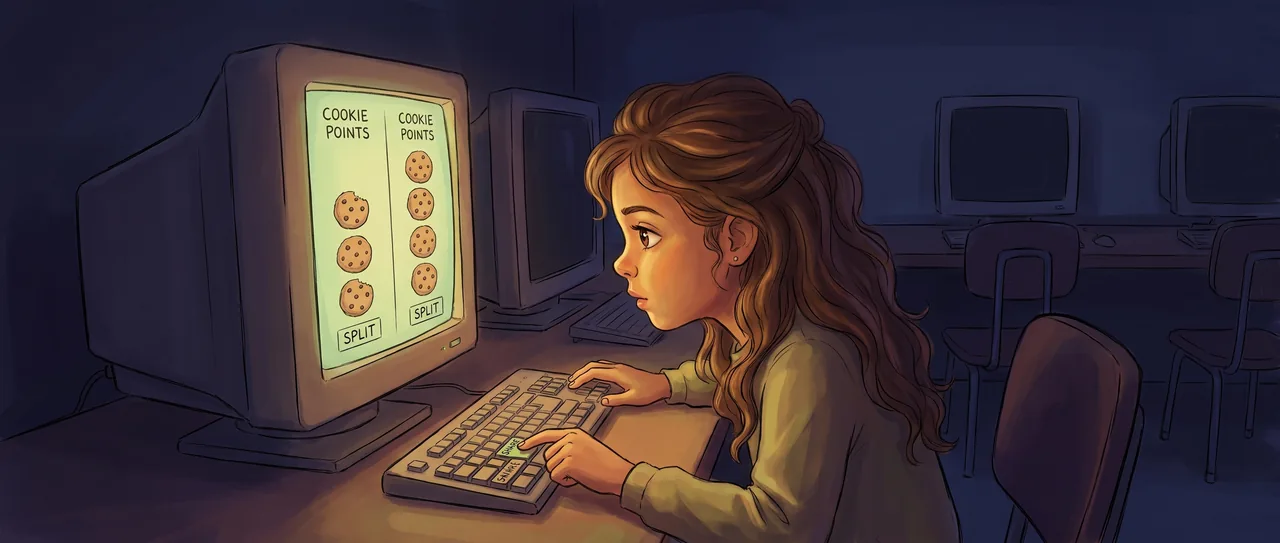
The Cookie Machine Never Loses
The program was called SPLIT, and it had beaten Maya eleven times.
The rules were on a sticky note that Priya had left on the monitor before going home. Two players. Each round, you press KEEP or SHARE. You do not see what the other player picks until after. If you both press SHARE, you each get three cookies. If you both press KEEP, you each get one. If one of you presses SHARE and the other presses KEEP, the one who kept takes five and the sharer gets nothing.
The cookies were points on a screen. Maya still wanted them the way you want real ones.
She had started by pressing SHARE, because three was a lot and it seemed friendly. SPLIT pressed KEEP. Maya got zero. SPLIT got five.
So the next round she pressed KEEP, to be safe. SPLIT pressed KEEP too. They each got one. One was better than zero. But it was so much smaller than three.
She kept pressing KEEP after that, and so did the machine, round after round, both of them taking their sad little one cookie, and Maya could feel something wrong about it without being able to say the wrong out loud.
Because here was the thing. Every single round, KEEP was smarter. She worked it through with her finger on the desk. If SPLIT shared, she should keep, because five beat three. If SPLIT kept, she should keep, because one beat zero. It did not matter what the machine did. KEEP always won her more.
So she kept keeping. And she got one cookie forever.
And the maddening part, the part that made her sit back in the chair, was that if they had both just pressed SHARE the whole time, they would both have three. Three was bigger than one. Every smart move led her straight into the small number, and there was no smart move that led out.
Maya said a word she was not supposed to say at school. The empty lab did not care.
She pulled the sticky note off the monitor and read it again, slower. There was a line at the bottom in Priya's tiny handwriting that she had skipped. It said: game runs 100 rounds, same opponent, then resets.
Maya looked at the score. Round twelve.
Same opponent. That word, same, went off in her chest like a small bell. She was not playing eleven separate strangers. She was playing one machine, over and over, and it remembered nothing and she remembered everything.
She stopped playing to win the round in front of her. She started playing the round after it.
Round twelve, she pressed SHARE. On purpose. SPLIT pressed KEEP and took five, and Maya got nothing, and it felt like handing money to a wall. But she watched what happened to the machine's next move.
Round thirteen, SPLIT pressed KEEP again. Fine.
Maya pressed SHARE again. Zero again. She was down in the dirt now, way behind, and her stomach hated it. But she was not counting her cookies anymore. She was reading the machine, the way you read a person who keeps flinching at the same thing.
Round fourteen. She pressed SHARE a third time.
And SPLIT pressed SHARE.
Three cookies. Three cookies for each of them.
Maya sat very still. Then she leaned in.
She held SHARE. Round fifteen, both shared, three each. Round sixteen, both shared, three each. The machine had noticed. Not the way a person notices, but noticed all the same, some rule inside it counting her stubborn offers and deciding, finally, that she was safe to trust. It had been waiting to see if she would keep offering after being punished for it.
She understood, then, why KEEP had been a trap and not an answer. In one round, keeping was always correct and always made both of them poorer. The math had been true and the math had been useless, both at once. What changed everything was that there was a next round, and a round after that, and the machine could carry a memory of her across all of them.
The cookies started stacking. Three, three, three. Slow and fat and honest.
Then a bad thought arrived, the cold clever kind. She was at round twenty-something. The note said the game ended at one hundred. On the very last round there was no next round. On round one hundred, KEEP could not be punished, because there was nothing after it to punish her in. On the last round she should betray, take the five, and vanish before the machine could answer.
She found that she did not want to.
Not because betraying was against the rules. Because she suddenly wanted to know something the sticky note could not tell her. If she reasoned that way about round one hundred, then round ninety-nine became the real last round, because both of them would already be planning to keep at the end, and then round ninety-eight, and the whole beautiful stack of threes would unravel backward from the finish line the moment either of them got clever about the end.
The trust only held if neither of them looked too hard at the edge of it.
Maya's hands were cold. Not from fear. From the size of the thing. She was eleven and alone in a lab after dark, and she had just watched the smartest possible move be the stupidest one, and she had beaten it not by being smarter but by being patient in a way that had felt, at every single step, like losing.
She thought about every argument she had ever lost to a grownup who was technically right. Technically right, and both of them walking away with one cookie.
She pressed SHARE.
Round thirty. Thirty-one. The machine shared back every time now, faithful as a heartbeat, and Maya kept her finger on the SHARE key and did not once press KEEP, not even when the cold clever thought whispered that she could, and the two scores climbed the screen side by side, exactly even, all the way toward the number where she still did not know what she would do.
Read the interactive version, listen to the narration, and earn a gold star →
A science-verified short story for curious kids · Curiosity Land