Older Than Everything
The magazine cost fifty cents and had a coffee ring on the cover.
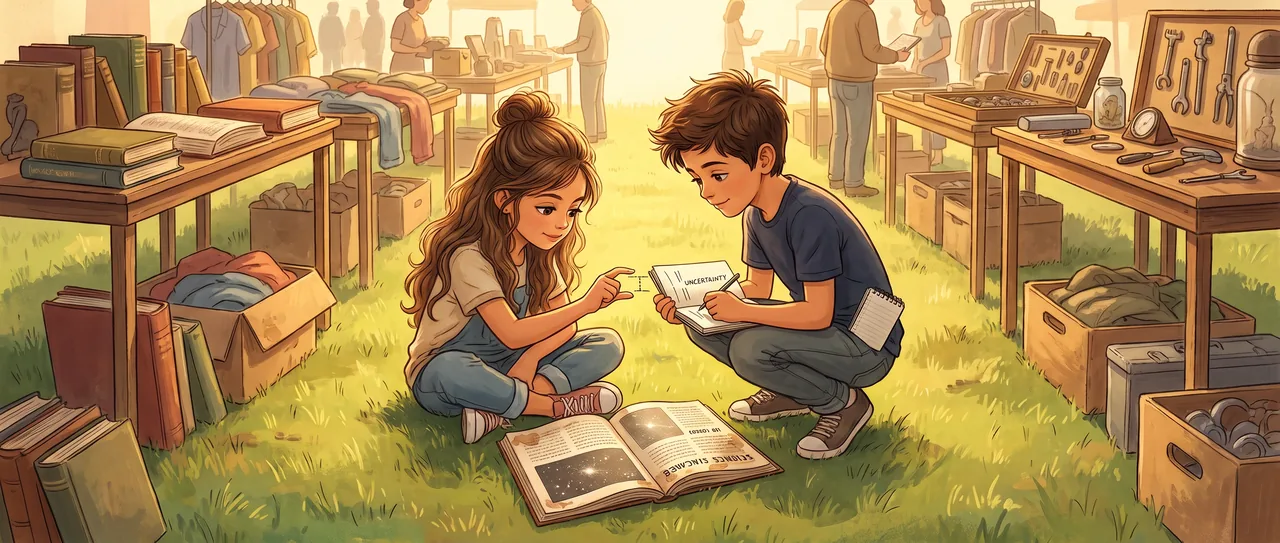
Maya found it in a shoebox between old road maps and a broken pair of binoculars. The seller, a man with a folding chair and a thermos, said the whole box was a dollar if they took the maps too.
"Just the magazine," Maya said, and handed him two quarters.
Soren was already reading over her shoulder. The page she had stopped on had a photograph of a plain, faded star, not even very bright, and a headline in big letters.
"'The star that is older than the universe,'" Soren read out loud. He stopped. "That can't be right."
"Read it again."
"I read it fine. It's just wrong. Something's older than the thing that contains it? That's like being taller than your own house."
The seller tipped his thermos toward them. "Methuselah star, they called it. My brother was into all that. Gave everyone a headache for a while, that one."
Maya sat down right there on the grass between the tables. Soren stayed standing but leaned so far over that his shadow fell across the whole article.
"Okay," Maya said. "Say the universe is about fourteen billion years old."
"Thirteen point eight," said Soren. "The article says thirteen point eight."
"And the star is?"
Soren found the number. "They measured it at sixteen billion. Plus or minus."
"Plus or minus how much?"
He scanned the column. "A lot. Almost a billion years, the wobble on it."
Maya pulled her knees up. "So somebody weighed a star and got a number bigger than everything. And instead of saying I must have measured it wrong, they printed it."
"That's the part I like," Soren admitted. He crouched down next to her. "They didn't hide it."
The seller was watching them the way adults do when they expect you to lose interest in about a minute.
"How do you even measure how old a star is," Maya said. It wasn't really a question to the man. She was thinking with her mouth.
"You can't ask it," Soren said. "So you have to read it. Like the ingredients." He tapped the page. "It says here this one has almost no metal in it. Almost pure hydrogen and helium."
"So?"
"So metal is what stars make. Heavy stuff. Iron, whatever. The universe started with just the light gases. Every star that lives and dies sprinkles heavier stuff into the next batch."
Maya turned to look at him. "So a star with no metal."
"Was built from almost the first stuff there was. Before anything had died yet to season it." Soren went quiet, then said, "That's not a middle-aged star. That's one of the very first ones."
"Okay." Maya pressed her thumbnail into the coffee ring on the cover. "So it's ancient. Fine. But ancient isn't the problem. Older than the universe is the problem. How does a measurement even do that?"
Soren read further, slower now. "They figure the age from how bright it is and how hot, and how fast it's burning through its fuel. Little numbers. And every little number has a fuzz on it. How far away it is, exactly. How much of each gas. And the fuzzes stack up."
"So the sixteen billion."
"Was the middle of a smear. The smear was so wide that one end of it poked out past the age of the universe." Soren looked up. "The star probably isn't actually older than everything. The measurement just had a shadow that fell in impossible territory."
Maya was shaking her head, but she was smiling. "No. No, wait. That's the boring version."
"It's the true version."
"It can be true and still not be the whole thing." She grabbed his sleeve. "Think about what has to be true for the smear to even matter. If they'd measured the universe as, like, twenty billion, nobody prints this. The only reason this is a headache is that the two numbers are almost touching. The oldest thing we can find and the beginning of time are right next to each other."
Soren stopped.
"Say that again," he said.
"The first stars started forming basically as soon as they possibly could. The star is nearly as old as the universe. Not older. Nearly. Bumping right up against the edge." Maya spread her hands about an inch apart. "There's almost no gap. The universe barely got a running start before it started making these."
Soren took the magazine out of her hands, gently, and held it closer to his face like the picture might have more in it than he'd seen.
"So the scary headline isn't scary," he said slowly. "It's the opposite. It's a measurement standing on the very edge of the beginning, waving."
"And they kept measuring," Maya said. "Right? They wouldn't just leave it."
Soren flipped to the end of the article. "It says newer distance measurements pulled the age down. Fourteen and a half, give or take. Fits now. Barely."
"Barely," Maya repeated. She liked the word.
"But the fuzz is still there. It always will be. We'll never get it exact." Soren looked almost happy about it. "There'll always be a version of this star that's a little too old for the sky it's sitting in."
The seller cleared his throat. "Fifty cents well spent, then," he said, and screwed the lid back on his thermos, done with them.
Maya stood up. She wasn't done at all.
"It's still up there," she said. "Right now. It doesn't know we argued about it."
Soren pulled his notebook from his back pocket. He wrote the star's name, HD one four zero two eight three, and under it the two numbers, the age of the star and the age of the universe, and drew them as two lines almost meeting. He left the tiny space between them empty.
They walked out through the rows of tables into the low afternoon light, and Soren kept the magazine open in front of him, reading the same paragraph again, not looking up, letting Maya steer him around the parked cars by his elbow.
Read the interactive version, listen to the narration, and earn a gold star →
A science-verified short story for curious kids · Curiosity Land