The Winding
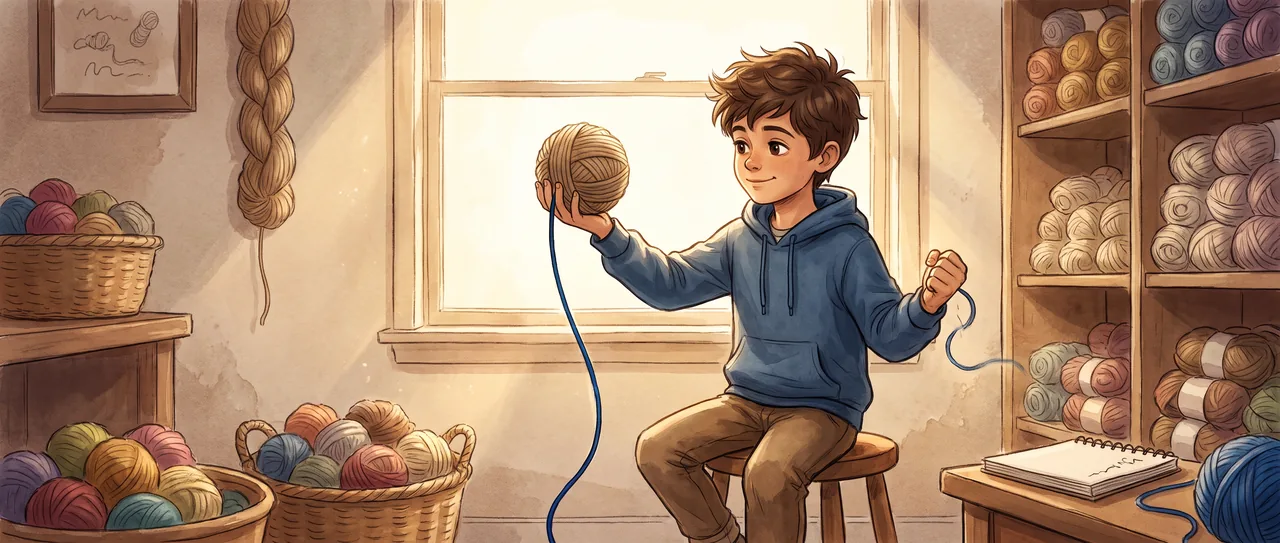
The wool smelled like sheep and dust and something warmer underneath, like the inside of a hat. Soren sat on the stool by the window while his aunt counted the till out front, and he wound the leftover yarn because his hands wanted something to do.
The skein his aunt had given him was a tangle. He found the loose end and started winding it around two fingers, around and around, and the ball grew fat and tight in his palm.
When it was tight, he tried to find the color band that had run through the middle. Earlier the yarn had a stripe in it, a length dyed deeper blue, and he had wanted to look at it. But now it was buried. Wound so tight against his fingers that the blue part had disappeared into the ball. He could not read it. It was in there. He simply could not get at it.
He loosened the wind. Let the loops go slack in his hand. The blue slid back into view, one long soft stretch of it, and he could see every fiber.
He wound it tight again. The blue vanished.
Loose. There it was.
He did this maybe six times, tight and loose, blue gone and blue back, before something in his chest went very cold and very awake at once.
His teacher had said it that morning, and it had slid right past him. She had held up a picture, a fat coiled thing like a telephone cord wrapped around beads. This is chromatin, she had said. Your DNA is almost two meters long and it fits inside a cell you cannot see because it wraps around proteins called histones. The beads. She had tapped the picture and moved on to the worksheet, and Soren had copied the word histone into his notebook and felt nothing, because a fact with nothing under it is just a shape.
He pulled his notebook out now. He drew the ball of yarn, tight, and the blue part hidden inside it. Then he drew it loose, the blue exposed.
He stopped drawing.
Two meters of thread. Wound around beads. And she had said something else, near the end, that he had not written down because he had not understood that it mattered.
Some parts wind tighter than others.
He sat very still with the yarn in his lap. If the whole two meters were wound the same, evenly, then every gene would be equally buried, equally reachable, and it would not matter where you were on the thread. But that was not what she had said. She had said some parts. Which meant the cell chose. The cell wound some stretches tight, tight as his fist, so tight the machinery that reads the thread could not reach in. And it left other stretches loose. Open. Readable.
He tugged the blue into the open and held it there against the window light. This gene, you can use. He clenched his fist around a different loop until it disappeared. This one, you cannot. Same thread. Same yarn all the way through. The difference was only how hard it was held.
His skin was doing something strange. Every cell in his own hand, the one holding the yarn, had the same two meters wound up inside it. The same complete instructions. A skin cell held the recipe for an eye, for a bone, for the inside of his stomach, all of it, the whole book. It just kept most of the book wound too tight to open. A skin cell was a skin cell because of what it kept shut, not because of what it was missing.
He looked at the back of his hand. It looked exactly the same as it had a minute ago and it was not the same at all.
His aunt called from the front that she was almost done. He did not answer. He was thinking about a thing his teacher had definitely not said, because maybe nobody had said it to her either.
If the winding could be tight or loose, then something did the winding. Something decided. And if something decided, then the decision could change. A part wound shut in the morning could be opened by afternoon. Cold could do it, maybe, or hunger, or fear, or a smell like the inside of a hat. The book was not printed. The book was being held open and shut, page by page, all the time, by hands he could not see, in every cell he had, right now, while he sat on a stool.
And some of those hands might remember. Might hold a page shut so long the cell forgot the page was there. Might pass the held-shut page down when the cell divided, so the daughter cell was born already knowing which pages to keep closed.
He did not know if that last part was true. It felt too big to be allowed. He wrote it down anyway, the question, with a hard slanting line under it, because he needed somewhere to put it and the inside of his head had run out of room.
Can a cell inherit a page it was never told to close?
His aunt came through the curtain wiping her hands on her apron. She saw the yarn ball, mostly wound, one long blue stretch hanging loose out of the tight part like a tongue.
"You unwound half of it," she said, not unkindly.
"I had to see the blue," Soren said.
She laughed and reached to take the skein from him and rewind it neat. He held it a second longer than he needed to. Then he let go, and watched her thumb press the blue back into the ball, around and around, until it was gone.
Read the interactive version, listen to the narration, and earn a gold star →
A science-verified short story for curious kids · Curiosity Land