The Spoon That Wasn't There Anymore
The card taped to the box said MISC METAL, DO NOT PAWN, and Mr. Okafor had waved at it on his way to lock the register.
"Sort it. Anything shiny, put on the shelf. I'm counting the drawer."
Maya lifted the spoon out first. It was the color of a mirror that had gone cloudy, heavier than it looked, cool against her fingers.
"Soren. Feel this."
He took it. Turned it over. There was no maker's mark, no dents, nothing wrong with it exactly.
"It's a spoon," he said.
"It's getting soft."
"Spoons don't get soft."
"Hold it longer."
He closed his hand around the bowl of it and waited, because waiting was a thing he was good at. Maya watched his fingers. After a minute he opened his hand and the spoon had a bend in it, a gentle sag where none had been.
"I didn't press," he said.
"I know. I watched."
He pressed now, lightly, and his thumb left a dent like the spoon was warm butter. A bead of silver welled up at the edge and slid, whole and round, into his palm. It did not feel wet. It rolled.
"Okay," Soren said, very carefully, the way he talked when something had stopped making sense in an interesting direction. "Metal doesn't do that at room temperature. Mercury does that, but mercury is a liquid, and this was solid ten seconds ago."
"You warmed it."
"I warmed it with my hand. My hand isn't hot."
They looked at each other.
"So its melting point is somewhere your hand can reach," Maya said. "Which is basically nowhere. Body heat is nothing. Body heat can't melt a paperclip."
Soren set the bead down on the counter and it sat there, a little silver dome, holding its shape. Then he laid the spoon beside it. Half the bowl had already slumped where his fingers had been.
"Put it down," he said. "Watch what it does cold."
They watched. On the cool glass counter the spoon firmed up again. The sag stayed, but it went hard. The bead beside it stayed a bead.
"It's not broken," Maya said. "It goes back. Hot soft, cold hard. Over and over?"
"I want to know the number," Soren said. "The exact temperature where it flips. Because if it's just above the room, then the room is the whole trick. The room decides whether it's a spoon or a puddle."
Maya was already looking toward the little back kitchen where Mr. Okafor made his tea, where the electric kettle sat with its light still glowing orange.
"Tea's hotter than a hand," she said.
"A lot hotter."
"So if a hand almost melts it."
Soren picked up the spoon. He looked at it the way you look at something you are about to lose on purpose.
"We should ask," he said.
"We should find out first. Then ask."
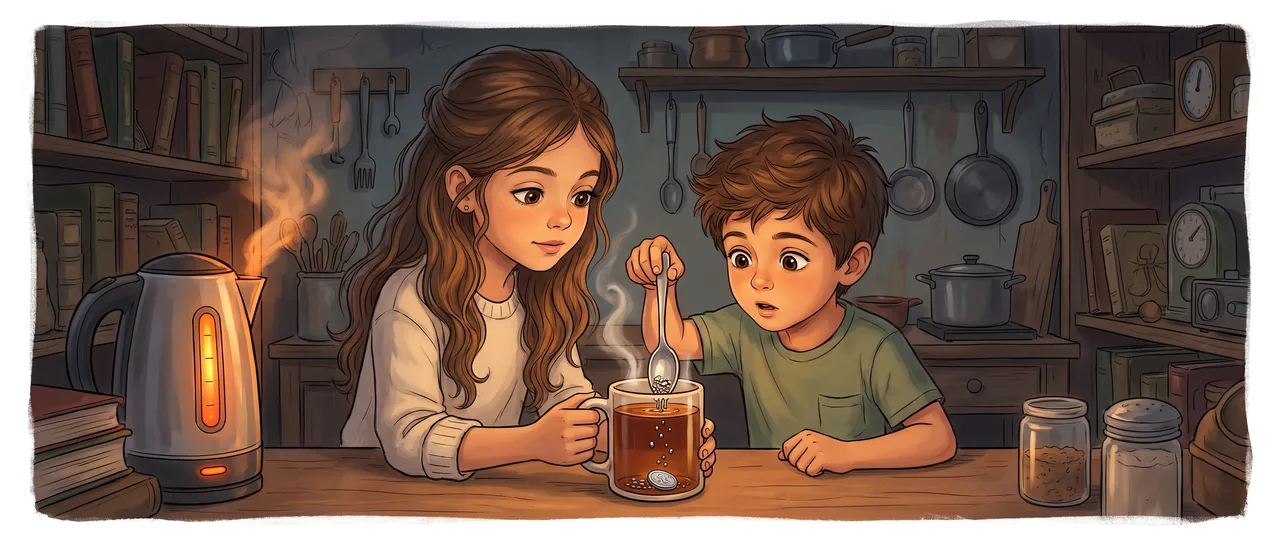
He carried the spoon to the kitchen doorway. Mr. Okafor's abandoned mug sat on the counter, steam still ghosting up off it, a teabag string hanging over the rim. Maya held the mug steady. Soren lowered the spoon in, bowl first, the way you would to stir.
It did not stir.
The bowl of the spoon simply stopped being a bowl. It went from a shape to a shine, unrolling into the tea like a curl of butter off a hot knife, and where the silver met the dark liquid it broke into a hundred tiny mirrored beads that scattered and skated along the bottom of the mug and gathered again in the deepest part, a little pooled coin of metal that had been, four seconds ago, something you could hold.
The handle was still a handle. Soren was pinching it. Then the handle softened at the pinch and drooped, and he let go, and it slid down into the tea and was gone too.
Neither of them said anything for a while. The kettle ticked as it cooled.
"It's under there," Maya said finally. "All of it. It didn't disappear. It's a puddle at the bottom of a mug."
"Twenty-nine point eight," Soren said.
"What?"
"I think I know what it is. There's a metal that melts at twenty-nine point eight degrees. Gallium. Room temperature is what, twenty-two, twenty-three. So the spoon lives its whole life seven degrees below melting. Seven degrees. It's always almost a liquid. It's just waiting."
Maya leaned over the mug. The pool at the bottom quivered when she breathed on it.
"So every solid thing," she said slowly, "is only solid for the temperature it happens to be in."
"Yeah."
"The counter. The window. My shoes. They're all just." She stopped. "They're all just holding their shape because the room is cool enough. There's a temperature where the counter is a puddle. There's a temperature where the window pours."
"For everything," Soren said. "Every solid thing has a number where it stops being solid. We just live in a room that's below most of the numbers. That's the whole reason anything stays a thing."
"And this one." Maya nodded at the mug. "This one has its number right next to us. So close a hand can reach it."
"So close a cup of tea just crossed it."
Mr. Okafor's footsteps came down the hall. "Did you two find the misc metal? There was a spoon my aunt swore was cursed, wouldn't sit right in a drawer."
Maya didn't turn around. She was still watching the little silver coin at the bottom of the tea, holding its shape now, hardening again as the mug lost its heat, becoming a solid thing once more in a room that was just barely cool enough to let it.
"It's not cursed," she said. "It's just closer to the edge than we are."
Soren reached past her and lifted the mug by the handle. He tilted it, slow, toward the light, and the pooled metal at the bottom slid across the ceramic and caught the orange glow of the kettle and gathered itself back into a single bright bead.
Read the interactive version, listen to the narration, and earn a gold star →
A science-verified short story for curious kids · Curiosity Land