The Rule the Giraffe Was Following
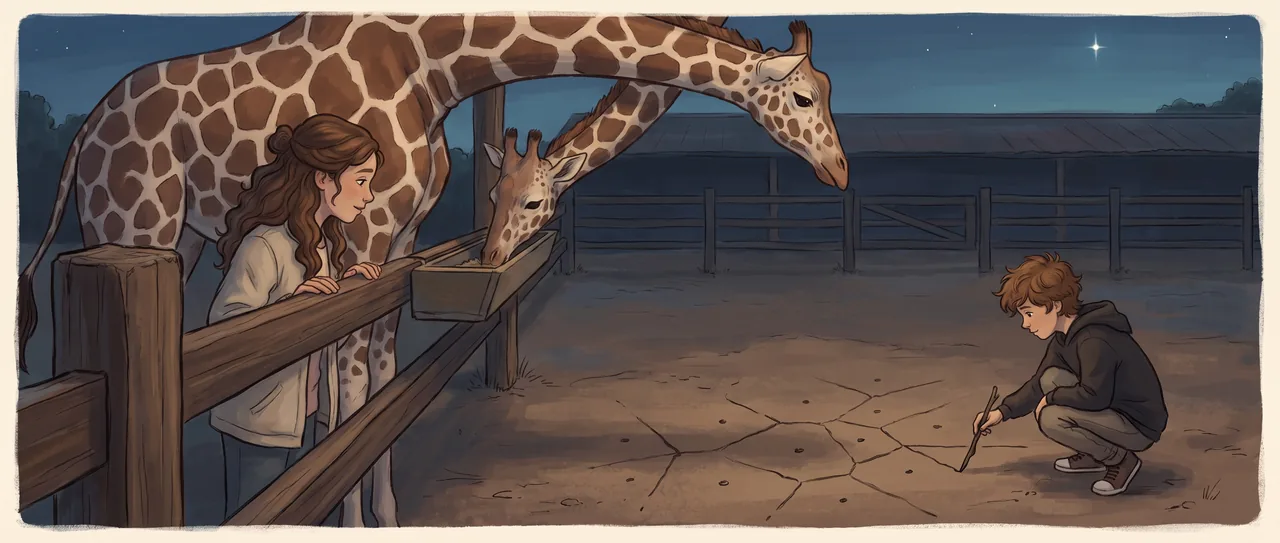
The keeper had gone in to hose down the trough, and the crowd had wandered off to the meerkats, so it was just the two of them at the rail and one enormous giraffe chewing sideways above their heads.
"Look at the patches," Maya said. "They fit together. No gaps."
"Course they fit," Soren said. "It's a giraffe."
"No, but look how they fit. The lines between them." She traced the air with one finger, following a pale seam that ran between two brown patches. "Every line is straight-ish. And every place three patches meet, it's like a little Y."
Soren looked. He was good at looking at the thing that seemed wrong, and nothing here seemed wrong, which was itself a little wrong. "They never meet four at a time," he said slowly. "It's always three. Always a Y, never an X."
"See."
"That's weird. If it was random, sometimes four corners would land in the same spot."
The giraffe swung its head to the trough and its whole neck went past them like a slow crane. Maya watched the patches slide.
"What if the lines aren't the thing," she said. "What if the lines are where the patches stop."
"Same thing."
"No." She was quiet, and then she was fast. "Put a dot in the middle of each patch. In your head. One dot per brown blob."
"Okay."
"Now the line between two patches. It's exactly halfway between their dots. It has to be. It's the fence between them. Everything on this side is closer to this dot, everything on that side is closer to that dot."
Soren stopped chewing his own lip. "That would do it," he said.
"Do what?"
"The no-X thing." He picked up a stick from the ground and crouched by a patch of bare dirt at the base of the fence. "Watch. Say I put three dots down." He poked three holes, spread apart. "Every point on the ground belongs to whichever dot is nearest. The border between dot one and dot two is a line. Between two and three, another line. Between one and three, another. Three borders."
"And they meet."
"They have to meet somewhere. One spot that's the same distance from all three dots at once." He drew it. Three lines came in and touched at one point, making a Y. "Three dots, one meeting point, three arms. A Y."
"So to get an X you'd need—"
"Four dots all exactly the same distance from one spot. Perfectly. Which basically never happens by accident." He sat back on his heels. "So it's always Ys. On the ground and on the giraffe."
Maya crouched next to him. "Do more dots."
He did. Eleven, twelve, scattered like she'd thrown them. Then he drew the borders, each one halfway between the nearest pair. The dirt filled up with rooms. Odd-shaped rooms, some big, some pinched, every wall straight, every corner a Y.
"That's the giraffe," Maya said softly. "That's exactly the giraffe."
They both looked up. The animal had a coat full of the same rooms, drawn in brown, and now that they had made it once in the dirt they could not stop seeing the dots that must be hiding in the center of each patch. Something the giraffe grew before it was born, some scatter of starter cells, each one claiming the skin nearest to it.
"Wait," Soren said. He looked at his dirt drawing, then at the giraffe, then at nothing. "It's not about giraffes."
"What?"
"It can't be about giraffes. It's just a rule about dots and nearest. Anything that's made of stuff spreading out from starting points would do this." He turned the stick over in his hand. "Bubbles in foam. The cracks in dry mud. Cells."
"Cells like—"
"Like in us. The picture in the science room. The one that looked like a stone wall." He was drawing faster now, more dots. "Every cell grew out from a center and pushed until it hit the next one. Halfway lines. Ys."
Maya had gone still, and then she said the thing she had been circling. "How far up does it go."
"How far up what?"
"The rule. Cells are little." She stood, and looked past the giraffe, past the roof of the enclosure, at the sky going the deep blue it went before the first stars. "If you put dots really far apart. Really really far."
Soren stood too.
"Stars," she said. "Whole galaxies. If they're just dots, and there's empty in between, and the empty is the border where you're not nearest to anybody—"
"Then the universe would have the same rooms." Soren's voice had gone careful. "Giant ones. With galaxies clumped on the walls and nothing in the middle of the rooms."
"Is that real? Is it actually like that?"
"I don't know." He looked at the dirt, the little scattered rooms by his shoe, then up at the sky where the same drawing might be waiting at a size neither of them could hold in their head. "But it's the same rule. It doesn't know how big it's allowed to be."
The first real star came out over the enclosure roof. Maya found it, then hunted for the next one, already trying to see the walls between them, the borders where the sky belonged to no star at all.
"Somebody drew the giraffe once," she said. "In a book. Somebody had to sit and copy every patch."
"They didn't have to," Soren said. "They just needed the dots. Everything else is where the dots stop being nearest."
He crouched one more time and pressed a fresh dot into the dirt, off on its own, away from the rest. The nearest borders bent toward it as he redrew them, every neighbor giving up a little of its room to the newcomer, the whole pattern rearranging itself around one point that hadn't been there a second ago.
Maya watched the walls move.
"Do another," she said, and the giraffe folded its neck down into the dark, wearing the answer all over its back.
Read the interactive version, listen to the narration, and earn a gold star →
A science-verified short story for curious kids · Curiosity Land