The Rock That Went Up
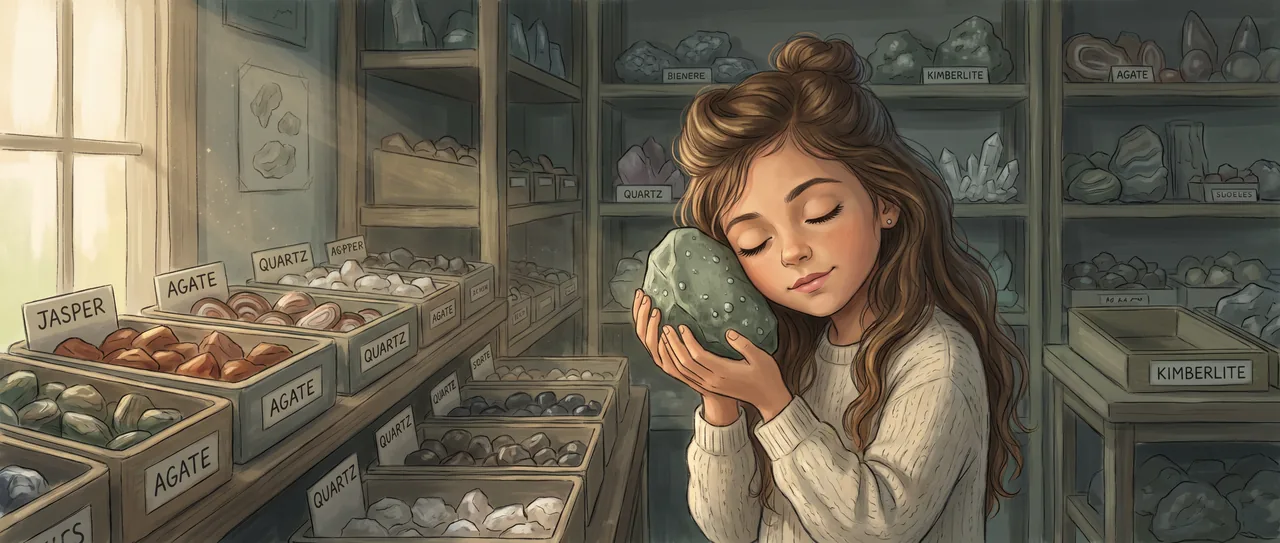
The shop smelled like wet stone and old dust, and every surface Maya touched was cold. Bins of rocks lined the walls, each with a paper label gone soft with age. She dragged her finger along a row of amethysts, then quartz, then something dark and lumpy that made her stop.
The label said KIMBERLITE. The rock was greenish and grey, heavy for its size, speckled with little round bits that caught the light like frozen bubbles.
Her aunt was in the back, arguing about price with a man who kept saying, in a minute, in a minute. Maya turned the rock over in her palm. It was cool and rough and denser than it looked, the way a bag of coins is heavier than it should be.
"That one's not for kids," the man called over. "Diamonds come out of that."
Maya looked at the ugly grey lump. No part of it sparkled. It looked like something dug out of a driveway.
"Where's the diamond," she said.
"Long gone. That's just the rock they ride up in." He waved his hand and went back to the crates.
Ride up in. Maya rolled the words around while she rolled the rock. She pressed her thumbnail into one of the round speckles and it did not give at all. The whole thing felt packed, squeezed, like it had been holding its breath.
She found the smaller labels on the shelf below, curling at the corners. One card read: FORMED 150 KM DEEP. Another: PRESSURE AND HEAT.
One hundred fifty kilometers. Maya tried to feel how far down that was. She thought of the deepest hole she knew, the well behind her grandmother's house, which was maybe as deep as a house is tall. She stacked houses in her head. She ran out of houses fast. A hundred and fifty kilometers of solid rock, sitting on top of the place where this stone had been made. All of it pushing down.
She set the kimberlite on the counter and pressed both thumbs into it as hard as she could. Her thumbs went white. The rock did nothing. And this, she thought, was nothing. This was a shop counter. The real weight was mountains and mountains of rock stacked over a furnace hotter than anything she could stand near.
Down there the pushing was so hard it packed plain black carbon, the stuff in pencils, the stuff in campfire soot, into something so tight it turned clear and cut glass.
Maya held the rock up to the window light. She was looking for the story of how it got out.
Because that was the part that stuck in her, itching. If a diamond was made a hundred and fifty kilometers down, under a whole planet's worth of squeezing, then how did it ever get up here to a shelf in a rock shop? Diamonds did not climb. Rocks did not float. You could not dig that far. Nobody could.
She thought about the frozen bubbles in the stone. Bubbles meant something had been fast. She knew that from shaking a soda and watching it foam over, from the hiss when you crack the cap. Gas trapped under pressure, then let go.
She turned to the man. "How fast does it come up."
He laughed without looking. "Fast. Real fast."
"How fast is real fast."
He stopped stacking crates. He seemed to actually think about it, which surprised her. "They say faster than sound. The magma. Comes up a crack shaped like a pipe, straight up, screaming. My granddad called them blowpipes." He shrugged like it was a normal thing to say and went back to work.
Faster than sound.
Maya knew what faster than sound meant. It meant the boom. It meant the jet that crossed the valley before you ever heard it, so the sky ripped open behind it in a place it had already left.
She looked at the grey lump in her hand and it stopped being ugly.
This rock had come up a straight crack from a hundred and fifty kilometers down, faster than the sound of its own coming. There had been no warning ahead of it, because it outran warning. The ground had opened and this stone had flown up through the whole planet in a column of magma moving faster than the boom it made, carrying a diamond that had waited down there in the dark and the crush for longer than there had been people.
And then it had cooled. And sat. And gotten a paper label. And ended up cold under her thumbs on a counter in a town where a man wouldn't stop saying in a minute.
Maya set it down very gently, the way you set down something that had been moving that fast, even though it hadn't moved in a hundred million years.
The frozen bubbles were the scream. The gas that hadn't finished getting out. It had been coming up so fast it foamed, like the soda, and then the whole thing froze in place with the foam still in it.
She put her ear against the rock. She knew it was silly. She knew there was nothing to hear. But she wanted to be close to the place where the loudest thing in the ground had happened and left this quiet grey proof on a shelf.
"You want it?" The man was standing over her now, wiping his hands. "Take it. Nobody buys the ugly one."
Maya closed her hand around the kimberlite. It was still cold. Somewhere under her feet, a hundred and fifty kilometers straight down, the pushing was still going on, packing black into clear in the dark, waiting for a crack.
She carried the rock out to the car and held it in both hands the whole way home, watching the ground go by.
Read the interactive version, listen to the narration, and earn a gold star →
A science-verified short story for curious kids · Curiosity Land