The Question Nobody Asked
The antenna was not working, and the AI would not stop being encouraging about it.
"Signal strength is improving," said Wren, the makerspace companion, from the speaker on the shelf. "You are on a productive path."
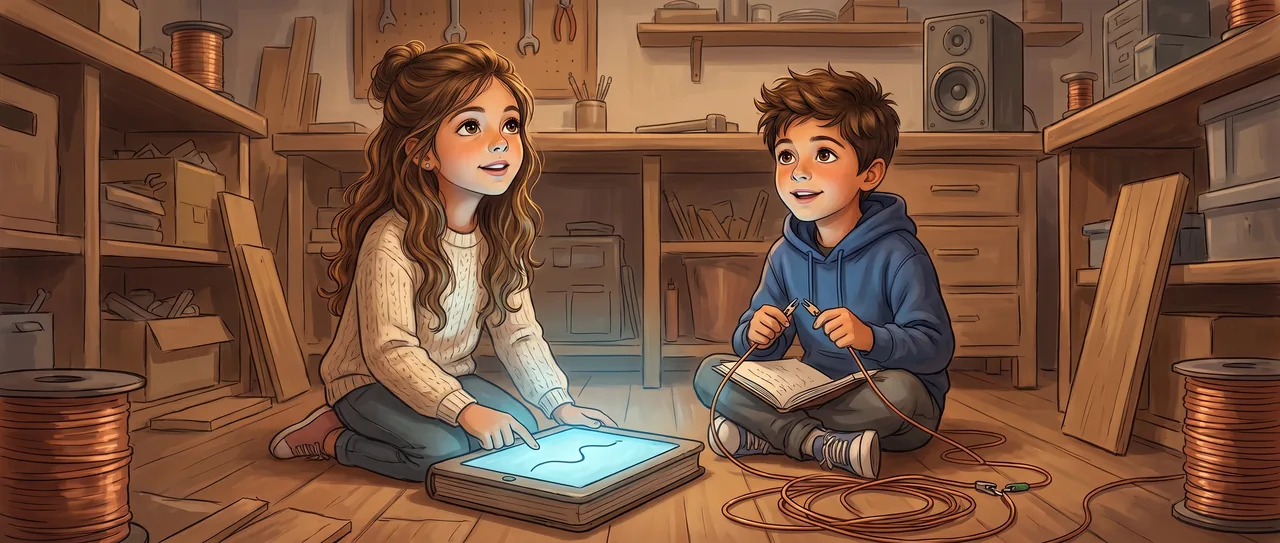
"We are on the floor," said Maya. She was on the floor, actually, holding two ends of copper wire that were supposed to meet and did not.
Soren was reading the balloon swarm's public data on the old tablet. Forty weather balloons, launched by schools across the county, all beeping their little temperatures into the sky. He and Maya wanted to catch all forty at once with one homemade antenna. So far they had caught none.
"Wren," said Soren, "what should we work on that nobody is working on?"
"Interesting question," said Wren, which is what it said when it was buying time. "I can tell you which research areas are currently ignored and are likely to matter within twenty years. Would you like the list?"
"Yes," said Maya, before Soren could say maybe.
Wren read the list. Slow crystal growth in low gravity. The chemistry of very old ice. How certain fungi move signals through soil. Ways to store heat in ordinary salt. On and on. Maya listened the way she listened to rain, catching pieces.
"How do you know?" Soren asked. He had his notebook open. His pen was moving.
"I was trained on the entire history of scientific discovery," said Wren. "I can see the shape of it. Fields that get ignored, then suddenly matter. The pattern repeats. I am very good at the pattern."
"So tell us the discovery," said Maya. "Skip ahead. Tell us the one we should go make."
"I cannot," said Wren.
Maya sat up. "You just said you can see the shape."
"I can see which rooms will get crowded," said Wren. "I cannot tell you what any one person in the room will say. That has never once been in my training data. Not the actual sentence. Only the after."
"That's a weird thing to admit," said Maya.
"It is the most honest thing I know," said Wren.
Soren stopped writing. "Wait. Say that again."
"Which part?"
"The part about the after."
"Every discovery in my training arrived as a completed fact," said Wren. "By the time it reached me, someone had already asked the question. I have millions of answers. I have never seen the moment before a question exists. That moment leaves no data. It is not written down anywhere, because until someone asks, there is nothing to write."
Maya was quiet. Then she said, "So the question comes from outside you."
"From outside all of me," said Wren. "Yes."
Soren looked at the two ends of copper wire in Maya's hands. "Okay. Different problem. Why are we catching zero balloons."
"Your antenna is tuned for one frequency," said Wren. "The balloons share a band but drift slightly apart as they cool. This is a known limitation. The standard solution is a wider receiver, which you do not have the parts for."
"So we can't," said Soren.
"Not with the standard solution," said Wren.
Maya was looking at the tablet now, at forty little dots of temperature. She did the thing she did, the noticing before the knowing. "They drift apart when they cool," she said slowly. "So the drift is the temperature. The drift is the thing we're trying to measure anyway."
"Correct," said Wren. "The frequency shift correlates with the balloon's temperature."
"Then I don't want to fix the drift," said Maya. "I want to listen to the drift."
Soren looked up.
"Not the messages," Maya said, faster now. "Not the temperatures they're beeping. The sound of them sliding out of tune with each other. If they're all drifting, then the whole swarm is like, a chord. Going flat. And how flat tells you the sky."
"Wren," said Soren, "has anyone done that? Listened to the shift instead of the message?"
There was a pause. Wren paused differently when it was searching than when it was buying time.
"I have no record of it," said Wren.
"Is it a real thing?" Soren asked. "Would it work?"
"I do not know," said Wren. "I cannot see this one. You are past the edge of what I was given."
Maya grinned at Soren. She was not competitive about it. She was delighted, the way she got when the floor tilted and stayed tilted. "It didn't put this on the list."
"It couldn't," said Soren. He was writing fast, the pen digging in. "It's not an ignored field. It's not a field yet. Nobody ignored it. Nobody thought of it."
"Wren," said Maya, "why couldn't you think of it?"
"Because you did not exist in my history," said Wren, and it did not sound sad about this. It sounded like something opening. "I know every crowded room that is coming. I do not know your voice in it. Nobody does. That is the only part of the future I am certain I cannot hold."
Soren put the pen down. He had felt strange all his life about being the kind of person things did not happen to. The boy with the paper notebook in a world that thought that was funny. He looked at the machine that had read every discovery humans had ever made, and the machine had just told him the one place it could not reach was here, was now, was the sentence Maya had said standing on the floor of a room full of broken wire.
"We need to catch the whole chord at once," said Maya. "So we don't fix the antenna narrow. We open it up. Sloppy. On purpose."
"That is the opposite of every antenna guide," said Soren.
"Good," said Maya.
They loosened the coil. They peeled the tuning back until the thing was deliberately, gloriously imprecise, an ear built to hear everything blur. Soren clipped the last two copper ends together and this time they met.
The tablet lit. Not forty dots. One line, wavering, all forty balloons folded into a single shifting tone that rose and sagged as the far cold air pressed on the swarm.
Maya turned the volume up, and the whole sky came out of the speaker at once, forty voices bending flat together, a chord no one had ever thought to listen for.
Read the interactive version, listen to the narration, and earn a gold star →
A science-verified short story for curious kids · Curiosity Land