The Nudge
The car went quiet in a way engines are not supposed to go quiet, and then it was just Maya, her uncle, and a road with no lights on either side of it.
"Battery," Uncle Ravi said, tapping the dark dashboard like it might wake up. "Tow truck is an hour out. Sit tight."
He called the number and then leaned his seat back and closed his eyes, which was his way of dealing with things he could not fix immediately. Maya got out.
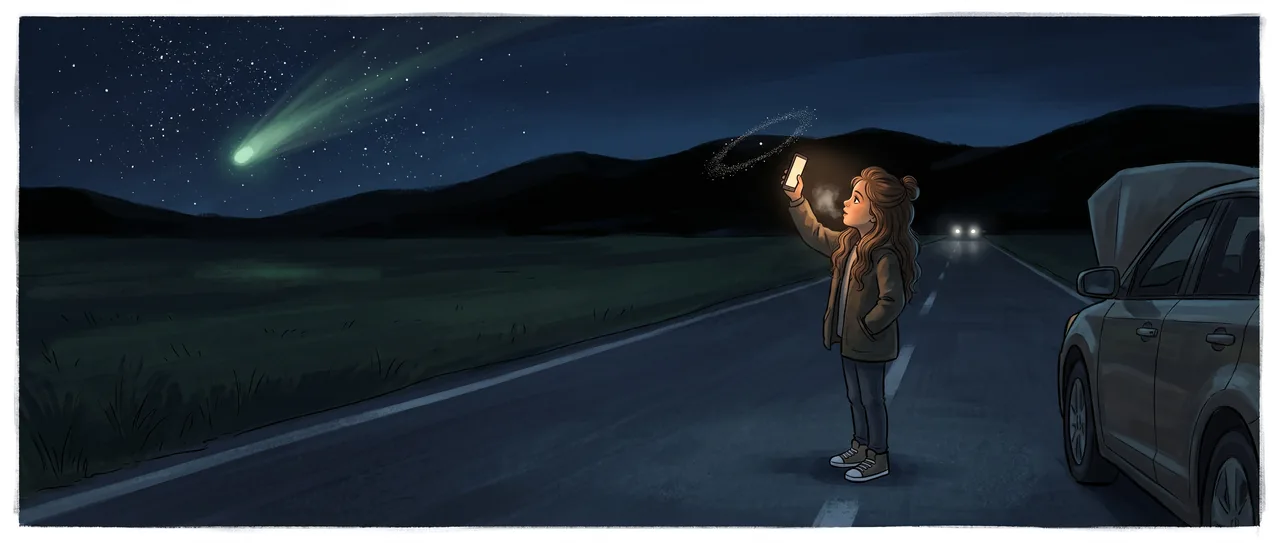
The cold came up through her sneakers first. Then the sky arrived all at once, the way it does when there are no streetlights to hold it back. So many stars that the familiar ones drowned. And low over the black shape of the hills, a smudge. Not a star. Stars are points. This was a point with something soft dragged out behind it, like a thumb had smeared it sideways.
A comet. She had seen the news alert about it that morning and forgotten. Now here it was, patient, faintly green, hanging above the field like it had all the time in the world.
Maya pulled out her phone and opened the sky map she kept, the one that named things when you pointed it up. It labeled the comet with a string of numbers. It said the comet had come from somewhere out past Neptune. A region. A belt of frozen things.
She held the phone toward the smudge and read the little panel of facts, breath steaming across the screen.
The belt out there was not empty. It held more than a hundred thousand chunks of ice and rock each bigger than a hundred kilometers across. She tried to feel that number and could not. A hundred thousand things, each one wider than the whole drive she and Ravi had just made, and those were only the big ones. The small ones were not even worth counting.
And every so often, the panel said, one of them got nudged. Slipped inward. Fell sunward for thousands of years and came out the far end of the dark as this, a green thumbprint over a cold field.
Maya lowered the phone.
Nudged by what.
The word sat in her like a splinter. Things do not just fall. Something has to push. She thought about the marble run she and her cousin had built out of paper towel tubes, how a marble sat still forever at the top until you touched it, and then it went and went and could not stop. The comet was a marble. Someone had touched it a very long time ago.
She pinched the sky map and zoomed out, out past the comet, out past the planets, until the screen showed a ring of tiny dots circling the sun far beyond everything. The Kuiper Belt, the label said. She turned slowly in the road, matching the ring on the screen to the real dark overhead, trying to place where all those hundred thousand things actually were right now, above the hills, above her.
And she noticed something the map was quietly showing her.
The dots on the far outer edge were not scattered evenly. They leaned. A clump of the most distant ones all pointed their long looping paths the same direction, like grass all combed by a wind she could not see. She dragged the view around. The lean stayed. It was not her eyes.
Maya frowned. Marbles do not comb themselves. If the outer edge of that ring was leaning one way, all together, then something was pulling on it. Something with enough weight to lean a hundred thousand frozen worlds.
She tapped the tilted region. The panel changed. It used careful words. It said the clustering might be caused by an undiscovered planet, far out, dark, never yet seen, its gravity slowly grooming the edge of the belt into that lean.
Might be. Undiscovered.
Maya read it twice to be sure it really said what she thought.
Somebody had looked at the same combed-grass lean she was looking at right now, on a road in the cold, and had done the arithmetic backward, the way she liked to do it, feeling the answer first and then chasing the reason. They had felt a weight that no telescope had ever caught. They had pointed at empty black sky and said there is something there, we just cannot see it yet, and the leaning is its footprint.
She turned to the actual sky, to the real dark past the comet, where the map said the tilted edge of the belt hung. There was nothing to see. Of course there was nothing to see. That was the whole point. The planet, if it was a planet, was too far and too dark and no one had found it. It might be found next year. It might be found by someone who was eleven right now, standing in a road, cold in the feet, holding a phone.
The comet had come all that way to tell her the edge of everything was leaning.
"Maya?" Ravi's voice, muffled, from inside the car. "You freezing out there?"
"Yeah," she said, and did not go in.
She held the phone up again and lined the little tilted ring against the black hills one more time, checking, because she did not trust a thing until she had looked twice, and the lean was still there, patient as the comet, combed all the same way by a hand nobody had shaken yet.
Far down the road, two small headlights turned onto the straightaway and began the long slow crawl toward the dead car, and above them, unbothered, the green smudge kept falling out of the dark it had been pushed from ten thousand years before Maya was born.
She stayed standing in the cold, phone raised, tracking the empty place in the sky where the weight had to be.
Read the interactive version, listen to the narration, and earn a gold star →
A science-verified short story for curious kids · Curiosity Land