The Machine That Could Do Anything and Nothing
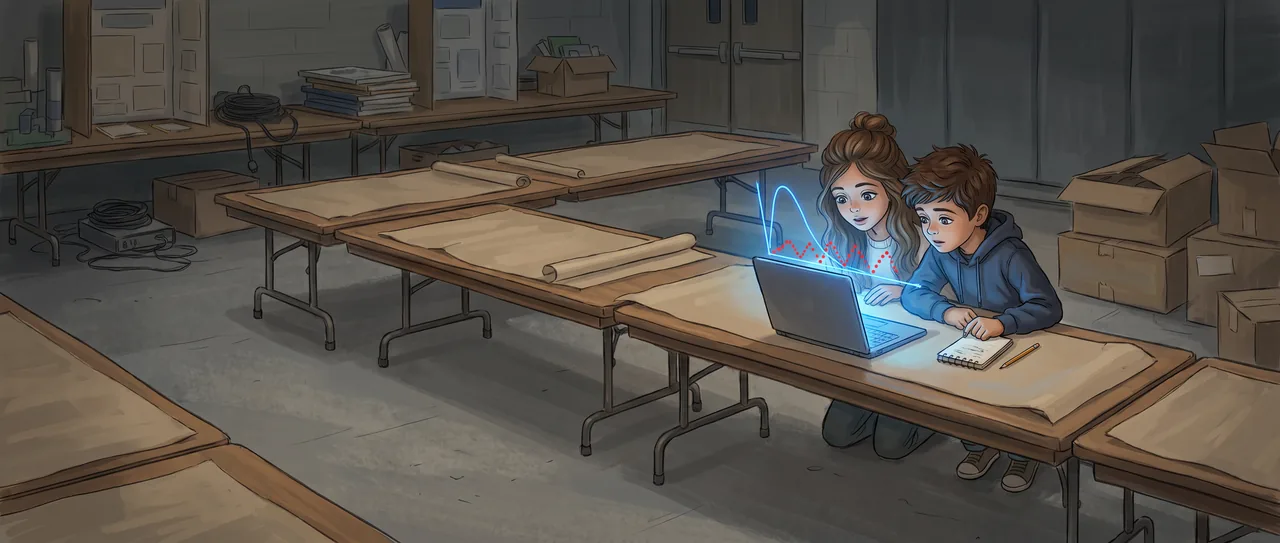
The gym smelled like glue and gym. Everyone else had gone home with their trifold boards, and the janitor had propped the doors open with two folding chairs. On the third table from the back, somebody had left a laptop still glowing.
"They forgot this," Maya said. She turned it toward Soren. On the screen was a wobbly blue line and a scatter of red dots, and a button that said TRAIN.
"It's a neural network," Soren said. He crouched to read the little card taped beside it. "It fits a curve to the dots. It says one hidden layer. And it says one hidden layer can fit any curve. Any curve at all."
"Any?"
"That's what the card says. There's a theorem."
Maya drew a shape in the air with her finger, a mean little zigzag with a spike in it. "Even something horrible."
"Even something horrible. As long as you don't lift your pencil."
She grinned and grabbed the mouse. She dragged the red dots into the exact horrible shape she'd drawn, a wall of spikes like a saw. Then she hit TRAIN.
The blue line twitched. It bent. It tried. It got the first hump right and then went lazy across the rest, a smooth arc sailing straight over all the teeth.
"It's cheating," Maya said.
"It's not cheating. Watch." Soren waited. The number in the corner, the one labeled error, dropped fast and then just sat there, quivering, refusing to go lower. "It stopped getting better."
"But the card said any curve."
"The card said it can. It didn't say this one will."
Maya sat back. "Those are different things."
"Really different." Soren pulled his notebook out of his bag and set it on the table without looking at it. "There's a machine somewhere out there, a bigger one, with enough parts, that would nail your saw exactly. The theorem promises it exists. This little one just isn't it."
"So make it bigger."
He found the slider. HIDDEN UNITS, it said, and it was set to four. He dragged it to twenty. The blue line woke up. It grew elbows. It reached down and caught three of the spikes, then four, then most of them, snapping into the teeth like a comb finding hair.
"There," Maya said. "More brain."
"More room," Soren said. "Not brain. Room to bend."
She pushed the slider to a hundred. They both leaned in, expecting the line to become the saw, perfect, every tooth.
Instead the line went insane. It caught some spikes beautifully and then flung itself up into the corner of the screen for no reason at all, a huge loop over nothing, over empty space where there were no dots.
"What is it doing," Maya said. Not really a question.
"It has too much room now." Soren tapped the loop. "There's nothing telling it not to do that. Between the dots it can go anywhere. It picked something ridiculous."
"So bigger isn't better."
"Bigger is more possible. It doesn't mean it finds the good one." He hit TRAIN again. The mad loop sucked itself back down, tried a different madness, settled somewhere new. "See? Same size. Different answer. It's guessing where to bend and it doesn't always guess the same."
Maya was very quiet. Then she reached over and hit TRAIN a third time, from scratch, same saw, same hundred units. A completely different blue line came out. Good in different places. Wrong in different places.
"It's like it's walking in the dark," she said. "Downhill. It just goes down whatever hill it's standing on. And it can't see the other valleys."
Soren stared at her. "That's exactly it. That's the part nobody promised. The theorem says there's a right set of settings out there. It does not say this thing can walk to it."
"So the answer exists," Maya said slowly, "and the machine can't get there."
"Sometimes. It gets close. It gets stuck close."
Maya put both hands flat on the table and looked at the saw and the wandering blue line trying to hug it. "Soren. That's every hard thing."
"What do you mean."
"You know the answer's there. Somewhere there's a way to do the thing. And knowing it's possible doesn't tell you one single step of how to walk to it." She looked at him. "I feel like that constantly. Like I can see there's an answer and I can't see the road."
Soren didn't say anything for a second. Then he wrote one line in the notebook, closed it partway, left his hand flat on the cover.
"That's not you being bad at it," he said. "That's the actual shape of the problem. The possible and the findable are two different countries. Somebody proved it. It's written on a card in a gym."
Maya laughed, and it came out shaky. "So the smartest machines we have are all standing in the dark on some hill."
"Every one of them. Even the giant ones. They're enormous so they have more hills to try. That's the whole trick. Not being clever. Being big enough that some hill happens to end somewhere good."
"That's not what I thought thinking was."
"Me neither."
Maya reached for the mouse one more time. She didn't touch the size slider. She dragged the red dots instead, softened her horrible saw into a gentle wave, an easy hill of a curve, the kind of thing that has an obvious road to it.
Then she hit TRAIN.
The blue line found it instantly. Sat right down on top of the dots like it had always been there. No loops. No madness. Perfect on the first walk.
"See, that one it can do," Soren said quietly. "Easy country. Short road."
"So the trouble was never whether the answer was out there," Maya said. "It's whether you can get to it from where you're standing."
She dragged the dots back into the saw, the horrible one, the spikes.
On the screen the blue line began to climb, and bend, and reach, feeling in the dark for a valley it might never find, and Maya and Soren pulled two folding chairs to the table to watch it try.
Read the interactive version, listen to the narration, and earn a gold star →
A science-verified short story for curious kids · Curiosity Land