The Letter That Was Wrong
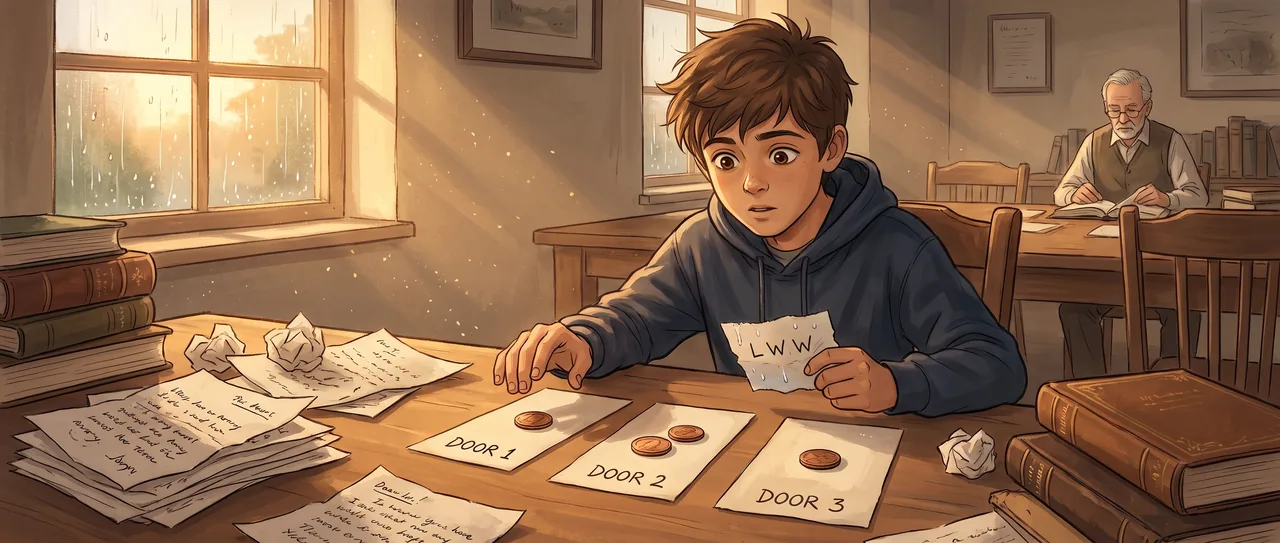
The rain had come sideways for an hour, so Soren stayed in the reading room of the historical society with a gray archive box open on the table. The volunteer at the desk, a man named Mr. Ackley, had told him the box was mostly junk, letters people mailed to the local paper about nothing. Then Mr. Ackley went back to alphabetizing something and did not look up again.
Most of the letters were about parking. But near the middle, someone had clipped a magazine column and stapled forty or fifty letters behind it, all dated the same spring. The column described a game. Three doors. A car behind one, a goat behind each of the other two. You pick a door. The host, who knows where the car is, opens a different door to show you a goat. Then he asks if you want to switch to the last unopened door.
The column said you should switch. It said switching wins two times out of three.
Soren read that twice. It felt wrong. Two doors were left. One car. That was one out of two, surely. He turned to the stapled letters.
The letters agreed with him, and they were furious.
The first was from a man who signed himself with three degrees after his name. He wrote that the columnist had done a grave disservice and should print a correction. The second was shorter and meaner. The third was from a high school math teacher who said he had shown the column to his class as an example of a published error. There were dozens. Professors. An engineer. Somebody from a statistics department. They all said the same thing in different handwriting. Two doors, one car, one half. The columnist was a woman, and several of the letters mentioned that, as if it explained the mistake.
Soren felt the strange comfort of a crowd agreeing with him. Then he felt uneasy, because it was a very large crowd, and crowds that size did not usually take the trouble to write letters unless something had gotten under their skin.
He found three coins in his pocket and a scrap of the note paper the society left out. He could not test doors, but he could test picking. He wrote the car behind door one every time, to keep it simple, and then he pretended to be someone who always guessed and always switched.
He did it slow. He guessed door one. The car was behind door one. The host opened a goat, he switched, he lost. He wrote L.
He guessed door two. Car was behind one. The host could only open door three, the goat. Soren switched to the door that was left, which was door one. He won. He wrote W.
He guessed door three. Same thing backward. The host had to open door two. Switching landed him on door one. Won. W.
Soren stopped and stared at the three marks. L, W, W.
He ran it again to be sure he had not tricked himself. It came out the same, and he saw why it had to. If he guessed the car first, switching moved him off it. That happened one time in three. If he guessed a goat first, and there were two goats, switching moved him onto the car, because the host had already thrown away the other goat for him. That happened two times in three.
The host was the part everyone had skipped. The host was not flipping a coin. The host knew, and he never opened the car, so every time Soren had started on a goat, the host was quietly steering him toward the prize. Two out of three of Soren's guesses started on a goat. The letters had treated the last two doors like strangers who had wandered in off the street. They were not strangers. One of them had been chosen for a reason.
Soren looked back at the letter from the man with three degrees. The handwriting was beautiful and certain. The man was not stupid. None of them were stupid. That was the part that sat in Soren's chest like a swallowed stone. They had all felt exactly what he had felt, one out of two, obvious, and they had been so sure of the feeling that they picked up pens.
He got out his own notebook and copied the sequence, L W W, and under it wrote how the host changed everything. His hand was not quite steady doing it.
"Find something?" Mr. Ackley called over.
"These people are all wrong," Soren said. "On purpose. I mean, they tried really hard to be wrong."
Mr. Ackley chuckled without understanding and went back to his alphabet.
Soren spread the letters out in rows the way he had spread the coins. He was looking for even one letter that had done what he had just done, that had gone slow and counted. He did not find one. They had all reasoned. Not one of them had played.
That was the thing he could not put down. A whole page of experts, and every single one had trusted the answer that arrived first, the fast clean obvious one, and the fast clean obvious one had been the trap. The slow clumsy thing with three coins and a scrap of paper had walked straight past all of them.
He thought about all the times a teacher had waited for the quick hand, the answer that sounded right immediately. He thought about how many times his own slow hand, wanting to check first, wanting to actually run the thing, had felt like being behind. Here was a box that proved the slow hand right and forty confident fast ones wrong, and the box had been sitting in a room nobody visited, waiting for someone patient enough to open it.
The rain had stopped. Light came in low and yellow across the table and lit up all that certain handwriting.
Soren gathered the coins back into his hand. He set them on door one, on door two, on door three, and played it one more time, watching his own fingers move the way the host's had to move, closing the doors the game did not allow.
Read the interactive version, listen to the narration, and earn a gold star →
A science-verified short story for curious kids · Curiosity Land