The Crack That Wasn't There Anymore
Aunt Deb painted boats. That was the whole business. Scrape the old finish, brush on the new, let it cure, do the next one. Maya sat on an upturned bucket at the far end of the yard, waiting, because the bus wouldn't come for another hour and there was nowhere else to be.
The bin next to her was full of scrap. Little rectangles of coated plastic, each one about the size of a phone, each one labeled in marker with a number and a date. Some of them were split down the middle. Some were only scratched.
Maya picked one up because it had a crack in it and she wanted to feel the crack.
But there was no crack. There was a line where a crack had been. A faint seam, slightly shinier than the rest, like the plastic had closed its own wound and left a scar.
She held it up to the last of the light. She ran her thumbnail along the seam. It did not catch. It should have caught. A crack catches a thumbnail. That is what a crack is for.
"Deb," she called. "What are these?"
"Rejects," Aunt Deb said, not looking up from the hull she was brushing. "Some coating company sent them. They wanted us to test a new hull finish, real-world conditions, sun and water. Half of them failed. Those are the ones that failed."
"How did they fail?"
"They cracked."
Maya looked at the rectangle in her hand. It had a number, forty-one, and it had a seam, and it did not have a crack.
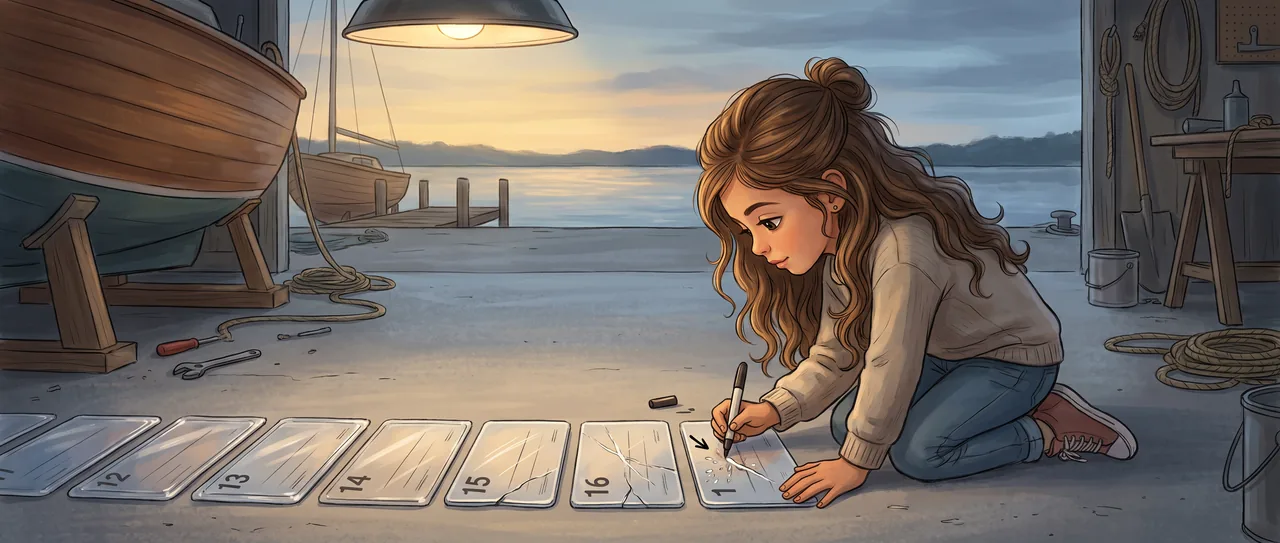
She found another one that was actually split, badly, a real gap she could see daylight through. She set it on the ground. Then she found forty-one's neighbors and lined them up on the concrete in a row, oldest date on the left.
The oldest ones had scars. The newest ones had cracks.
That was backwards. Old things were supposed to be more broken, not less. She sat with that for a while. The list of them in her head was long and she liked it that way.
She took the badly split one, the one with the real gap, and she pressed the two edges together with both thumbs. Nothing happened. It stayed a gap. So the plastic couldn't just close itself whenever it wanted. Something had to have been there. Something that ran out, or ran dry, or was never in this batch at all.
She carried forty-one over to Aunt Deb.
"This one cracked and then unfixed itself," Maya said.
Aunt Deb finally looked. She took the coupon, turned it in the shop light, frowned. "Huh. That's the seam. Company said not to worry about seams." She handed it back. "Cosmetic, they said."
"It's not cosmetic. It's the opposite of a crack."
"It's a boat finish, kiddo. Paint doesn't heal."
But Maya had already turned away, because she had thought of a thing to try and the thought was louder than the conversation.
She went back to the bin and dug until she found one that was only scratched, not split, a fresh white scrape across the coating from something in the bin. She held it under the shop light and watched the scratch.
At first, nothing.
Then, so slowly she had to stop blinking, the white scrape began to darken. Not fade. Fill. Something was moving into the scratch from the sides, from underneath, a wetness seeping up out of the material itself, sitting in the groove, thickening.
Maya did not breathe.
She put the coupon down very gently on the bucket, as if it were an animal that might spook, and she got down on her knees and put her eye level with it.
The scratch was a channel. And along the channel, where her scrape had cut deepest, she could see them now that she was looking for them, tiny round shadows in the coating like the seeds in a strawberry, some of them whole, some of them burst open exactly where the scratch crossed them.
When the scratch had cut through, it had cut them open too. And whatever was inside had come out. It had nowhere to go but into the crack. So it went into the crack, and it filled the crack, and now it was hardening in the crack, and in an hour it would be a shiny seam that would not catch a thumbnail.
The plastic was not healing. The plastic was bleeding on purpose. Someone had built it to bleed exactly and only where it was hurt.
Maya sat back on her heels.
The old ones had scars because the old ones had been out in the sun and water long enough to get scratched and then heal. The new ones had cracks because their scratches were too fresh, or because they were the ones where the little seeds had already run dry. The failures weren't failures. The company had thrown away the coupons that proved it worked because they didn't know how to read a scar.
She thought about her own knee, the pale line on it from falling off the dock two summers ago. She had not decided to heal that. Her skin had done it without asking her, sending things to the wound she had never seen and could not name.
Someone had figured out how to teach that to plastic. Someone had looked at a scab and thought, I could put that in a boat.
"Deb," Maya said, not loud. "Can I keep these?"
"The rejects? Take the whole bin."
Maya carried the bin to the bucket and started laying every single coupon out on the concrete in the dying light, scratched ones facing up, and she took her marker and drew a small careful arrow on each one, pointing at the place where it was busy closing itself, so that in an hour she could come back and see which arrows pointed at seams.
One of the scratches, right under her arrow, was already going dark.
Read the interactive version, listen to the narration, and earn a gold star →
A science-verified short story for curious kids · Curiosity Land