The Count
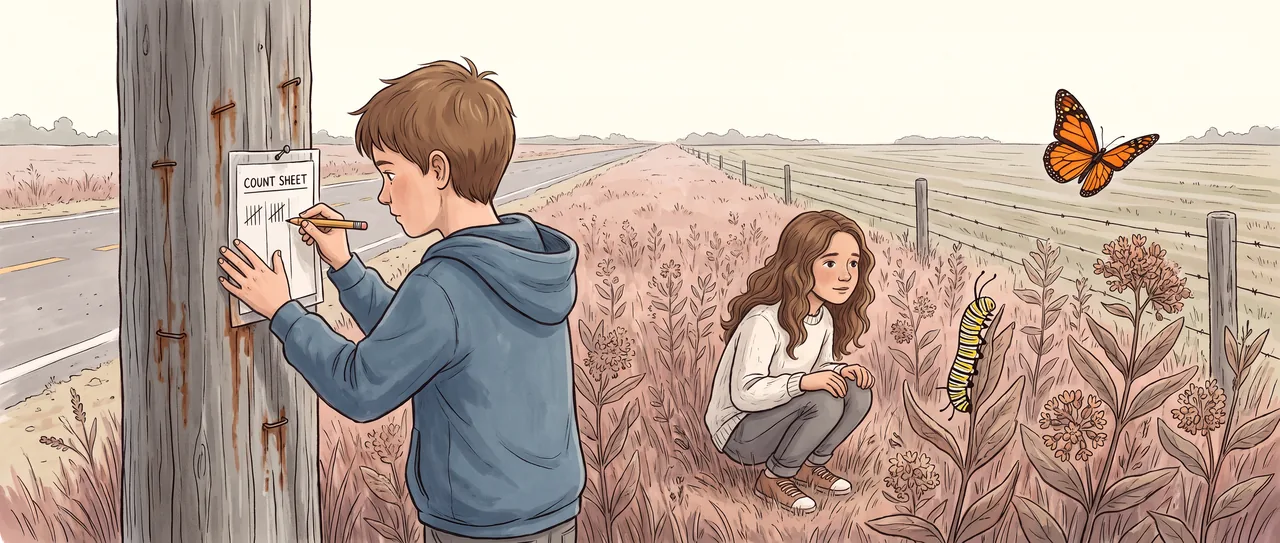
The post was gray and split, and somebody had stapled a laminated sheet to it years ago. The staples had rusted orange streaks down the wood.
"Monarch Count," Soren read. "Tally your sightings. Started nineteen ninety-eight."
Under the words was a grid. Columns of little pencil marks, some faded almost to nothing, some pressed hard by whoever came through. Each column had a year at the top.
"Look at the old ones," Maya said. She dragged her finger down the first column. "That's a lot of marks."
"Forty-one," Soren said, counting. "In one afternoon, somebody saw forty-one."
He slid his finger across to the newest column. The year was this one. There were two marks.
"Two," he said.
Maya didn't answer right away. She was looking past the post, at the patch of weedy ground between the parking lot and the highway fence. Tall stalks, broad leaves, pinkish flowers going brown.
"That's milkweed," she said. "The whole patch."
"How do you know?"
"Because there's a caterpillar on it." She crouched. "Striped. Yellow and black and white."
Soren crouched beside her. The caterpillar was fat and unbothered, chewing a leaf into lace.
"Only milkweed," Maya said. "That's the thing about them. The caterpillar eats only this. Nothing else. If the milkweed's gone, the caterpillar's gone."
"So there should be tons of butterflies here," Soren said. "There's tons of milkweed." He looked back at the post. "But the sheet says two."
He pulled out his notebook and copied the numbers. Forty-one. Then years he had to squint at. Thirty. Twenty-two. Nineteen. Then a gap where two years had no marks at all, just the printed grid. Then single digits. Then two.
"It's not the milkweed here," Maya said. "The milkweed here is fine."
"Then what."
"Everywhere else." She stood and turned in a slow circle, taking in the parking lot, the road, the fields beyond the fence mowed flat and green and empty. "They don't stay here. This isn't their house. They're going somewhere."
Soren remembered something. "Mexico. They fly to Mexico. The whole way."
"From Canada," Maya said. "That's insane, by the way. They weigh less than a paperclip and they fly to a country they've never been to."
"How do they know the way?"
"Nobody knows." She said it flatly, like it was the most interesting fact in the world and she was annoyed she couldn't chew it more. "The one that flies to Mexico is like the great-great-grandkid of the one that left. It's never been there. It goes anyway."
Soren wrote that down. Then he stopped and looked at the empty fields.
"So this patch is one stop," he said slowly. "On a really long road. And the milkweed here being fine doesn't matter if all the stops in between got mowed."
"Or sprayed," Maya said.
"Or sprayed."
They were quiet. A truck went by on the highway and the milkweed leaned in the wind of it and stood back up.
"There's another thing," Maya said. "The timing."
"What timing?"
"They leave when it gets cold. Cold is the signal. But if it stays warm too long, they leave late. And the flowers they need on the way, the ones that feed the grown-up butterflies, those bloom on their own schedule. So the butterflies show up and the flowers are already done." She frowned. "They arrive at the gas station and the gas station's closed."
"That's not in the sheet," Soren said.
"It's in the sheet." Maya pointed at the two years with no marks. "Somebody stood here and counted zero. Twice."
Soren looked at the blank rows for a long time. He thought about somebody driving up, walking to the post with a pencil, standing in the sun watching the milkweed, and writing nothing. And coming back the next year and writing nothing again.
"Okay," he said. "But I want to know if it's still true. The sheet says two. That was somebody else, some other day." He closed the notebook. "Let's count."
So they counted.
They stood on opposite ends of the patch so they wouldn't count the same one twice. They watched the flowers and the fence and the sky. A grasshopper jumped and Soren almost yelled and then didn't. A cabbage white fluttered through, small and pale, and Maya said, "Not that. That's not it."
Eleven minutes. Soren checked his phone.
"One," Maya said. "Yours or mine?"
An orange butterfly came over the fence, tilting on the truck-wind, black lines through the orange like a stained-glass window somebody had drawn with a ruler. It landed on a brown flower, decided against it, and lifted off toward the field.
"Mine," Soren said. "That's one."
They waited. The sun moved. Nothing else came.
"Are you going to write it down?" Maya asked.
Soren looked at the laminated sheet, and the rusty staples, and the column for this year with its two pencil marks made by a stranger.
"It's not our sheet," he said.
"It's a count," Maya said. "You count. That's the whole point. Somebody in nineteen ninety-eight saw forty-one and wanted the next person to know."
Soren found a pencil stub wedged behind the post, left there on purpose by somebody who understood. He held it against the laminated surface. It barely marked. He pressed harder.
One line, in the column for this year. Under it, the three marks that were already there. Their one made it three.
"Three now," Maya said.
"For this whole patch. This whole year." Soren looked at the caterpillar, still eating, that didn't know it was rare. "That thing's going to be a butterfly. And then it's going to fly to a mountain in Mexico it's never seen, because its great-grandparents did."
"If the road's still there," Maya said.
"If the road's still there." He looked down the highway, at the empty mowed fields running to the edge of everything, and then at the one weedy patch that wasn't empty. "Somebody planted this. This didn't just happen. Look, it's in rows."
Maya crouched back down to the caterpillar. It reached the edge of the leaf and lifted its front end into the air, feeling for the next thing to hold, finding nothing, waving there in the space between one leaf and the next.
Read the interactive version, listen to the narration, and earn a gold star →
A science-verified short story for curious kids · Curiosity Land