The Census Nobody Took
The bus was supposed to go to the tide pools. The tide pools were underwater, which the teacher said was ironic, so the museum let forty wet kids in for free.
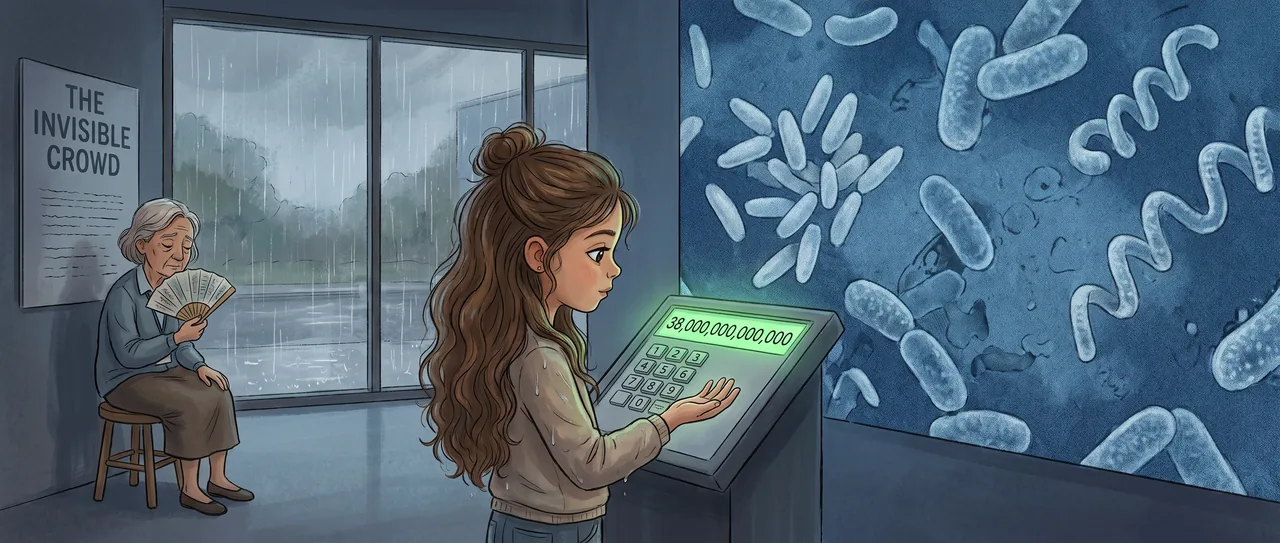
Maya walked past the dinosaur and past the meteorite everyone was touching and into a dim room that no one else wanted, because the sign on it said THE INVISIBLE CROWD and there were no bones.
The room was quiet the way a closet is quiet. One wall was a photograph blown up enormous, grainy and blue, full of shapes like rice and rods and springs. A card underneath said the photo was a piece of somebody's insides, magnified.
A docent sat on a stool near the corner, folding a paper fan out of a brochure. He was old and clearly bored and clearly there to make sure nobody licked anything.
"There's a game," he said, without much hope. "Guess how many."
Maya looked at the button on the wall. GUESS THE NUMBER OF BACTERIA IN ONE PERSON. There was a keypad, and a screen above it that said WRONG in cheerful letters, apparently from the last kid.
She thought about the ocean. She'd read once that there were more stars than grains of sand on all the beaches. Numbers like that had stopped scaring her. They'd started to feel like scenery.
She punched in a billion. A billion sounded enormous.
WRONG. HIGHER.
She blinked. She added zeros. A hundred billion.
WRONG. HIGHER.
"Higher," she said out loud.
"Keep going," said the docent, fanning himself. "Everybody stops too early. They think they're being generous."
A trillion. WRONG. HIGHER. Ten trillion. WRONG. HIGHER.
Her thumb slowed down. She was pressing numbers now that she couldn't picture, and the machine kept saying they were too small. She got to thirty-eight trillion and the screen went green and made a sound like a tiny trumpet.
CORRECT. AROUND 38,000,000,000,000.
She read the zeros twice. Then she read the card beside the keypad, because a number that big had to have a trick in it, and she wanted the trick.
The card said the bacteria in one human body numbered about thirty-eight trillion. Then it said the second thing, and the second thing was the thing.
The number of your own cells, the card said, is about the same.
Maya stood very still.
"That's a typo," she said.
"It isn't," said the docent.
"The same? Not the bacteria more, not me more. The same?"
"Close enough that scientists argue about which wins," he said. "They recount. The number keeps changing. Every time you go to the bathroom you change the census." He seemed to enjoy this part. It was possibly the only part he enjoyed.
Maya looked at the giant blue photograph. Rice and rods and springs. She looked at her own hand.
She had always thought of herself as one thing. A Maya-shaped bag with a Maya inside it. But if you counted the living cells in the bag, half of them weren't her. Half of them were someone else. Trillions of someones. They had come in with food and dirt and other people, they had moved in, and they had never left, and there were as many of them as there were of her.
"So which half is me," she said. She wasn't really asking the docent. She was asking the photograph.
"That's the good question," he said. "That's the one they didn't put on a card."
She read the rest of the wall fast, the way she ate when she was hungry. The bacteria helped digest what her own body couldn't. They made vitamins she needed. They trained the part of her that fought off sickness, taught it what to attack and what to leave alone. And there was a line, near the bottom, printed smaller, like the museum wasn't quite sure it was allowed to say it.
The bacteria in the gut, it said, send signals along a nerve that runs to the brain. They are linked to mood. To how calm or unsettled a person feels. To thinking itself.
Maya read that line three times.
"They talk to my brain," she said.
"There's a nerve," the docent said. "A big one. Traffic goes both ways. Nobody has the whole conversation written down yet."
She thought about mornings she woke up unsettled for no reason she could name. Days when the world felt slightly off and she couldn't find the reason, and everyone told her she was being sensitive. She had always looked outward for the cause. A bad dream. The weather. Something someone said.
She had never once thought to look inward at thirty-eight trillion neighbors having a conversation she wasn't invited to.
"Nobody knows what they're saying," she said.
"Nobody," said the docent, and for the first time he stopped fanning himself. "Twenty years ago we barely knew they were down there. We thought the gut was plumbing. Now there are people spending their whole lives learning the language. They're just starting. Most of what those things do, we haven't got the first word for."
Maya looked at the number again. Thirty-eight trillion. It had stopped being scenery. Every one of them was alive right now, inside her, while she stood in a dim room a boy her age would call boring, and not one of them knew there was a museum, and not one of them knew there was a Maya, and all together they were half of what she was made of.
The field trip whistle blew somewhere out by the meteorite. Wet shoes squeaked toward the exit.
Maya did not move yet.
"If they help you think," she said slowly, "then some of the thinking that just figured this out. Some of that was them."
The docent opened his mouth. Then he closed it. He looked at her the way people look at a light they didn't expect to come on.
"Huh," he said. "I never took it that far."
The whistle blew again. Maya pressed the keypad one more time, clearing the green number back to zero for whoever came next, and left it blank, and walked toward the squeaking shoes.
Behind her the screen waited in the dark, asking the empty room to guess how many.
Read the interactive version, listen to the narration, and earn a gold star →
A science-verified short story for curious kids · Curiosity Land