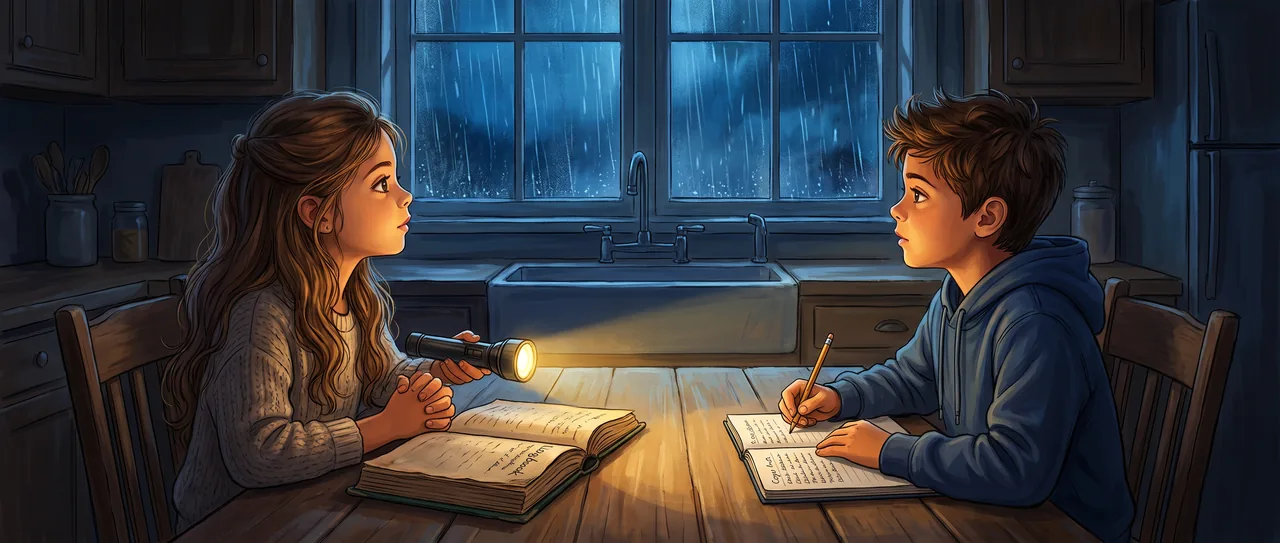
The Thing That Came Through the Window
The storm had knocked out the lights, so they were reading by the flashlight Soren kept in his backpack. Rain came sideways against the kitchen window in long gray sheets. On the table between them sat a logbook, cloth-bound, soft at the corners, that Maya's grandmother had kept for forty years.
Weather, mostly. Dates and cloud types and the direction the wind came from. Maya turned pages while thunder walked around the hills outside.
"Here," she said. "Listen to this one."
She read it out loud. June, a long time ago. A ball of light the size of a grapefruit had come in through the closed window over the sink. It had drifted across the kitchen at the height of a person's chest, slow as a soap bubble. It had gone around the table, not through it. Then it had faded, her grandmother wrote, with no bang and no smell and no mark left anywhere.
Soren stopped writing in his own notebook. "Through the closed window."
"That's what it says."
"Glass was fine after?"
Maya checked. "She says the glass was fine. She checked it with her hand."
Soren looked at the window over the sink. The same window, probably. Rain ran down it in ropes. He got up and put two fingers against the cold glass, the way you check whether something is real.
"That can't happen," he said. He was not arguing. He was reporting the size of the problem. "Light doesn't move like a bubble. Fire doesn't go around a table. And nothing solid goes through glass and leaves the glass fine."
"She wasn't the kind of person who made things up," Maya said.
"I know." He came back to the table. "That's what makes it worse."
Maya kept turning pages. She had the feeling she got when a shape was starting to show itself, before she had words for it. She found another entry. Different year. Different handwriting, shakier, near the back.
This one was not her grandmother's sighting. It was copied out. Her grandmother had written above it, in careful letters, From a book, they have been seen for hundreds of years and no one can say what they are.
Below that were three more, all copied. A sailor in the seventeen hundreds. A woman on a train in Germany. A whole classroom in nineteen sixty-something who watched one roll down the aisle and out the door.
"They all say the same things," Maya said. "Slow. Round. Quiet when it goes."
"People who never met each other," said Soren. He was writing fast now, copying the details, the sizes, the speeds. "Different countries. Different centuries. Same shape."
He stopped and looked at what he had written.
"That's the part that gets me," he said. "If they were all lying, they'd lie different. Lies don't line up. These line up."
Maya looked out the window at the storm. Somewhere out there, up in the churning dark, lightning was doing something ordinary, the thing everyone had explained a hundred years ago, positive up top, negative below, the crack and the flash. That part was solved. She had read about it. Grown-ups could tell you the whole story of a lightning bolt down to millionths of a second.
"Soren," she said. "Do the scientists know what the balls are?"
Soren was honest about what he didn't know. It was the thing she trusted most about him.
"I don't think so," he said slowly. "I've read about lightning. Regular lightning, they've got. But the balls, I've never seen anyone say this is what it is. They've got guesses. Spinning gas. Bits of burning silicon knocked out of the ground. Nobody's made one on purpose that acts right. Not really. Not the going-through-glass part."
"So it's still open," Maya said.
"It's been open for hundreds of years," said Soren.
He said it the way you'd say a door had been left open for hundreds of years. Both of them sat with that. The flashlight made one small circle of yellow on the table and everything outside it was dark and loud.
Maya put her finger on her grandmother's line. Hundreds of years and no one can say what they are.
"She copied these out," Maya said. "All these strangers. Why would she do that?"
"Because it happened to her," said Soren. "And she wanted to know she wasn't the only one."
Maya nodded. She could feel the whole thing widening around her, the kitchen and the storm and the years. Every one of those people had sat somewhere like this, in a room, and something round and bright had come in past all the rules, and they had spent the rest of their lives half sure no one believed them.
"They saw it right," Maya said. "That's the thing. They saw it right and they said it right and it still doesn't fit anything."
"Being right isn't the same as being explained," said Soren.
"No," said Maya. "It's not."
Soren looked back down at his notebook, at the four copied sightings and his grandmother's fifth, lined up in a column in his own handwriting now.
"You could add hers to a real study," he said. "People collect these. That's a thing scientists actually do, they gather up the reports because they can't make the thing itself. Every good report helps. Even from a long time ago."
"So it counts," Maya said. "What she saw. It's not just a story in a drawer."
"It counts," said Soren. "That's how you'd start. You'd start with people who saw it right."
Maya looked at the window over the sink for a long time. The same window. Chest height, her grandmother had written. Slow as a soap bubble. Around the table, not through it.
The power came back with a small click. The overhead light snapped on, ordinary and yellow, and the storm outside shrank to just weather.
Maya reached up and turned the light off again.
In the dark her eyes went back to the rain on the glass, and she and Soren sat and watched the window over the sink, both of them, the way you watch a place where something once came in.
Read the interactive version, listen to the narration, and earn a gold star →
A science-verified short story for curious kids · Curiosity Land