The Origami Problem
The depot smelled like wet cardboard and warm dust. Maya's mother ran the paper line, and on late shifts Maya and Soren waited on two folding chairs beside a mountain of things people had thrown out.
"Somebody dumped a whole office," Soren said. He was holding a page covered in ribbons and spirals, like somebody had drawn a plate of noodles and taken it very seriously. "Look. This one's got a shape in it."
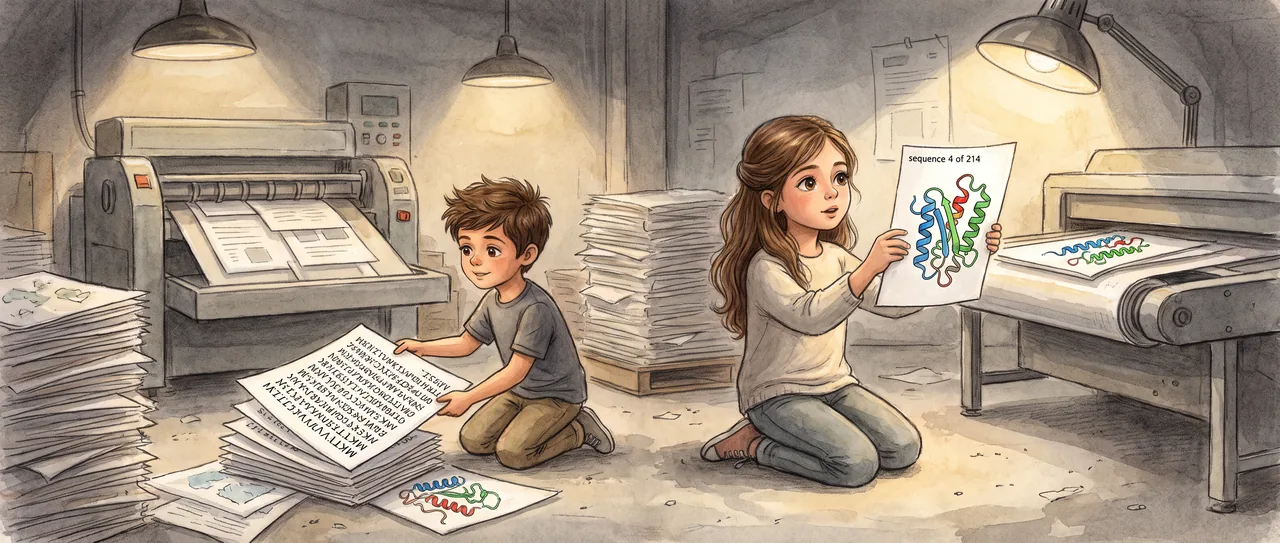
Maya took it. Across the top it said: predicted structure, sequence 4 of 214.
"There's more," she said, and dug into the bin. Page after page. Some were just letters. Long strings of them. M, K, T, L, V, over and over, no spaces, running off the edge.
"That's not words," Soren said.
"No. But this one's the noodle picture." Maya laid the letter page next to the ribbon page. "And this says sequence 4. So does this. Same number."
Soren leaned in. "So the letters and the noodles are the same thing."
"The letters are flat," Maya said. "The noodles are folded up."
He turned the letter page over, like the answer might be printed on the back. It wasn't. "How do you get from one to the other?"
Maya was already folding a strip of scrap paper, creasing it, letting it spring. "You fold it. But the letters don't say how to fold. There's no dotted lines."
"There has to be a rule," Soren said. "You can't just have letters that become a shape with no rule in between."
"Try it, then." Maya slid him the letter page. "You're good at rules. Tell me where it bends."
Soren read the string. M, then K, then a long run of the same three letters. He tried to imagine it as a chain. He got about six letters in and stopped.
"I can't," he said. "I don't know why this letter bends left and that one bends right. It's just a chain. A chain could fold a million ways."
"A million," Maya repeated. She liked the number. She did not like that it sat there doing nothing.
She pulled a stray staple, straightened it, tried to bend it into the ribbon shape. It flopped. She tried again. Flopped.
"That's the problem," Soren said slowly. "A chain this long, if it could fold any way it wanted, it'd take forever to try them all. Longer than forever."
"But the noodle picture is one shape." Maya tapped it. "Not a million. One. So the real chain isn't trying them all. It just goes."
"How does it know which one?"
"That's what I'm asking you."
Soren was quiet, reading the page with the number 4 in the corner, then the page with the shape. He noticed something .
"These are all predicted," he said. "Every page says predicted. Not photographed. Not measured. Somebody guessed the shape from the letters."
"Guessed?"
"Predicted's a fancy guess." He fanned the whole stack. "Two hundred and fourteen of them. Somebody looked at two hundred and fourteen chains of letters and drew what shape each one folds into. Without folding anything."
Maya sat back. "That was the thing my mom's boss threw out. That was somebody's actual job."
"For fifty years," Soren said, because there was a header on one page he hadn't mentioned yet, a caption at the bottom of a summary sheet. He read it out. "A problem unsolved since the nineteen seventies. The folding problem."
"Fifty years," Maya said. "People couldn't do this for fifty years."
"And these pages have two hundred and fourteen of them done." Soren spread them across the concrete floor, kneeling. "Somebody figured out the rule."
Maya knelt beside him. "So what's the rule? It has to be on here somewhere."
They looked. It wasn't. There was no dotted line, no bending instruction, no formula that said this letter turns and that one doesn't. Just the letters, and then, somehow, the shape.
"It's not on the page," Soren said finally. "That's the whole thing. Nobody can write the rule down as a sentence. It's too big. So they made a computer look at every folded shape anyone had ever measured, all of them, and learn what letters go with what folds. Then it looked at new letters and knew."
"Knew," Maya said. "Or guessed so well it may as well know."
"Guessed close enough that they stopped calling it guessing."
Maya picked up the noodle page again and held it near the light. Every protein in your body was on a page like this somewhere. Every one had folded itself, instantly, correctly, the first time, without a diagram, a million wrong ways available and it took none of them.
"Soren," she said. "Everything alive is doing this right now. In us. Every second."
"Folding."
"Getting it right. The first try. No dotted lines." She pressed her hand flat against her own chest, felt it going, and thought about the machinery under there choosing the one shape out of a million, over and over, never stopping to think.
Soren was still on the floor with the pages fanned around his knees. "For fifty years the smartest people couldn't see the rule. And your hand's been doing it your whole life without being told."
"So has yours."
He looked at his own hand. Opened it. Closed it.
"Somebody threw this away," Maya said. "This is the answer to a fifty-year question and it's in the recycling."
"They probably printed a new copy," Soren said. "There's more coming. There's going to be one of these for every protein there is. Millions."
Maya was already sorting. Not throwing back. Keeping. She stacked sequence 1 on sequence 2 on sequence 3, squaring the edges, building the order back.
"What are you doing?"
"Putting them in order," she said. "Somebody spent fifty years on this. I'm not leaving it in a bin."
Soren found sequence 4 and handed it up to her. She set it on top and pressed the stack flat with both hands. Down the line, the sorting machine kept running, pulling flat paper in and letting nothing fold.
Read the interactive version, listen to the narration, and earn a gold star →
A science-verified short story for curious kids · Curiosity Land