The Number That Kept Showing Up
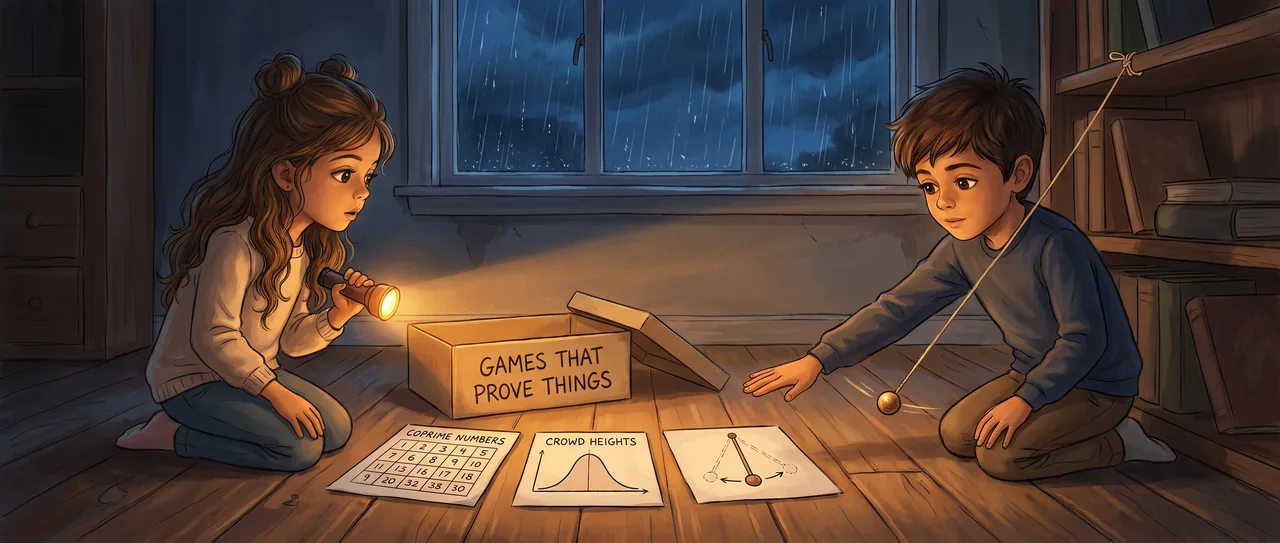
The storm knocked the power out at seven, which is how they ended up on the floor with a flashlight and a shoebox labeled, in old handwriting, GAMES THAT PROVE THINGS.
"Your great-uncle was strange," Maya said.
"He built lenses for telescopes," said Soren. "Strange is the job."
Inside were index cards, a bag of glass beads, and a wooden pendulum on a little brass hook. There was also a card on top, and the handwriting said: START HERE. PICK TWO. FIND THE THREE.
"Pick two what," said Maya.
Soren turned the card over. On the back was a grid of numbers from one to a hundred, and a rule. Pick two numbers at random. Check if they share any factor bigger than one. Do it a lot. Count how often they don't.
"Don't share any factor," Maya said. "So like seven and nine. Nothing divides both."
"Coprime," Soren said. "That's the word. He wrote it here."
They played it like a card game. Maya called numbers, Soren checked them, and they made two piles, share and don't-share. The flashlight made the beads throw little circles on the wall. After forty tries the don't-share pile was bigger.
"More often than not," Maya said. "They usually don't share anything."
"About how often, though." Soren counted. "Twenty-five don't-share out of forty. That's around sixty percent."
"Keep going. It'll settle."
They kept going until Soren's hand cramped. The fraction wobbled and then stopped wobbling around a number a little over sixty out of a hundred.
"Sixty-one, sixty-two percent," Soren said. "It parks there."
Maya frowned at the pile. "Why would random numbers care about parking anywhere."
There was another card under the beads. It said: THE ANSWER IS SIX DIVIDED BY A SQUARE. FIND WHICH SQUARE.
"Six over something squared equals point six one," Soren said. He did it in the flashlight, dividing and guessing. "Six over point six one is about nine point eight. So the square is nine point eight. So the number is..." He stopped.
"Three point one," Maya said, before he finished. She was not doing the arithmetic. She just knew the shape of it. "Three point one something. Say it."
Soren said it. "The square root of nine point eight seven. That's three point one four."
Neither of them said anything for a second. The rain leaned on the window.
"That's pi," Maya said. "Pi is in the numbers game."
"Pi squared, over six," said Soren, reading the last line of the card, which said exactly that. "That's how often two random numbers are coprime. One over pi squared over six."
"There's no circle," Maya said. She said it slowly, like she was checking her own pockets. "We didn't draw anything round. We didn't measure anything round. We picked numbers out of the air."
"Pi is supposed to be about circles." Soren was already reaching into the box. "Circumference over diameter. That's the whole point of it."
"Then what is it doing in a card game about factors."
Soren pulled out the pendulum on its brass hook. There was a card tied to the string. It said: HANG ME. TIME MY SWING. THE FORMULA HAS ME IN IT TOO.
Maya took the flashlight. "Us in it too. He means pi."
They hung the pendulum off the edge of the bookshelf and let it swing. Soren counted seconds under his breath while Maya watched it tick back and forth, back and forth, the little bead cutting the same path every time.
"The card says the time of one swing is two pi times the square root of length over gravity," Soren read. "Pi. Right in the middle of a thing that swings in a straight line."
"It's not a circle either." Maya pointed at it. "It goes side to side. That's a line. That's the flattest, un-roundest thing."
"But there's pi in the timing."
Maya sat back on her heels. She watched the bead. "Okay. So it's not that pi lives in circles."
"What do you mean. It's the circle number."
"We call it the circle number because that's where people met it first." She was talking fast now, chasing it. "But look. Coprime numbers. Swinging weights. Neither one is round. If pi keeps walking into rooms that have no circles in them, then pi isn't a fact about circles."
"Then what's it a fact about," Soren said.
"Something underneath both." She waved her hand at the pile of cards and the swinging bead. "Something that the circle has, and the swing has, and the numbers have. Something they all share and we don't have a good name for."
Soren looked at the box. He was quiet, and then he opened it wider and started laying every card out on the floor in the flashlight beam. Coprime numbers. The pendulum. There was another card he hadn't read, about heights of people, about how measuring a thousand strangers piles them into a curve, and the formula for that curve had pi sitting inside it too, next to a square root, holding the whole bell shape together.
"People's heights," Soren said. "He measured people, and pi came out."
"No circles in a crowd," Maya said.
Soren spread his hand flat over all three cards at once, the numbers and the swing and the crowd. "He wasn't collecting games. He was collecting sightings."
"Sightings of the same thing," said Maya. "In three places that shouldn't know about each other."
The flashlight beam narrowed and yellowed. Soren shook it and it steadied.
"Do you think he figured out what it was underneath," Soren asked. "The thing they share."
Maya looked at the bottom of the shoebox. There was one more card there, face down, and she could see the ink showing through the back of it. She didn't turn it over yet. She wanted to guess first.
"I don't think he did," she said. "I think that's why he kept building them. To keep catching it."
She turned the card over. In the old handwriting it said one line: WHEN YOU FIND IT EVERYWHERE, YOU HAVE STOPPED LOOKING AT SHAPES AND STARTED LOOKING AT THE THING SHAPES ARE MADE OF. I NEVER GOT TO THE BOTTOM. YOUR TURN.
Maya set the card down on the floor. Soren reached over and gave the pendulum one more push, and they both watched the bead swing its flat straight line, back and forth, timing itself against a number that had no business being there.
Read the interactive version, listen to the narration, and earn a gold star →
A science-verified short story for curious kids · Curiosity Land